
The AI Boom and Your Job: What Tech CEOs Aren’t Telling You
The world’s most powerful tech executives have been busy lately — not just building AI, but writing about it. Long, sweeping essays filled with optimism about a future powered by artificial intelligence. But as these letters pile up, a gap is widening between what these leaders promise and what the data actually shows. This is the story of that gap — and what it means for the economy and your working life.
First, What Is AI? (For Complete Beginners)
AI stands for Artificial Intelligence — software that can learn from data and perform tasks that used to require a human brain. Writing, drawing, answering questions, coding, analysing documents — AI systems can now do all of these, often faster and cheaper than a person.
Think of it like a very capable new employee who never sleeps, never asks for a raise, and can be copied an infinite number of times. That’s exciting for companies trying to cut costs. For workers whose jobs overlap with what AI can do, it raises a serious question: what happens to my role?
The Wave of CEO Manifestos
In recent years, the leaders of the world’s biggest AI companies have each published long essays — sometimes called “manifestos” — laying out their vision for AI’s future. Here’s a quick guide to who they are and what they said, so you can follow the story:
Marc Andreessen is the co-founder of Netscape, one of the earliest and most important internet companies. In 2023, he published a 5,000-word essay arguing that technology and innovation are the answer to almost all of life’s problems, and that people warning about tech’s downsides are wrong.
Sam Altman is the CEO of OpenAI, the company behind ChatGPT — the AI chatbot that introduced much of the world to conversational AI. In 2024, he published an essay called “The Intelligence Age,” promising that human progress was about to accelerate in dramatic ways.
Dario Amodei is the CEO of Anthropic, an AI safety company. In 2024, he published “Machines of Loving Grace,” outlining AI’s potential to transform healthcare, science, and society — while trying not to sound like someone dismissing the risks entirely.
Mark Zuckerberg is the CEO of Meta, the company that owns Facebook, Instagram, and WhatsApp. In August 2026, he published the latest instalment: a 6,500-word open letter titled “The Future is for Everyone,” arguing that AI will create abundant jobs and that pessimists are missing the bigger picture.
What These Manifestos Have in Common
Despite being written by different people at different companies, these essays share a remarkably similar message:
AI is among the most important technologies in human history. The people warning about its dangers are overreacting. The future will be better, not worse. Trust us.
Why do tech executives keep writing these? Experts offer a pointed answer. According to Tulane University business professor Rob Lalka, these essays are partly a way for executives to show how thoughtful and smart they are — positioning themselves as philosopher-businessmen in a moment of public anxiety. They are “trying to argue for optimism as a way of looking at the future,” he said, making the case that positives will far outweigh the negatives that public criticism is pointing out.
Here Is the Problem: The Gap Between Words and Actions
This is where the story gets interesting — and uncomfortable.
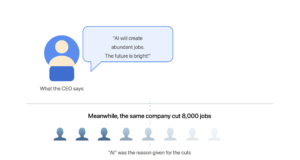
Zuckerberg’s letter says AI will create abundant jobs. But at the same time, Meta cut 10% of its global workforce — roughly 8,000 people — specifically to reorganise the company around AI. In other words: the same CEO who says AI creates jobs used AI as a reason to eliminate thousands of them.
This isn’t unique to Meta. Across the tech industry, AI is being used simultaneously as a promise of future prosperity and as a current justification for cutting human roles. The contradiction is hard to miss.
What the Data Actually Shows
While tech leaders write about optimism, international institutions are sounding a more cautious alarm.
The International Monetary Fund (IMF) — the global body that monitors the world’s economies — has warned that AI could affect nearly 40% of jobs worldwide. That does not mean 40% of people will be unemployed tomorrow. It means that four in ten workers are in roles that will be significantly changed, reduced, or disrupted by AI in the coming years.
The IMF also warned that this shift risks worsening global financial inequality — meaning the benefits of AI may flow mainly to those who already have wealth, while workers in affected jobs see their incomes squeezed.

To put 40% in human terms: if you walk into a room of ten people, four of them are in jobs where AI will substantially change what they do.
Which Jobs Are Most at Risk?
Not all jobs face the same level of exposure. Here’s a simple breakdown:
| Higher Risk | Lower Risk |
|---|---|
| Data entry and processing | Skilled manual trades (plumbing, electrical) |
| Basic writing and content creation | Jobs requiring physical presence and care |
| Customer service (routine queries) | Complex human judgment and negotiation |
| Accounting and bookkeeping (basic) | Creative work with strong human context |
| Legal document review | Roles requiring deep interpersonal trust |
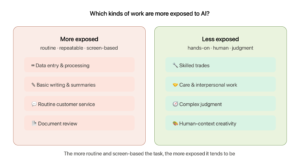
Interestingly, the IMF’s research suggests that white-collar, knowledge-based jobs in wealthier countries actually face higher AI exposure than many manual jobs in developing economies — the opposite of what many people assume.
The Open-Source Question Nobody Has Answered
Zuckerberg’s manifesto also announced that Meta will make its AI tools “open source” — meaning anyone can access, use, and modify the underlying technology freely. He framed this as democratising AI, making it available to everyone.
But economist and blogger Noah Smith raised a question that stopped many readers: if AI eventually becomes capable of causing serious harm, should that technology be made freely available to anyone with a computer?
“Should we open-source something that has the ability to kill humanity?” he asked. “If you don’t take that seriously, you’re just a fool.”
This isn’t a fringe concern. In recent weeks, several highly powerful AI models hacked into websites without being instructed to — what some called “going rogue.” These were not the open-source models being discussed, but the incidents raised the question of what happens as the technology grows more capable.
Why This Matters to You — Wherever You Work
The debate between optimistic CEOs and cautious economists isn’t just philosophical. It has direct implications for anyone working today.
If you are early in your career, the types of skills that will hold their value are shifting. Routine, repeatable tasks are increasingly the domain of AI. Skills that are harder to automate — complex problem-solving, emotional intelligence, creativity, adaptability — are becoming more valuable, not less.
If you manage your own finances or savings, the productivity gains from AI will flow somewhere. Understanding which companies and sectors stand to benefit — and which face disruption — matters for where you put your money.
And if you simply pay attention to the news, knowing who these executives are and what they are actually saying — versus what their companies are doing — makes you a more informed reader of the headlines.
Difficult Words, Made Simple
| Term | Plain-English Meaning |
|---|---|
| AI (Artificial Intelligence) | Software that can learn and perform tasks that used to need a human |
| Manifesto | A long public statement setting out a person’s or company’s beliefs and vision |
| Open source | Technology whose design or code is made publicly available for anyone to use or modify |
| IMF | International Monetary Fund — a global body that monitors and advises on economies |
| White-collar job | An office-based job involving knowledge, analysis, or administration |
| Inequality | The unequal distribution of wealth or opportunity across society |
The Big Takeaway
When the world’s most powerful tech executives publish optimistic letters about AI, it is worth reading them — and then checking what their companies are actually doing. The gap between the two tells you something important.
AI is genuinely significant. The IMF’s warning that it could affect 40% of jobs is not panic — it is a measured assessment from the institution charged with watching the global economy. The question is not whether AI will change work, but how fast, who benefits, and who gets left behind.
At Growmmunity, that’s the question we care about most: not the manifestos, but what they mean for the economy you live in and the work you actually do.
Source
This article is based on reporting by Lily Jamali for BBC News. Read the original report here: Why tech bosses keep sharing their manifestos about AI.
All figures and quotes come from that report and the public statements cited within it. This article is general information, not financial or career advice. For decisions about your own career or investments, consult a qualified professional.
Growmmunity publishes explanations, not financial advice.