
Why Is Car Insurance So Expensive? The $50,000 Car Behind Your $2,500 Premium
Why is car insurance so expensive? Start with the numbers drivers keep staring at in disbelief: the average full-coverage premium has climbed to roughly $2,500 a year by CarInsurance.com’s count — more than double the ~$1,127 of just a few years ago — and government data shows auto insurance costs up about 55% since 2020, one of the steepest climbs of any item in the entire inflation basket. In one survey of 1,510 drivers, nearly two-thirds saw their premium rise within a single year.
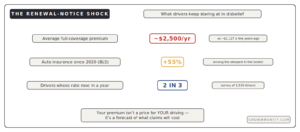
Here’s the beginner’s key to the whole mystery: your premium isn’t really a price for your driving. It’s a forecast of claim costs — what it would cost to fix cars, heal people, and replace vehicles if things go wrong. And nearly every ingredient in that forecast has exploded at once: cars that cost more than $50,000 new, bumpers full of cameras and sensors, tariffs on imported parts, record repair bills, medical costs, lawsuits, and a run of billion-dollar weather disasters. This guide unpacks the machine behind the bill, why identical drivers pay wildly different amounts, and what genuinely lowers it — in plain English. (New to economics? Start with What Is an Economy? and Inflation Explained.)
First: what a premium actually is
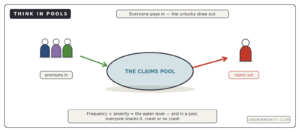
An insurer is a pool. Everyone pays in; the unlucky draw out. Your premium is your share of the pool’s expected payouts — claim frequency (how often crashes happen) times claim severity (what each one costs) — plus the company’s expenses. That’s the whole machine. Which means the question “why did my premium jump?” almost always translates to: “why did fixing crashes get so expensive?” — even if you personally haven’t had one. In a pool, everyone shares the water level.
The five forces filling the pool
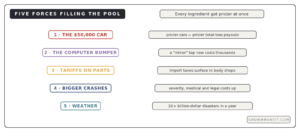
1. The $50,000 car. The average new vehicle now tops $50,000 (Kelley Blue Book). Pricier cars mean pricier total-loss payouts — the insurer literally owes more when one is wrecked. This is the odometer principle on wheels: vehicle prices ratcheted up through the inflation years and never came back down.
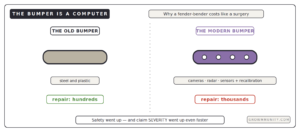
2. The bumper is now a computer. Modern fenders carry cameras, radar, and sensors. A “minor” tap that once cost hundreds now runs thousands, because the crumpled corner contains the safety tech — and recalibrating it requires specialists. Repair severity has risen even faster than repair frequency.
3. Tariffs and parts. Industry analyses list rising costs of parts and replacement vehicles due to tariffs among the direct drivers of premiums — a concrete, everyday landing spot for the trade-war economics we’ve covered: import taxes surface in body shops, then in everyone’s renewal notice.
4. Bigger crashes, bigger bills. Post-pandemic roads brought more severe accidents and more distracted driving; traffic deaths jumped double digits in recent years. Add sharply higher medical costs and legal fees per injury claim, and each accident simply costs the pool more than it used to.
5. Weather. Floods, hail, wildfires, and hurricanes total cars by the parking-lot-full — the US logged 20+ billion-dollar disasters in a single year — and those comprehensive claims land in the same shared pool. It’s why entire states (Louisiana at ~$2,700 a year, Florida) run structurally expensive: the pool there fills faster.
Why your neighbour pays half what you do
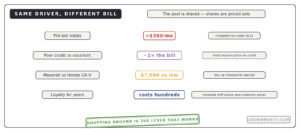
The pool is shared, but shares are individually priced — and some of the pricing surprises people.
Geography is destiny: the same driver can pay over $300 a month in the most expensive states and under $131 in the cheapest. State rules matter too — “no-fault” states, which require insurers to cover more claim types, tend to run pricier.
Your credit score is in your premium: most insurers use credit-based scores, and drivers with poor credit can pay around double for identical coverage — one of the least-known facts in personal finance, and a bridge to why credit health compounds everywhere.
The car chooses its own bill: a Maserati can cost ~$7,000 a year to insure; a Honda CR-V sits near the bottom of the table. High-tech EVs from some makers rank among the priciest mainstream cars to cover, purely on repair costs.
Loyalty quietly costs money: consumer studies keep finding the same thing — staying put for years often means missing hundreds in savings, because insurers price new business more keenly than renewals. Comparison-shopping is, boringly, the single most effective lever drivers have, alongside bundling, safe-driver and low-mileage discounts, and (for those with savings buffers) higher deductibles.
Why this belongs in the affordability series
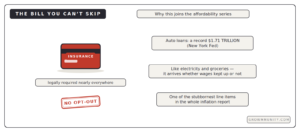
Car costs are the quiet giant of household budgets: America carries a record $1.71 trillion in auto loans (the New York Fed data from our credit-card explainer), and insurance is legally mandatory nearly everywhere — you cannot simply opt out the way you can skip a subscription. Like electricity and groceries, it’s a bill that arrives whether or not wages kept up — which is exactly why insurance sits so high on the list of prices people feel, and why it keeps showing up in inflation reports as one of the stubbornest line items.
Two honest views: gouging or gravity?
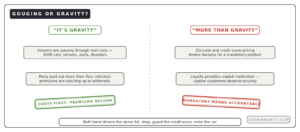
The “it’s gravity” view: insurers are largely passing through real costs — $50,000 vehicles, sensor-stuffed repairs, tariffed parts, medical and legal inflation, disaster losses. Many insurers spent recent years paying out more in claims than they collected; premiums are catching up to arithmetic, not padding profits, and the rate of increase is already slowing as those costs stabilise.
The “it’s more than gravity” view: opaque pricing built on credit scores and zip codes strains fairness — punishing poverty and location as much as driving; loyalty penalties exploit inattention; and mandatory products deserve stricter scrutiny than optional ones, because customers can’t walk away from the market entirely. On this reading, real cost pressure is genuine and the pricing machinery deserves the regulatory heat it’s getting.
Both sides give a driver the same to-do list: shop the market regularly, guard the credit score, mind the vehicle choice, and stack every discount — because whatever the cause, the pool’s water level is set; your share is the part you can still negotiate.
Difficult words, made simple
| Term | Plain-English meaning |
|---|---|
| Premium | Your share of the pool’s expected payouts — now ~$2,500/yr for full coverage on average |
| Claim severity | The cost per accident — rising faster than accident counts |
| Full coverage | Liability plus damage to your own car (collision + comprehensive) |
| Comprehensive | Non-crash damage — theft, hail, floods; where climate claims land |
| Total loss | Car worth less than the repair — payout equals the car’s value, hence $50K matters |
| Deductible | What you pay before insurance does — raising it lowers the premium |
| No-fault state | Each side’s insurer pays its own injuries — broader coverage, higher premiums |
| Credit-based insurance score | The credit-linked number most insurers price with — poor credit can double the bill |
| ADAS | The cameras and sensors in modern bumpers — safety up, repair bills way up |
| Loyalty penalty | Renewal prices drifting above new-customer prices — shopping around fixes it |
The big takeaway
Car insurance is expensive because everything it promises to replace got expensive first. A premium is a forecast of claims, and the forecast now contains $50,000 vehicles, computerised bumpers, tariffed parts, costlier injuries, and weather that totals cars by the thousand. Add pricing that keys off zip codes and credit scores, and two identical drivers can live in different financial universes.
Three tools worth keeping. First, think in pools: your bill reflects everyone’s claims, which is why it rose even if you drove perfectly. Second, severity is the story — it’s not that crashes multiplied; it’s that each one costs multiples more. Third, the levers that work are unglamorous: shop the market on a schedule, protect the credit score, choose the car with its insurance bill in mind, and never assume loyalty is being rewarded — the data says it usually isn’t.
New to economics? Start with Inflation Explained — then read the groceries explainer and the credit-card explainer, the neighbouring rooms of the same affordability house.
Sources
This article synthesizes reporting and data from Insurance.com, CarInsurance.com, and The Zebra:
• Insurance.com: Why is car insurance so expensive, and will it go down?
• CarInsurance.com: Why is car insurance so expensive? Rates, trends and how to save
• The Zebra: Why is Car Insurance so Expensive?
Additional figures from the Bureau of Labor Statistics (auto insurance +~55% since 2020), Kelley Blue Book (average new-car price), NOAA (billion-dollar disasters), and the Federal Reserve Bank of New York (auto-loan balances), as cited within the reports above. Averages vary by coverage level and methodology, which is why quoted figures differ across sources. This is general information, not financial or insurance advice.
Growmmunity publishes explanations, not financial advice.