
Subscription Fatigue Explained: The $273-a-Month Bill Nobody Remembers Signing Up For
Subscription fatigue now has receipts. The average American household spends roughly $273 a month on subscriptions — up from $237 in 2018 — and here’s the finding that explains everything else: 89% of consumers underestimate their own total. By one per-person count, the typical consumer juggles 8.2 active services. Streaming alone runs about $69 a month per household, per Deloitte — and the industry’s own trade press has started asking whether “streamflation” has hit its breaking point.
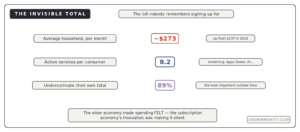
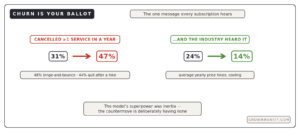
The rebellion is measurable too: 47% of consumers cancelled at least one subscription within a year (up from 31% two years earlier), 44% cancel after a price hike, and 41% of Americans say the content they pay for isn’t worth the price. This guide explains why everything became a subscription, the quiet math of “streamflation,” the forgetting economy that keeps charging you, and the churn strategies consumers invented to fight back — in plain English. (New to economics? Start with What Is an Economy?)
First: why did everything become a subscription?
Because for a business, a subscriber is worth far more than a shopper. A one-time sale is a transaction; a subscription is a relationship with a meter running. Revenue becomes predictable, customers stop re-deciding every month, and — the crucial part — the default flips: a shopper must choose to buy again, but a subscriber must choose to leave. Inertia, once the enemy of sales, becomes the product’s best salesman.
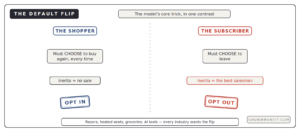
Software discovered this first, streaming perfected it, and now razors, cars’ heated seats, groceries, and AI tools all bill monthly — the average AI user alone now stacks four premium AI subscriptions (~$66 a month). Each individual fee looks tiny. That’s the design. It’s the same psychology as the pay-in-four button: small numbers slip past the brain’s spending alarm, and only the bank statement — which 74% of people admit they don’t fully track for recurring charges — knows the truth.
“Streamflation”: the quiet math
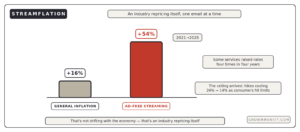
The flagship case is streaming, and one statistic tells the story: the average price of ad-free streaming plans rose 54% from 2021 to 2025 — against roughly 16% general inflation over the same stretch (Forrester / BLS, via Variety). That’s not prices drifting with the economy; that’s an industry repricing itself, one “effective next month” email at a time. Some services have raised rates four times in four years.
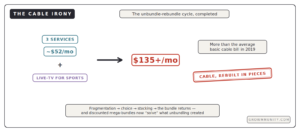
And the endgame has a familiar punchline. Stack three standard services and you’re near $52 a month; add a live-TV service for sports and you can pass $135 — more than the average basic cable bill in 2019. The great unbundling of cable, sold as liberation, has quietly rebuilt cable’s price tag in pieces. Economists call this the unbundle-rebundle cycle: fragmentation creates choice, choice creates stacking, stacking recreates the bundle — and now the discounted mega-bundles are returning to “solve” the problem the unbundling created.
There is a ceiling, though, and the industry just hit it: with consumers at their limits, average streaming price hikes have already cooled from 24% per subscription to 14% year-over-year (Ampere Analysis) — the clearest sign yet that cancellation, the subscriber’s only vote, is finally being counted.
The forgetting economy
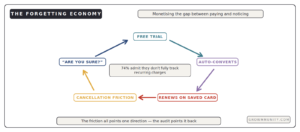
Here’s the concept that makes this an economics lesson: subscriptions monetise the gap between what you pay and what you notice. Free trials that auto-convert, annual renewals on saved cards, cancellation flows with extra steps and “are you sure?” detours — the friction all points one direction. The business term is “reducing churn”; the household experience is paying for a meditation app from a resolution two years past.
That’s why the 89%-underestimate statistic is the most important number in this article. In the older economy, spending was salient — you handed over money and felt it. The subscription economy’s innovation was making spending silent. The fix is boringly effective: an annual “subscription audit” — one statement, one list, one honest question per line: would I sign up for this again at this price? Nearly half the country has started asking it; that’s what the cancellation wave is.
The fight-back: churn as a consumer strategy
Consumers, it turns out, learn. 48% have subscribed to a service for one show or event, then cancelled — the “binge-and-bounce.” Households rotate services seasonally, chase promo pricing, drop to ad-supported tiers (36% of streaming users say they’d accept twice the ads for a lower bill), and share plans where allowed. The subscription model’s superpower was inertia; the countermove is deliberately refusing to have any. The result is a genuine tug-of-war: companies adding cancellation friction, drip-pricing, and password crackdowns on one side; an increasingly nomadic subscriber base on the other — with 43% of Americans saying they’re likely to cancel a streaming service within three months at any given time.
Two honest views: fair model or fatigue by design?
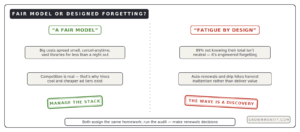
The “fair model” view: subscriptions spread big costs into small ones, stay cancel-anytime (unlike the cable contracts they replaced), and fund enormous content and software libraries for less than a night out. Competition is real — that’s why hikes are cooling, cheaper ad tiers exist, and bundles are returning. The tool isn’t the problem; unmanaged stacking is, and the fix sits with the user and a checklist.
The “fatigue by design” view: a model where 89% of customers don’t know what they’re paying isn’t neutral — it’s engineered forgetting. Auto-renewals, buried cancellations, and steady drip-hikes (54% in four years!) harvest inattention rather than deliver value, and the “cancel anytime” freedom mostly measures how rarely people audit their statements. On this reading, the cancellation wave isn’t churn — it’s customers discovering their own bills.
Both sides hand you the same homework: run the audit, know your total, and make every renewal a decision instead of a default.
Difficult words, made simple
| Term | Plain-English meaning |
|---|---|
| Subscription fatigue | The measurable exhaustion — 47% cancelled at least one service in a year |
| Streamflation | Streaming’s private inflation — ad-free prices +54% in four years vs ~16% CPI |
| Recurring revenue | Why businesses love the model — predictable money with inertia as salesman |
| Churn | Subscribers leaving — the only vote a subscriber has, now being cast en masse |
| Default flip | Buyers must opt in; subscribers must opt out — the model’s core trick |
| Auto-renewal | The saved-card engine of the forgetting economy |
| Unbundle-rebundle cycle | Cable broke into pieces that now cost more than cable — so bundles return |
| Binge-and-bounce | Subscribe for one show, cancel after — practised by 48% |
| Ad-supported tier | Cheaper plan paid with attention instead of cash |
| Subscription audit | One statement, one list, one question per line: would I sign up again? |
The big takeaway
The subscription economy’s real product was never movies or software — it was your inattention, billed monthly. The model works brilliantly when value is real and ruinously when forgetting does the buying, and the country has reached the moment where the two get sorted: hikes cooling, cancellations surging, bundles returning, and 89% of households discovering their own totals.
Three ideas worth keeping. First, silent spending is still spending — salience, not size, is what the model removed, and an audit puts it back. Second, watch the unbundle-rebundle cycle — it explains streaming, and it will explain the next industry that fragments into monthly pieces. Third, churn is your ballot: the recent cooling of price hikes is direct proof that cancellation, exercised at scale, is the one consumer message every subscription business hears perfectly.
New to economics? Start with What Is an Economy? — then read Inflation Explained and the Buy Now, Pay Later explainer — the sibling psychology of small, silent payments.
Sources
This article synthesizes reporting and survey data from Variety, Reviews.org, and Yahoo Finance:
• Variety: Streaming Price Increases: Is ‘Streamflation’ at a Breaking Point?
• Reviews.org: Streaming Fatigue Report: How Price Hikes Are Changing the Way Americans Watch TV
• Yahoo Finance: The cost of streaming — what we’re paying now vs 5 years ago
Additional figures from Deloitte’s Digital Media Trends, Forrester, Ampere Analysis, West Monroe, C+R Research, and Bango subscription research, as cited within those pieces and industry statistics compilations. Survey figures vary by methodology, which is why totals differ across sources. This is general information, not financial advice.
Growmmunity publishes explanations, not financial advice.