
Supply and Demand: The Two Forces Behind Every Price You Pay
Supply and demand is the single most important idea in all of economics. Nearly every price you encounter — the cost of your morning coffee, the rent on your apartment, the price of a plane ticket, even the wage you earn — is set by the invisible tug-of-war between these two forces. Understand them, and the economic world stops looking random and starts making sense.
Most people have heard the phrase a thousand times without ever having it explained clearly. Today we fix that, building the concept from the ground up using everyday examples, with the US economy as our reference point.
What demand really means
Demand is how much of something people want to buy, and crucially, how that amount changes with price.
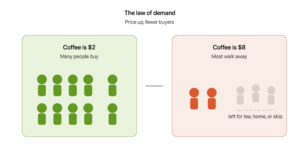
The core rule is simple and intuitive: when the price goes up, people want less; when the price goes down, people want more. If coffee costs $2, plenty of people buy it daily. If it suddenly costs $8, many switch to tea, make it at home, or skip it. Same coffee, different demand — purely because the price changed.
This relationship is called the law of demand, and it holds across almost everything. Cheaper flights fill more seats. Higher petrol prices push people toward smaller cars and public transport. The quantity people want is not fixed — it moves in the opposite direction to price.
What supply really means
Supply is the mirror image: how much of something producers are willing to make and sell, and how that changes with price.
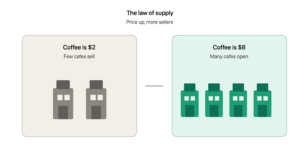
Here the rule runs the other way: when the price goes up, producers want to make more; when the price goes down, they make less. If coffee sells for $8 a cup, every café in town wants to sell as much as possible and new cafés open. If it drops to $2, the least efficient sellers give up and supply shrinks.
This is the law of supply. Higher prices act as a signal to producers: there is money to be made here, so make more. Lower prices signal the opposite.
Where the two forces meet: the price
Now put the two together, and something elegant happens.
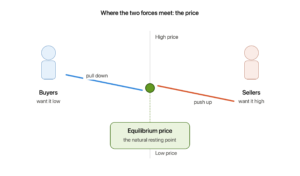
Buyers want low prices. Sellers want high prices. They pull in opposite directions. The price where the amount buyers want to buy exactly equals the amount sellers want to sell is called the equilibrium price — the natural resting point of the market.
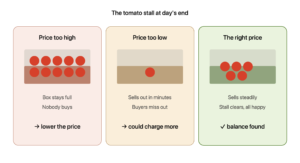
Think of a farmers’ market at the end of the day. If a stall priced its tomatoes too high, it is left with unsold boxes — so the seller lowers the price to clear them. If the price is too low, the tomatoes sell out in minutes and buyers are left disappointed — a signal the price could have been higher. Through countless small adjustments like these, markets constantly search for the price that balances the two forces.
No committee sets this price. No central authority decides it. It emerges naturally from millions of individual decisions — which is exactly what economist Adam Smith meant by the famous “invisible hand” guiding the market.
What happens when the balance shifts
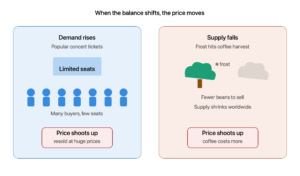
Prices are not static because supply and demand are always moving. Understanding what shifts them lets you read almost any price change in the news.
When demand changes
If a product suddenly becomes popular, demand rises. More buyers compete for the same goods, and the price climbs until supply catches up. This is why concert tickets for a hugely popular artist sell out and reappear on resale sites at eye-watering prices — demand massively exceeds the fixed supply of seats.
The reverse also happens. When demand for a product collapses — say, DVDs after streaming arrived — prices fall as sellers scramble to offload stock nobody wants.
When supply changes
If supply shrinks while demand stays the same, prices rise. A frost that destroys a coffee harvest reduces the supply of beans, and coffee prices climb worldwide. If supply expands — a bumper harvest, a new factory, a fresh oil discovery — prices tend to fall.
The 2022 inflation spike we discussed in Inflation Explained was, at its heart, a supply and demand story: government stimulus boosted demand while broken supply chains restricted supply. Too much money chasing too few goods pushed prices up sharply.
Why this matters everywhere
Supply and demand is not just about shops and products. It sets the price of almost everything in the economy.
Wages are the price of labour. When a skill is rare and employers need it badly — like software engineering during a tech boom — demand outstrips supply and wages soar. When many people can do a job and few employers need it, wages stay low. Your salary is, in large part, a supply-and-demand outcome.
Housing is a classic case. When many people want to live in a city but few new homes are being built, limited supply meets high demand and prices rocket. Cities with lots of construction tend to have more affordable housing, because supply keeps pace with demand.
Interest rates, which we will look at next, are essentially the price of money — set by the supply of savings and the demand for loans, nudged by the central bank.
Currencies rise and fall on supply and demand too. When the world wants US dollars, the dollar strengthens. When demand for a currency falls, it weakens.
When supply and demand break down
The model is powerful, but the real world sometimes interferes with the clean balance.
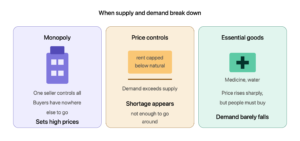
Monopolies distort it. When one company controls the entire supply of something, it can set prices far above where a competitive market would land, because buyers have nowhere else to go.
Price controls override it. When governments cap the price of something — like rent — below its natural level, demand exceeds supply and shortages appear. When they set a floor above the natural level, surpluses build up.
Essential goods bend the rules. For things people cannot do without — certain medicines, water, insulin — demand barely falls even when prices rise sharply, because people have no choice but to buy. This is why essentials are often regulated.
These exceptions do not disprove the model. They show why economists watch so carefully for cases where the invisible hand needs a visible one to keep markets fair.
Difficult words, made simple
| Term | Plain-English meaning |
|---|---|
| Demand | How much of something people want to buy at a given price |
| Supply | How much of something producers are willing to sell at a given price |
| Law of demand | When price rises, people want less; when it falls, they want more |
| Law of supply | When price rises, producers make more; when it falls, they make less |
| Equilibrium price | The price where the amount wanted equals the amount for sale |
| Invisible hand | The way individual choices naturally guide markets to a balancing price |
| Monopoly | When one seller controls a market and can set prices freely |
The big takeaway
Supply and demand is the engine underneath every price in the economy. Buyers push prices down, sellers push them up, and the point where they balance is the price you actually pay. When either force shifts — a change in tastes, a disrupted harvest, a rare skill, a flood of new money — the price moves in response.
Once you see this tug-of-war everywhere, the economy becomes far easier to read. A headline about rising rents, soaring wages in one industry, or a spike in oil prices is never really about the product itself. It is always, underneath, a story about supply meeting demand — the two invisible hands behind every price tag in the world.
Sources
This article presents standard economic principles of supply and demand. It is general educational information, not financial advice.
Related reading: Inflation Explained.
Growmmunity publishes explanations, not financial advice.