
Deflation: Why Falling Prices Can Be More Dangerous Than Rising Ones
Deflation sounds like wonderful news. If inflation means your money buys less over time, then deflation — falling prices — should mean your money buys more. Cheaper groceries, cheaper cars, cheaper rent. What could possibly be wrong with that?
Quite a lot, as it turns out. Deflation is one of the most feared words in economics, and central banks around the world work harder to avoid it than almost anything else. Today we explain the paradox at the heart of falling prices: why something that helps you as an individual shopper can quietly strangle an entire economy.
What deflation actually is
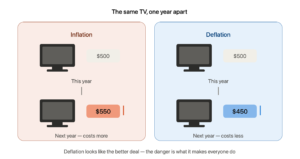
Deflation is the opposite of inflation. It is a general fall in prices across an economy over time. Not a single item going on sale, but the overall price level dropping month after month, so that the same amount of money buys progressively more.
As covered in Inflation Explained, inflation erodes the value of money. Deflation does the reverse — it increases the value of money. Cash you hold today will buy more next year than it does now. On the surface, that sounds like a gift to savers and shoppers.
The problem is what it does to behaviour. And that is where the danger hides.
The deflationary spiral: how falling prices feed on themselves
Here is the mechanism that makes economists lose sleep.
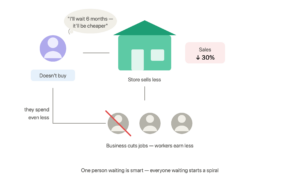
Imagine prices are falling by 3% a year. You are thinking about buying a new sofa. But you reason: if I wait six months, it will be cheaper. So you delay the purchase. Millions of other people reason exactly the same way, about sofas, cars, appliances, holidays, and homes.
All that delayed spending means businesses sell less. To survive on lower sales, they cut costs — which usually means cutting jobs or lowering wages. Now those laid-off or lower-paid workers spend even less. Falling demand pushes prices down further. Which gives everyone even more reason to wait. Which reduces spending again.
This self-reinforcing loop is called a deflationary spiral, and it is extraordinarily hard to escape. Each turn of the wheel makes the next turn worse. Where inflation is a fire that can be cooled, deflation is more like quicksand — the more the economy struggles, the deeper it sinks.
Why deflation is worse than inflation
Both inflation and deflation are problems, but they are not equally dangerous, and it is worth understanding why deflation frightens policymakers more.
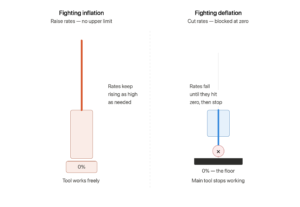
Inflation has a clear cure. A central bank can raise interest rates as high as necessary to crush it. It is painful, but the tool works and there is no upper limit to how high rates can go.
Deflation has no easy cure. To fight deflation, a central bank cuts interest rates to encourage borrowing and spending. But interest rates cannot fall below roughly zero — you cannot pay people to borrow money indefinitely. This is called the zero lower bound. Once rates hit zero and deflation continues, the central bank’s main tool stops working. It is like a car with the accelerator already pressed to the floor while the vehicle keeps slowing down.
Deflation makes debt heavier. This is the cruelest part. If you owe $200,000 and prices and wages are falling, your debt stays fixed at $200,000 while your income shrinks. The real weight of the debt grows every year. This crushes borrowers, discourages anyone from taking loans, and chokes off the lending that a healthy economy depends on.
The real-world example: Japan’s Lost Decades
Japan is the case study every economist returns to, because it shows exactly how devastating and how persistent deflation can be.
In the late 1980s, Japan was an economic superpower — the world’s second-largest economy, seemingly unstoppable. Property and stock prices soared to dizzying heights in what became one of history’s biggest asset bubbles. At the peak, the land under the Tokyo Imperial Palace was reportedly worth more than the entire state of California.
Then, at the start of the 1990s, the bubble burst. Stock prices collapsed, property values crumbled, and Japan fell into a deflationary trap it would struggle against for more than three decades. This period became known as the Lost Decades.
The numbers tell a stark story. Japan’s nominal GDP was roughly 521 trillion yen in 1995. A quarter of a century later, in 2019, it was about 559 trillion yen — almost flat. The economy did produce more in real terms during those years, but falling prices erased the gains entirely. An entire generation grew up knowing only stagnation.
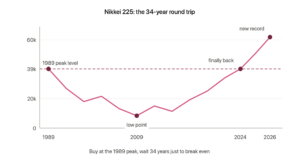
The stock market told an even more dramatic tale. Japan’s Nikkei 225 index peaked at the end of 1989 and then fell for years. Astonishingly, it did not return to that 1989 peak until February 2024 — a gap of more than 34 years. Only in 2026 did the index climb to genuine new record highs, as Japan finally showed signs of escaping deflation.
Why did Japan get stuck for so long?
Several forces trapped Japan, and each one offers a lesson.
Psychology set in. Once an entire population expects prices to keep falling, waiting to spend becomes the rational default. That expectation becomes self-fulfilling and enormously hard to reverse.
The population was ageing. Japan’s shrinking, ageing population meant fewer young workers and consumers driving demand. An older population tends to save more and spend less, which deepens deflationary pressure.
Banks were wounded. Many banks were crippled by bad loans from the bubble era. These weakened banks were reluctant to lend, which choked off the credit that could have revived spending.
Monetary policy hit its limit. With interest rates already at or near zero, the Bank of Japan found its traditional tools ineffective. It had to invent unconventional new policies — many of which the rest of the world later borrowed during their own crises.
How economies escape deflation
Escaping a deflationary spiral is difficult, but not impossible. The tools tend to be aggressive because the problem is so stubborn.
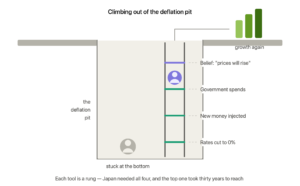
Cutting interest rates to zero is the first move, making borrowing as cheap as possible to encourage spending and investment.
Quantitative easing comes next when rates can go no lower. Here the central bank creates new money and uses it to buy assets, pushing money into the financial system to encourage lending and spending. Japan pioneered this approach, and the US and Europe adopted it during their own crises.
Government spending can step in directly. When households and businesses refuse to spend, the government can spend on their behalf — building infrastructure, cutting taxes, or sending money to citizens — to restart the circular flow.
Changing expectations may be the most important and the hardest. If a central bank can convince people that prices will rise again, they will start spending now rather than waiting. Japan’s recent large wage increases and its return to inflation suggest it may finally have broken the psychology after more than thirty years.
Why this matters to you — wherever you live
Deflation might feel like a distant, technical concern, but it shapes the world you live in.
The reason the US Federal Reserve targets 2% inflation rather than zero is precisely to keep a safe buffer away from deflation. Policymakers would rather risk mild inflation than flirt with the deflationary trap that swallowed Japan for a generation.
Understanding deflation also reframes how you hear economic news. When a central bank seems strangely relaxed about a little inflation, or cuts rates aggressively at the first sign of falling prices, it is not being careless. It is remembering Japan. It is choosing the problem it knows how to solve over the one that has no easy cure.
And on a personal level, it explains a counterintuitive truth: a small, steady rise in prices is not your enemy. It is the sign of an economy that is moving, lending, hiring, and growing. Perfectly stable or falling prices, appealing as they sound, often signal an economy that has stopped moving altogether.
Difficult words, made simple
| Term | Plain-English meaning |
|---|---|
| Deflation | A general fall in prices across the economy over time |
| Deflationary spiral | A self-feeding loop where falling prices reduce spending, which pushes prices down further |
| Zero lower bound | The point where interest rates hit zero and cannot easily go lower |
| Asset bubble | When prices of things like property or stocks rise far above their real value |
| Nominal GDP | The size of an economy measured in current prices, before adjusting for inflation |
| Quantitative easing | A central bank creating new money to buy assets and boost the economy |
| Lost Decades | Japan’s long period of deflation and stagnation after its 1990 bubble burst |
The big takeaway
Deflation is the perfect example of how something good for one person can be terrible for everyone at once. Cheaper prices help you as a shopper, but when everyone delays spending in anticipation of even cheaper prices, the economy can seize up entirely.
The danger is not falling prices themselves — it is the spiral they can trigger, and the fact that once it starts, there is no easy tool to stop it. Japan’s Lost Decades stand as a thirty-year warning of just how sticky that trap can be.
This is why every mention of inflation in the news carries a hidden counterpart. When central banks fight to keep inflation low but positive, they are steering carefully between two dangers — and deflation is the one they fear most.
Sources
Details on Japan’s Lost Decades, Nikkei 225 figures, and deflationary policy are drawn from public economic history sources and market data as of 2026. This article is general educational information, not financial advice.
Related reading: Inflation Explained.
Growmmunity publishes explanations, not financial advice.
1 thought on “Deflation: Why Falling Prices Can Be More Dangerous Than Rising Ones”