
GDP Explained: How We Measure the Size of an Entire Economy
GDP is the number that governments, investors, and journalists watch more closely than almost any other. When you hear that an economy “grew 3%,” “fell into recession,” or is “the world’s largest,” GDP is the figure behind those words. Yet for such a famous number, remarkably few people can explain what it actually measures.
Today we fix that. By the end, you will understand what GDP is, how it is calculated, what it reveals about a country, and — just as importantly — what it hides. We will use the US economy, the world’s largest, as our anchor throughout.
What GDP actually measures
GDP stands for Gross Domestic Product. In plain terms, it is the total value of all the goods and services a country produces in a given period, usually a year.
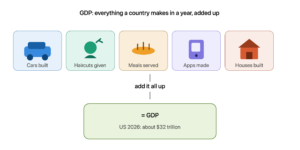
Every car built, every haircut given, every meal served in a restaurant, every app downloaded, every house constructed — add up the market value of all of it, and you have GDP. It is essentially a country’s total economic output, expressed as a single dollar figure.
In 2026, US GDP is roughly $32 trillion. That number represents everything the American economy produces in a year, and it is larger than the combined output of China, Germany, and India. When people say the US is the world’s biggest economy, this is the figure they mean.
The four pieces of GDP
Economists calculate GDP by adding up four types of spending. You have met these before as the four engines of an economy, and they fit together with a simple formula: GDP = Consumption + Investment + Government spending + Net exports.
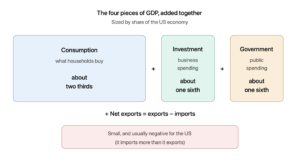
| Component | What it counts | US share (roughly) |
|---|---|---|
| Consumption | Everything households buy | About two thirds |
| Investment | Business spending on factories, tools, tech | About one sixth |
| Government spending | Public spending on services and infrastructure | About one sixth |
| Net exports | Exports minus imports | Usually negative for the US |
In the United States, consumption dominates. Because American households spend so much, US GDP rises and falls largely with the mood and wallets of ordinary consumers. This is why a weak retail sales report can rattle markets — consumer spending is by far the biggest slice of the pie.
Nominal vs real GDP: the trap you must avoid
Here is the single most important thing to understand about GDP, and the mistake that catches most beginners.
Imagine an economy produces exactly the same amount of goods this year as last year — not a single extra item. But prices rose 5% due to inflation. Measured in raw dollars, GDP would appear to have grown 5%, even though nothing more was actually produced. That growth is an illusion created purely by rising prices.
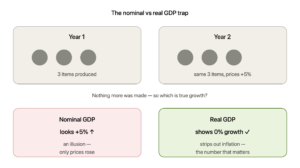
To solve this, economists use two versions of GDP:
Nominal GDP measures output at current prices, without adjusting for inflation. It mixes together real growth and price rises.
Real GDP strips out inflation, showing whether an economy actually produced more. This is the figure that matters. When the news reports the economy “grew 2.3%,” it almost always means real GDP.
The lesson connects directly to Inflation Explained: any economic growth number is meaningless until you know what inflation was. Nominal growth of 5% with 5% inflation means the economy did not actually grow at all.
Why GDP growth matters so much
When real GDP grows, an economy is producing more than before. That usually means more jobs, rising incomes, higher business profits, and greater government tax revenue. Growth is what lifts living standards over time.
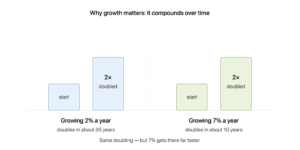
The compounding effect is easy to underestimate. An economy growing at 2% a year roughly doubles in size every 35 years. One growing at 7% doubles in just a decade. This is why the difference between 2% and 3% growth, which sounds trivial, has enormous consequences over a lifetime.
Growth also feeds on itself through the circular flow. More production means more income, which means more spending, which encourages still more production. This is the healthy version of the loop that runs in reverse during a recession.
When GDP shrinks: recession
When real GDP falls instead of rising, the economy is contracting. A common rule of thumb defines a recession as two consecutive quarters of falling real GDP, though official definitions consider a broader set of signals.
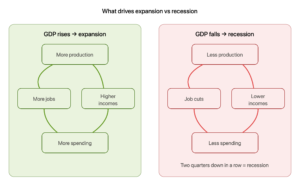
A shrinking economy usually means the reverse of growth: businesses earn less, jobs are cut, incomes fall, and spending drops further. Because GDP is the headline measure of economic health, a negative reading sends immediate signals to policymakers, investors, and businesses to prepare for tougher times.
What GDP does not tell you
For all its importance, GDP is a deeply incomplete measure, and understanding its blind spots is part of reading it well.
It ignores distribution. GDP measures total output, not who receives it. An economy can post impressive GDP growth while most of the gains flow to a small group and ordinary households feel no improvement at all. A rising GDP does not guarantee that life is getting better for the average person.
It misses unpaid work. A parent raising children, someone caring for an elderly relative, or volunteer work adds enormous value to society but counts as zero in GDP, because no money changes hands.
It ignores wellbeing and the environment. GDP counts a factory’s output but not the pollution it creates. It rises when people spend money cleaning up a disaster, even though the disaster made everyone worse off. It measures activity, not happiness or sustainability.
It says nothing about debt. A country can boost GDP in the short term by borrowing heavily, which looks like growth today but stores up problems for tomorrow.
These limitations do not make GDP useless. They mean it should be read as one crucial gauge among several, not as a complete scorecard for a society.
Difficult words, made simple
| Term | Plain-English meaning |
|---|---|
| GDP | The total value of everything a country produces in a year |
| Nominal GDP | Output measured at current prices, not adjusted for inflation |
| Real GDP | Output adjusted for inflation — the number that shows true growth |
| Consumption | Spending by households, the biggest part of US GDP |
| Net exports | Exports minus imports |
| Recession | A period when real GDP shrinks, often for two quarters or more |
| GDP per capita | GDP divided by population — a rough measure of output per person |
The big takeaway
GDP is the closest thing economics has to a single number for the size of an economy. It adds up everything a country produces, and its growth or decline signals whether times are getting better or worse. Real GDP, which strips out inflation, is the figure that truly matters.
But GDP is a measure of quantity, not quality. It tells you how much an economy produces, not how fairly the rewards are shared, how happy people are, or whether the growth can last. Read it as a powerful headline gauge — one that tells you a great deal, but never the whole story.
Sources
US GDP figures are drawn from the US Bureau of Economic Analysis and IMF data as of 2026. This article is general educational information, not financial advice.
Related reading: Inflation Explained.
Growmmunity publishes explanations, not financial advice.