
Recession vs Depression: What They Mean and Why One Is Far Worse
Recession is a word that can move markets, decide elections, and change millions of lives — yet it is often used loosely and misunderstood. Its more extreme cousin, depression, is rarer and far more devastating. Knowing the difference between the two, and understanding what actually happens during each, is essential to reading economic news with any real confidence.
Today we explain both clearly: what defines them, what causes them, how they end, and why economists and central banks fight so hard to prevent them. As always, we use the US economy as our anchor.
What a recession actually is
A recession is a significant, widespread decline in economic activity that lasts more than a few months. The simplest rule of thumb is two consecutive quarters of falling real GDP — two straight three-month periods where the economy produces less than before.
In practice, the official call is more nuanced. In the United States, a group of economists at the National Bureau of Economic Research looks at a broad range of signals — employment, income, spending, and production — before formally declaring a recession. But the two-quarter rule is a useful shorthand for most people.
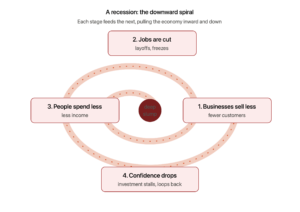
During a recession, the downward spiral from earlier in this series takes hold. Businesses sell less, so they cut jobs. Unemployed workers spend less, so businesses sell even less. Confidence drops, investment stalls, and the whole economy contracts together. It is the circular flow running in reverse.
What a recession feels like
Numbers on a chart do not capture what a recession actually means for people. On the ground, it looks like this:
Jobs become harder to find and easier to lose. Companies freeze hiring, cancel projects, and lay off staff. People who keep their jobs feel less secure and cut back on spending, worried about what comes next. Businesses see falling sales and delay investment. House prices often soften as buyers grow cautious. The mood shifts from optimism to anxiety.
Recessions are a normal, if painful, part of the economic cycle. Economies naturally move through periods of expansion and contraction, and downturns, while unpleasant, are recurring features rather than rare catastrophes.
What a depression is
A depression is a recession that becomes far deeper and lasts far longer. There is no precise universally agreed definition, but a depression involves a severe, prolonged collapse in economic activity — often a fall in GDP of 10% or more, or a downturn lasting several years rather than several months.
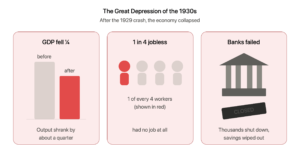
The defining example is the Great Depression of the 1930s. After the 1929 stock market crash, the US economy did not simply dip — it collapsed. GDP fell by roughly a quarter. Unemployment reached about 25%, meaning one in four workers had no job. Thousands of banks failed, wiping out people’s savings. The devastation spread worldwide and lasted for the better part of a decade.
That is the crucial difference in scale. A recession is a painful downturn. A depression is an economic catastrophe that can reshape a generation.
Recession vs depression: the key differences
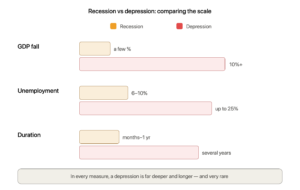
| Feature | Recession | Depression |
|---|---|---|
| Duration | Months to about a year | Several years |
| Depth of GDP fall | Usually a few percent | 10% or more |
| Unemployment | Rises, often to 6–10% | Can reach 20–25% |
| Frequency | Every several years | Very rare |
| Recovery | Usually within a year or two | Can take a decade |
What causes these downturns
Recessions and depressions can be triggered by several forces, often working together.
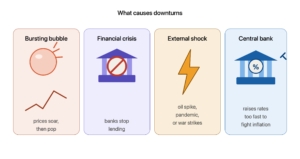
Bursting bubbles. When asset prices — houses, stocks — rise far above their real value and then crash, the sudden loss of wealth can drag the whole economy down. This is what happened in 2008, when a housing bubble collapsed.
Financial crises. When banks fail or stop lending, the credit that businesses and households depend on dries up. Because banks create most of the money in an economy, a banking crisis can freeze economic activity fast.
External shocks. A sudden oil price spike, a pandemic, or a war can disrupt supply and demand violently, tipping an economy into contraction. The 2020 COVID recession is the clearest recent example.
Central bank action. Sometimes downturns are partly deliberate. When a central bank raises interest rates aggressively to fight inflation, it can slow the economy so much that it tips into recession. This is the delicate balance we explored when discussing how the Fed fights inflation.
How economies fight back
Modern governments and central banks have tools to soften downturns and speed recovery — tools that barely existed during the Great Depression, which is a major reason depressions have become so rare.
Cutting interest rates makes borrowing cheaper, encouraging spending and investment to restart the circular flow.
Government spending can replace private demand. When households and businesses stop spending, the government can step in — funding infrastructure, cutting taxes, or sending money directly to citizens, as many countries did during the 2020 pandemic.
Support for the financial system keeps banks lending. In 2008, governments rescued failing banks precisely to prevent a recession from spiraling into a depression.
The lesson of the 1930s reshaped economic policy permanently. Today, at the first sign of a serious downturn, authorities act aggressively — because they know the alternative is the abyss the world fell into during the Great Depression.
Why this matters to you
Understanding these downturns changes how you interpret the news and the world around you.
When headlines warn of a possible recession, you now know what that means: a broad contraction, rising unemployment, cautious spending — serious, but usually temporary and recoverable. When you see central banks cutting rates or governments announcing spending packages, you understand they are trying to stop a downturn from deepening.
You also gain perspective. Recessions are a recurring part of the economic cycle, not a sign the world is ending. Depressions, the genuine catastrophes, have become rare precisely because policymakers learned hard lessons and built tools to prevent them. That distinction — between a painful but normal downturn and a true collapse — is one of the most useful things a beginner can carry into any economic conversation.
Difficult words, made simple
| Term | Plain-English meaning |
|---|---|
| Recession | A significant decline in economic activity, often two quarters of falling GDP |
| Depression | A severe, prolonged recession with a huge fall in output |
| Economic cycle | The natural rhythm of expansion and contraction in an economy |
| Unemployment rate | The share of people who want work but cannot find it |
| Asset bubble | When prices rise far above real value before crashing |
| Stimulus | Government or central bank action to boost a weak economy |
| The Great Depression | The severe global economic collapse of the 1930s |
The big takeaway
A recession and a depression sit on the same spectrum, separated by scale. A recession is a normal, recurring downturn — painful, but usually short and recoverable. A depression is a rare, devastating collapse that can define an entire generation, as the 1930s did.
The reason depressions have become so rare is that the world learned from the last one. Central banks and governments now act quickly and forcefully at the first sign of serious trouble, armed with tools designed specifically to keep an ordinary recession from becoming a historic catastrophe. Knowing the difference between the two is one of the clearest signs that you have moved from economic beginner to informed reader.
Sources
Historical figures on the Great Depression and recession definitions are drawn from public economic history sources and the National Bureau of Economic Research. This article is general educational information, not financial advice.
Related reading: GDP Explained.
Growmmunity publishes explanations, not financial advice.