
One Shopping Report, and the Whole World Felt It
On Friday, August 14, 2026, the US government released a routine monthly report: how much money Americans spent at stores in July. The number came in at minus 0.6% — meaning people spent less than the month before. Experts had expected a small increase of 0.1%.
That tiny gap set off a chain reaction that moved the value of money in every country on Earth. By the end of the day, the US dollar had weakened, the euro had risen, and the Japanese yen had climbed.
If none of that makes sense yet, don’t worry. We’re going to explain it through two ordinary people — one in the US, one outside it — so you can actually feel what’s happening.
Meet Amy and Ben
Let’s introduce our two characters. We’ll follow them through this whole story.
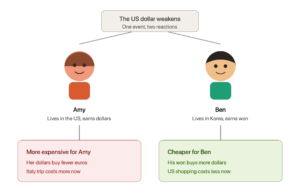
Amy lives in Texas, USA. She earns dollars, spends dollars, and is planning a summer trip to Italy.
Ben lives in Seoul, South Korea. He earns Korean won, but he loves shopping on American websites and dreams of visiting New York someday.
Same news event. Two completely different experiences. Let’s see why.
First, What Does “Retail Sales” Even Mean?
Retail sales is just a fancy term for one simple thing: how much stuff people bought at stores last month. Clothes, groceries, electronics, furniture — all of it added up.
Why do experts care so much about this one number? Because in the US, regular people’s shopping makes up the majority of the entire economy. When Amy and millions of people like her keep shopping, the economy hums along. When they suddenly pull back, it’s a warning sign that something is cooling down.
In July, Amy — like many Americans — spent less. Maybe prices felt too high, maybe she was worried about her job. Multiply that hesitation by millions of people, and you get a 0.6% drop. That drop is what alarmed the experts.
The Domino Effect, Step by Step
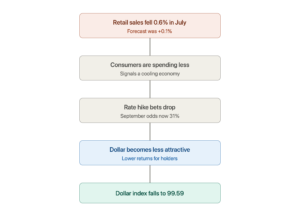
Here’s where it gets interesting. That one number triggered a series of dominoes. Let’s knock them over one at a time.
Domino 1: “People are spending less”
When shopping drops, it usually means people are nervous about the future — worried about jobs, prices, or the economy. Businesses notice this too, because they earn less when customers hold back.
Domino 2: “The economy might be slowing down”
A slowdown isn’t automatically a disaster, but it changes what everyone expects to happen next — especially what they expect from an organization called the Federal Reserve.
What Is the Federal Reserve? (The Most Important Term Here)
The Federal Reserve — usually just called “the Fed” — is the central bank of the United States. Think of it as the thermostat for the entire US economy.
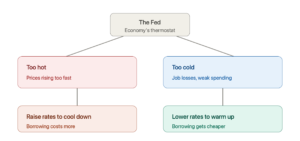
When the economy runs too hot (prices rising too fast), the Fed raises interest rates to cool it down. Raising rates makes borrowing money more expensive, so people and businesses spend a bit less, and prices stop climbing so quickly.
When the economy runs too cold (people losing jobs, spending dropping), the Fed lowers rates to warm it back up.
So the Fed is constantly deciding: warm it up, or cool it down?
Domino 3: “The Fed probably won’t raise rates now”
Before this report, some traders thought the Fed might raise rates in September to keep prices in check. But if the economy is already cooling on its own — as the weak shopping data suggests — then raising rates could accidentally freeze it. So traders lowered their bets: the chance of a September rate hike dropped to just 31%.
Domino 4: “The dollar is now less attractive”
This is the final domino, and it’s the one that affects Amy and Ben directly. To understand it, we need one more simple idea.
The Bank Analogy That Explains Everything
Imagine two banks side by side.
Bank A pays you 5% interest on your savings. Bank B pays only 2%.
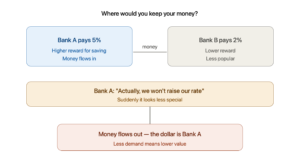
Where would you put your money? Bank A, of course — you earn more just by keeping your money there. Money from all over would flow into Bank A.
Now imagine Bank A makes an announcement: “Actually, we’re not going to raise our interest rate. We might even lower it soon.” Suddenly Bank A isn’t so special anymore. Some people move their money out, looking for a better deal elsewhere. Bank A becomes a little less popular.
Here’s the key: the US dollar is Bank A.
When people expect the Fed to raise interest rates, the dollar is like a high-interest savings account — everyone wants it, so its value rises. When that expectation disappears (Domino 3), the dollar becomes less appealing, money flows elsewhere, and its value falls.
That’s exactly what happened on Friday. The dollar’s value dropped, while the euro and yen rose in comparison.
Now — How Does This Hit Amy vs. Ben?
This is where being American or not-American completely changes the story.
Amy (American, earns dollars)
Amy is planning her trip to Italy. A weaker dollar is bad news for her. Why? Because in Italy, she’ll need euros — and now each of her dollars buys fewer euros than before. Her Italian vacation just got slightly more expensive.
But it’s not all bad for Amy. A weaker dollar can make American-made products cheaper for foreign buyers, which can help US companies that sell abroad. And the cooling economy might eventually mean lower interest rates on loans — good if Amy wants to buy a house or car later.
Ben (non-American, earns won, shops in the US)
For Ben, a weaker dollar is often good news. When the dollar weakens, his Korean won can buy more dollars than before. So:
- His shopping on American websites gets a little cheaper.
- If he finally takes that New York trip, his money stretches further there.
- Any savings he holds in dollars, however, are now worth slightly less in won terms.
Notice the pattern: the exact same news that made Amy’s life more expensive made Ben’s a little cheaper. That’s the nature of currency — when one goes down, another goes up. It’s always relative.
What Should Each of Them Watch Next?
If you’re like Amy (living in your home currency’s country):
- Watch what the Fed decides in September. If they hold rates or cut them, the dollar could stay soft — plan big overseas purchases or trips with that in mind.
- Keep an eye on the job market. Weak spending plus weak hiring can signal a broader slowdown that affects your income and job security.
If you’re like Ben (living outside the US, dealing with dollars):
- A weaker dollar can be a window of opportunity for dollar purchases, US travel, or converting money — but currencies swing both ways, so don’t assume it’ll last.
- If you hold savings or investments in dollars, understand that their value in your home currency moves with these headlines.
- Watch both central banks — your own country’s and the US Fed. The gap between them is what drives exchange rates.
The Yen: A Quick Bonus Story
The original news also spotlighted Japan’s yen, and it’s a great example of the same forces in action.
The yen has been extremely weak — recently near a 40-year low. Japan’s government tried “intervention,” which simply means buying its own currency to prop up its value. Picture a shop owner buying their own product to stop the price from crashing: it works for a moment, but fades unless something deeper changes.
The deeper change may be coming: Japan’s central bank is considering raising its interest rates soon — the opposite of what the US Fed is expected to do. Two central banks moving in opposite directions is exactly the kind of gap that makes currency values shift.
Difficult Words, Made Simple
| Term | Plain-English Meaning |
|---|---|
| Retail sales | How much people bought at stores last month |
| Federal Reserve (the Fed) | The US central bank — the “thermostat” of the economy |
| Interest rate | The reward for saving, and the cost of borrowing |
| Rate hike | Raising interest rates to cool the economy down |
| Dollar’s value / exchange rate | How much of another currency one dollar can buy |
| Intervention | A government buying its own currency to support its value |
| Central bank | The institution that controls a country’s money and interest rates |
The Big Takeaway
Economic news feels overwhelming until you realize it almost always follows the same simple chain: a piece of data comes out, it changes what people expect a central bank to do, and money flows accordingly.
And remember Amy and Ben. The same headline is never universal — it lands differently depending on which currency you earn, where you live, and what you’re planning to do with your money. That’s why, at Growmmunity, we always ask not just “what happened?” but “what does it mean for you, specifically?”
Source
This article is based on reporting by Karen Brettell for Reuters, published on Yahoo Finance. Read the original report here: Dollar falls on surprise drop in US retail sales.
All figures come from that report. Amy and Ben are illustrative examples created to explain the concepts. Exchange rates change constantly — always check current rates before making financial decisions.
Growmmunity publishes explanations, not financial advice. For decisions that affect your money, consult a qualified professional.
1 thought on “Why the Dollar Fell: US Retail Sales Explained Simply”