
America’s National Debt Just Hit $40 Trillion — That’s $117,000 for Every American
On 18 August 2026, the United States crossed a line no country has ever crossed before: its national debt passed $40 trillion.
The number made headlines everywhere — and then, for most people, it slid right past. And honestly, that is understandable. $40 trillion is not a number the human brain can picture. Nobody has ever seen it, held it, or spent it. It might as well be “a lot.”
But this milestone genuinely matters for ordinary life — for mortgage rates, credit card bills, and the price of borrowing anything. This guide explains what the national debt actually is, how it got this big, why it grew under both political parties, and what it means for you — in plain English, with no side-taking. (If economics is new to you, start with our foundation guide, What Is an Economy?)
First: what is the national debt? (And how is it different from the deficit?)
Two words get mixed up constantly in this story, so let’s separate them first — because once you have this distinction, every debt headline becomes readable.
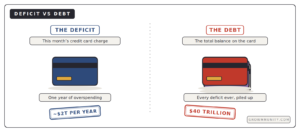
The deficit is one year’s overspending. If the government collects $5 trillion in taxes but spends $7 trillion, this year’s deficit is $2 trillion.
The debt is all the overspending ever, piled up. Every year’s deficit gets added to the mountain.
A household analogy: the deficit is how much you put on the credit card this month. The debt is the total balance on the card. The US has run a deficit — spent more than it collected — almost every single year since the late 1990s. The last time the budget was balanced was over 25 years ago. Each year’s gap landed on the pile, and the pile just passed $40 trillion.
One more piece: who is the money owed to? When the government needs cash it does not have, it borrows by selling Treasury bonds — essentially official IOUs that promise repayment with interest. Investors, pension funds, banks, foreign governments, and ordinary people buy them. Of the $40 trillion, about $32.3 trillion is owed to these outside holders, and about $7.8 trillion is money one part of the government owes another (mainly the Social Security trust fund).
OK, but how big is $40 trillion, really?
This is where the CNN reporting does something genuinely useful: it translates the untranslatable. Here are the comparisons that make the number real.
| Comparison | What it shows |
|---|---|
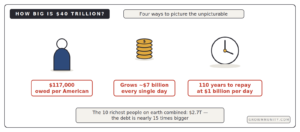
| Per person | Divided across roughly 343 million Americans, the debt comes to about $117,000 per person — every adult, every child |
| Paying it down | At $1 billion repaid every single day, it would take nearly 110 years to clear |
| The world’s richest people | The 10 wealthiest people on earth are worth about $2.7 trillion combined. The debt is nearly 15 times that |
| All US retirement savings | Every retirement account in America totals about $47.6 trillion — barely ahead of the debt |
| Daily growth | The debt grows by nearly $7 billion every day, according to the Peter G. Peterson Foundation |
| Speed | The debt was under $20 trillion in 2016. It doubled in under a decade |
And the trajectory matters as much as the level. Michael Peterson, CEO of the Peterson Foundation, put it bluntly: on the current path, the debt reaches $50 trillion in just six years.
The background: how did it get this big?
Here is the part that headlines often skip, and it is where a beginner most needs the full picture. The debt did not come from one president, one party, or one decision. It snowballed across administrations of both parties over decades, for four main reasons.

1. America is ageing. Roughly 10,000 Baby Boomers retire every day, and people are living longer. That means ever-larger spending on Social Security and Medicare — the two biggest items in the budget — while the number of workers paying in per retiree keeps shrinking. This is not a policy anyone chose; it is demographics doing what demographics does.
2. Taxes were cut while spending rose. Over recent decades Congress repeatedly passed packages that reduced tax revenue and increased spending at the same time — including the Tax Cuts and Jobs Act of 2017 and the One Big Beautiful Bill Act of 2025 under President Trump. Whatever the merits of each policy, arithmetic is arithmetic: less coming in plus more going out equals bigger deficits.
3. Covid. Roughly a third of the increase since 2017 came from two years of emergency pandemic borrowing — relief packages passed under President Trump and then President Biden. Both parties signed off; the bills were enormous.
4. Interest on the debt itself. This is the sneaky one, and it deserves its own paragraph.
The snowball: when debt starts feeding itself
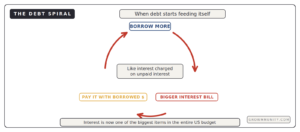
Think about a credit card balance you never pay off. The interest charges get added to the balance — and then you pay interest on the interest. The balance grows even if you stop spending.
The national debt now works the same way. As both the debt and interest rates have risen, the government’s annual interest bill has ballooned into one of the largest items in the entire federal budget. And since the budget is already in deficit, those interest payments are made with more borrowed money — which increases the debt, which increases next year’s interest bill.
This is what budget experts mean when they warn about a “debt spiral.” Maya MacGuineas, president of the Committee for a Responsible Federal Budget, told CNN that unsustainable borrowing on this scale strains efforts to address affordability and risks exactly that kind of dangerous spiral if lawmakers don’t act.
One more detail that worries economists specifically: all of this is happening in relatively good economic times. Debt normally balloons during wars, recessions, and emergencies — that is what borrowing capacity is for. Running record deficits when the economy is fine means less room to respond when the next genuine emergency arrives.
Why should you care? The path from $40 trillion to your mortgage
Here is the transmission chain, step by step, because it is shorter than you might think.

Step 1: The government needs to borrow more and more, so it sells more and more Treasury bonds.
Step 2: To attract enough buyers for that flood of bonds, it has to offer higher interest rates. This is already visible: the yield on the 30-year Treasury bond recently hit 5.33% — the highest since 2007.
Step 3: Treasury rates are the reference point for almost all other borrowing in the economy. When they rise, mortgage rates, credit card rates, car loans, and business loans rise with them.
That is the whole chain: government borrowing → higher Treasury yields → higher rates on everything you borrow. The $40 trillion is not an abstraction that lives in Washington. A slice of it is priced into your monthly payments. (For how interest rates ripple through prices and daily life, see our explainers on Inflation and Why the Dollar Fell.)
The obvious question: how is the US even allowed to borrow this much?
If a household or a company borrowed like this, lenders would have cut it off long ago. So why do investors keep lending America trillions?
The short answer: because of what the dollar is. The US dollar is the world’s reserve currency — the money that countries, banks, and companies everywhere hold and trade in. Treasury bonds are treated as the safest asset on earth, so there is almost always demand for them. That gives the United States a borrowing privilege no other country enjoys.
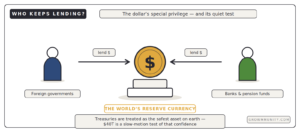
But that privilege is exactly why experts watch this number so closely. The whole arrangement rests on the world’s confidence that America will always pay. The debt becoming this large, this fast, is a slow-motion test of that confidence. We explained the entire mechanism in Dollar Dominance: Why the World Runs on US Dollars — it is the perfect companion piece to this story.
Is this a crisis? Two honest views
As always, we give you both serious positions rather than picking one.

The alarmed view: the debt has doubled in a decade, grows $7 billion a day, is on track for $50 trillion within six years, and its interest costs are crowding out everything else — all during good times. Budget watchdogs across the political spectrum warn that without raising taxes, cutting spending, or both, a genuine debt crisis becomes possible. The bond market’s rising yields suggest investors are starting to demand compensation for the risk.
The calmer view: the US has carried large debts before and always paid. It borrows in its own currency, which it can never run out of, and demand for Treasuries remains deep precisely because there is no real alternative. On this view the debt is a serious long-term management problem — not an imminent emergency — and the US economy’s size and growth still comfortably support it.
Both views are held by credentialed, serious people. What almost everyone agrees on is captured in the NBC reporting: the spending that built this debt came from both parties, and so far, neither has shown the political will to reverse it. The disagreement is about how much time there is — not about the direction.
Difficult words, made simple
| Term | Plain-English meaning |
|---|---|
| National debt | The total of all the government’s accumulated borrowing — the full credit card balance |
| Deficit | One year’s gap between what the government collects and what it spends |
| Treasury bond | The government’s IOU — buy one, and the government owes you your money back with interest |
| Yield | The interest rate a bond effectively pays; rises when the government must work harder to attract lenders |
| Interest payments | What the government pays each year just for holding its debt — now one of the biggest budget items |
| Debt spiral | When interest is paid with borrowed money, so the debt feeds its own growth |
| Balanced budget | A year when the government spends no more than it collects — last achieved in the late 1990s |
| Reserve currency | The money the whole world holds and trades in — the dollar’s special status that lets the US borrow cheaply |
| Intragovernmental debt | Money one arm of government owes another, mainly the Social Security trust fund (~$7.8T of the total) |
| Fiscal watchdog | Independent groups that track government borrowing and warn about unsustainable paths |
The big takeaway
The $40 trillion milestone is best understood not as a single event but as a speed reading. The debt doubled in under ten years, grows $7 billion a day, and is on course for $50 trillion within six — driven by an ageing population, decades of cutting taxes while raising spending, pandemic emergencies, and now interest compounding on itself. Both parties built it; neither is currently reversing it.
For you, the practical meaning runs through interest rates: more government borrowing pushes Treasury yields up, and everything you borrow is priced off those yields. The debt is why “safe” 30-year government bonds now pay their highest rate since 2007 — and part of why mortgages and credit cards cost what they do.
Three things worth watching from here: whether Treasury yields keep climbing (the market’s live verdict on the debt), whether interest costs keep swallowing a bigger share of the budget, and whether any serious deficit-reduction plan emerges from either party. Until one does, the milestone worth circling on the calendar is already known: $50 trillion, about six years away.
New to economics? Start with What Is an Economy? and What Is Money? — then read Dollar Dominance to understand why the world keeps lending America money.
Sources
This article is based on reporting by CNN and NBC News:
• CNN: National debt reaches grim $40 trillion milestone. Here’s why that matters
• CNN: The national debt just hit $40 trillion. But just how big is $40 trillion?
• NBC News: U.S. debt crosses $40 trillion threshold after doubling under Trump and Biden
All figures and quotes are drawn from those reports and the sources cited within them, including the Peter G. Peterson Foundation and the Committee for a Responsible Federal Budget. This article presents the fiscal facts and both mainstream interpretations without endorsing either party’s policies. This is general information, not financial advice.
Growmmunity publishes explanations, not financial advice.
2 thoughts on “America’s National Debt Just Hit $40 Trillion — That’s $117,000 for Every American”