
Index Funds Explained: The Simple Investment That Beats the Experts
Index funds are, in the words of many financial experts, the single best way for ordinary people to invest — and yet most beginners have never had them explained clearly. They are simple, low-cost, and have quietly outperformed the vast majority of highly paid professional investors over time. If there is one investing idea worth understanding properly, this may be it.
Today we will explain what an index fund actually is, why it works so surprisingly well, and why some of the most respected investors in the world recommend it above almost everything else. As always, we will keep everything grounded in plain language and clear examples.
Starting with a problem: picking stocks is hard
Imagine you want to invest in the stock market. The obvious approach is to pick individual companies you believe will do well — buy shares in this business, avoid that one, and try to choose winners.
But here is the difficulty. There are thousands of companies, and predicting which specific ones will thrive is extraordinarily hard. Even professional investors, who do this full-time with vast resources, mostly fail to consistently pick winners better than the overall market. Study after study has shown that the majority of professional fund managers underperform the simple market average over the long run.

If the experts struggle, what hope does a regular person have? This is exactly the problem the index fund was invented to solve — and its solution is beautifully counterintuitive.
The big idea: buy everything instead of guessing
An index fund takes a radical approach. Instead of trying to pick the winning stocks, it simply buys a tiny piece of every company in an index — and then holds them all.
Remember the S&P 500 from Stock Market Indexes Explained — the index of about 500 large US companies? An S&P 500 index fund buys shares in all 500 of those companies at once, in the right proportions. When you put money into it, you instantly own a microscopic slice of 500 of America’s biggest businesses, all in a single purchase.
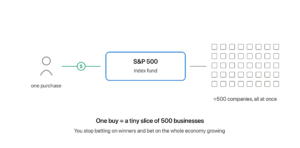
You are no longer betting on which companies will win. You are simply betting that the overall economy will keep growing over time — which, throughout history, it has. Instead of searching for needles in a haystack, an index fund buys the entire haystack.

Why this simple approach works so well
It seems almost too simple to be effective. Yet index funds have outperformed most active stock-pickers for several powerful reasons.
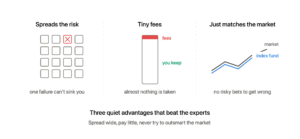
Instant diversification. Because you own hundreds of companies at once, no single company can sink you. If one business fails, it is a tiny fraction of your holdings, cushioned by hundreds of others. This spreading of risk across many companies is one of the most important protections in all of investing.
Very low costs. This is a huge and underappreciated advantage. Funds that pay teams of experts to pick stocks charge high fees for that effort. An index fund just buys everything and holds it, so it needs almost no expensive management, and its fees are tiny. Over decades, the difference between high fees and low fees can add up to an enormous gap in your final returns, because you keep more of what you earn.
No need to outsmart the market. Since the index fund simply matches the market’s overall performance, it never has to make the risky, difficult bets that cause active investors to underperform. By aiming only to match the market rather than beat it, it quietly ends up beating most of those who try to beat it.
The power of low fees, shown simply
The fee advantage deserves a closer look, because it is where index funds quietly win the race. Imagine two investors who both earn the same market returns over many years. One pays high yearly fees for an actively managed fund; the other pays tiny fees for an index fund.
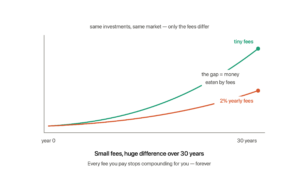
Even a difference of just one or two percent in annual fees, which sounds trivial, compounds relentlessly over decades. Each year, the high-fee investor loses a slice of their returns to costs, and that lost slice can never grow for them in future years. Over a working lifetime, the low-fee index investor can end up with dramatically more money — not because they picked better investments, but simply because they kept more of their returns instead of paying them away. In investing, costs are one of the few things you can actually control, and index funds control them ruthlessly.
What the greatest investors say
You do not have to take this on faith. Some of the most successful investors in history have publicly championed index funds for ordinary people.
The idea was pioneered by an investor who believed regular people deserved a fair, low-cost way to share in the market’s growth, and who created the first index fund for everyday investors. Since then, the approach has been endorsed by many of the most respected names in finance, who have repeatedly advised that for most people, a simple low-cost index fund will beat trying to pick stocks or paying someone else to do it. When the world’s best investors tell ordinary people not to try to be clever, but simply to buy the whole market cheaply and hold it, that advice is worth taking seriously.
The honest trade-offs
Index funds are powerful, but honesty requires noting their limits, so you understand exactly what you are choosing.

You will never beat the market. By design, an index fund matches the market — so you give up any chance of dramatically outperforming it. You accept average market returns in exchange for simplicity, low cost, and the near-certainty of doing better than most active investors. For the vast majority of people, that is a fantastic trade. But it does mean no spectacular, better-than-everyone gains.
You still fall when the market falls. An index fund holds the whole market, so when the market drops in a downturn, your fund drops with it. Diversification protects you from any single company failing, but not from a broad market decline. Index investing rewards those who can stay calm and hold on through the inevitable falls, rather than panic-selling at the bottom.
It rewards patience above all. The magic of index funds appears over years and decades, not weeks. They are a tool for the patient long-term investor, not for anyone hoping to get rich quickly.
Why this matters to you
Understanding index funds hands you one of the most practical pieces of financial knowledge that exists. It reveals that successful investing for most people is not about being brilliant, picking hot stocks, or paying experts. It can be as simple as buying the whole market cheaply and holding it patiently for a long time.
This knowledge cuts through an enormous amount of financial noise. The industry often profits by making investing seem complicated and by charging for expertise that frequently underperforms a simple index. Knowing that a low-cost index fund quietly beats most of that expertise protects you from unnecessary fees and needless complexity. Whether or not you ever invest, understanding the index fund reveals a profound truth: sometimes the simplest, most patient approach is also the most powerful.
Difficult words, made simple
| Term | Plain-English meaning |
|---|---|
| Index fund | A fund that buys every company in an index instead of picking stocks |
| Diversification | Spreading money across many investments to reduce risk |
| Active fund | A fund where experts try to pick winning stocks, for a fee |
| Fees (expense ratio) | The yearly cost of owning a fund, taken from your returns |
| Passive investing | Simply matching the market rather than trying to beat it |
| Compounding | Growth building on previous growth over time |
| Market return | The overall gain of the whole market over a period |
The big takeaway
An index fund is a simple investment that buys a tiny piece of every company in an index and holds them all, instead of trying to pick winners. This humble approach beats most professional stock-pickers for three reasons: it spreads risk across hundreds of companies, it charges tiny fees, and it never has to make the risky bets that cause active investors to fail.
You give up the chance to dramatically beat the market, and you still fall when the market falls. But in exchange, you get simplicity, low cost, built-in diversification, and the near-certainty of outperforming most who try harder. It is why so many of the world’s greatest investors give the same advice to ordinary people: do not try to be clever — just buy the whole market cheaply, hold it patiently, and let time do the work. Sometimes the simplest idea is the most powerful one of all.
Sources
This article explains standard principles of index fund investing. It is general educational information, not financial advice. Always consider your own circumstances and, where appropriate, consult a qualified professional before investing.
Related reading: Stock Market Indexes Explained.
Growmmunity publishes explanations, not financial advice.