
Compound Interest: The Simple Force Einstein Reportedly Called the Eighth Wonder
Compound interest is often described as the most powerful force in personal finance, and once you truly understand it, you will see why. It is the quiet mechanism that can turn modest savings into a fortune over a lifetime — or, working against you, turn a small debt into a crushing one. It rewards patience like almost nothing else in the financial world, and it is astonishingly simple to grasp.
Today we will explain exactly what compound interest is, show step by step how it grows, and reveal why time matters even more than the amount of money you start with. We will keep everything concrete and clear, because this single idea may be the most valuable one in this entire series.
Simple interest vs compound interest
To understand compounding, we first need its simpler cousin: simple interest.

Simple interest is calculated only on your original amount. Imagine you put $1,000 in an account paying 10% a year in simple interest. Every year, you earn $100 — always calculated on the original $1,000. After five years, you have earned $500, giving you $1,500. Steady, predictable, and linear.
Compound interest is where the magic happens. Here, you earn interest not only on your original money, but also on the interest you have already earned. Your interest earns interest. That small difference sounds minor, but over time it produces staggering results.
Watching compounding grow, step by step
Let us follow the same $1,000 at 10%, but this time with compound interest, year by year, so you can see the snowball form.
| Year | Starting amount | Interest earned (10%) | New total |
|---|---|---|---|
| 1 | $1,000 | $100 | $1,100 |
| 2 | $1,100 | $110 | $1,210 |
| 3 | $1,210 | $121 | $1,331 |
| 4 | $1,331 | $133 | $1,464 |
| 5 | $1,464 | $146 | $1,610 |
Notice what is happening. In year one, you earn $100 — the same as simple interest. But by year five, you earn $146, because you are earning interest on all the interest that came before. With simple interest you had $1,500 after five years; with compound interest you have $1,610. The gap is still small after five years — but watch what time does to it.
The real power: time
Compound interest starts slow and then explodes. The longer it runs, the more dramatic it becomes, because the snowball keeps gathering more snow with every roll.
That same $1,000 at 10% keeps growing. After 10 years it becomes about $2,600. After 20 years, about $6,700. After 30 years, about $17,400. After 40 years, about $45,000. You put in $1,000 once and never added a cent, yet it multiplied more than fortyfold — purely because interest kept earning interest, year after year.

This is the crucial lesson: with compounding, time is the most powerful ingredient — even more than the amount you start with. A small sum given many decades to grow can outperform a large sum given only a few years. This is why starting early, even with little, is so extraordinarily valuable.

The rule of 72: a handy shortcut
Here is a simple trick that lets you estimate compounding in your head. To find roughly how many years it takes for money to double, divide 72 by the interest rate.
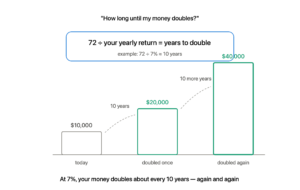
At 10%, money doubles in about 72 ÷ 10 = 7.2 years. At 6%, it takes about 12 years. At 3%, about 24 years. This little shortcut, called the rule of 72, instantly shows why higher returns and longer time frames matter so much. It also reveals why even a couple of extra percentage points of return can dramatically change how fast your money grows.
Compounding works against you too
Compound interest is not always your friend. When you borrow, the very same force works powerfully against you — and understanding this can protect you from serious harm.
Credit card debt is the classic trap. Credit cards often charge very high interest, and that interest compounds. If you do not pay off your balance, you are charged interest on your interest, and the debt can snowball frighteningly fast — the same explosive growth we admired above, but now piling up against you.

This is the two-sided nature of compounding. Put simply: when you save and invest, compounding is a powerful ally building your wealth. When you borrow at high interest, it becomes a relentless force draining it. The wise approach is to get compounding working for you through saving and investing, while avoiding letting it work against you through high-interest debt.
How to put compounding to work
Understanding compounding naturally points to a few timeless principles, without needing any specific financial product.
Start early. Because time is the most powerful ingredient, the earlier money begins compounding, the better. Even small amounts started early can outgrow larger amounts started late. Time in the market beats the size of the deposit.
Be patient. Compounding is slow at first and only becomes spectacular later. The temptation is to give up during the unimpressive early years, but the greatest growth comes at the end, if you let it run.
Reinvest, do not withdraw. The whole engine depends on interest staying in to earn more interest. Every time you take earnings out, you slow the snowball. Letting returns build on themselves is what creates the dramatic long-term growth.
Avoid high-interest debt. Since compounding works against borrowers too, escaping high-interest debt is one of the most powerful financial moves there is — it stops the force from working against you.
Why this matters to you
Compound interest is arguably the most important single concept in personal finance, because it governs both how wealth is built and how debt destroys it. Grasping it changes how you see money across your entire life.
It explains why financial experts urge people to start saving young, why patience is rewarded so richly, and why high-interest debt is so dangerous. It reframes small, consistent actions — saving a little regularly, starting a few years earlier, avoiding costly borrowing — as decisions with enormous long-term consequences, thanks to the quiet multiplying power of time.
Most of all, it offers a hopeful truth: you do not need to be wealthy or brilliant to benefit. You need only to understand this one force, start as early as you can, be patient, and let time do the work. That is the essence of compound interest — the simple, patient miracle at the heart of building wealth.
Difficult words, made simple
| Term | Plain-English meaning |
|---|---|
| Simple interest | Interest calculated only on your original amount |
| Compound interest | Interest earned on both your money and its past interest |
| Principal | The original amount of money you start with |
| Reinvest | Leaving earnings in so they can earn more |
| Rule of 72 | A shortcut: 72 ÷ interest rate ≈ years to double |
| Compounding period | How often interest is added, such as yearly or monthly |
| High-interest debt | Borrowing, like credit cards, where compounding hurts you |
The big takeaway
Compound interest is the force of earning interest on your interest, and over time it grows money not in a straight line but in an accelerating curve. Start with $1,000, leave it alone at a steady return, and decades later it can multiply many times over — with time, not the starting amount, doing most of the work. The rule of 72 gives you a quick way to see how fast money doubles at any return.
The same force works in reverse on high-interest debt, which is why compounding must be understood as a two-edged sword. Get it working for you by starting early, staying patient, and reinvesting your gains, while avoiding letting it work against you through costly borrowing. Master this one idea, and you hold the key to how wealth is quietly, patiently built over a lifetime.
Sources
This article explains standard mathematical principles of compound interest. It is general educational information, not financial advice.
Related reading: Index Funds Explained and Interest Rates Explained.
Growmmunity publishes explanations, not financial advice.