
Bubbles and Crashes: Why Markets Sometimes Lose Their Minds
Bubbles and crashes are among the most dramatic events in all of economics — moments when markets seem to collectively lose their minds, sending prices soaring to impossible heights before collapsing in spectacular fashion. From tulip flowers in the 1600s to houses in 2008, the same strange pattern has repeated across centuries, wrecking fortunes and reshaping economies each time.
Why does this keep happening? Why do smart people, again and again, pay absurd prices for things that later collapse in value? Today we will explain exactly what a bubble is, walk through the predictable stages it follows, and reveal the very human psychology that drives this recurring madness. As always, we will keep everything clear and grounded in real examples.
What a bubble actually is
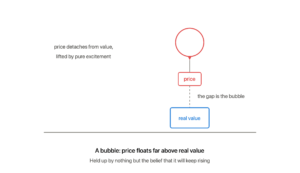
A bubble is when the price of something rises far above its real, sensible value — driven not by genuine worth, but by excitement, speculation, and the belief that prices will keep climbing forever.
Think back to what we learned in Why Stock Prices Move: prices are supposed to reflect real value, like a company’s actual earnings. In a bubble, that connection snaps. Prices detach from reality and float upward on pure emotion. People stop buying something because it is genuinely worth the price, and start buying simply because it keeps going up and they expect to sell it later to someone else for even more.
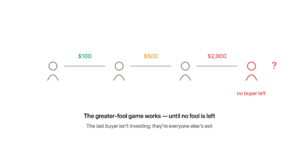
This is the essence of a bubble: buying not for value, but purely in the hope that a “greater fool” will pay you more tomorrow. It works, until suddenly it does not.
The famous example everyone should know
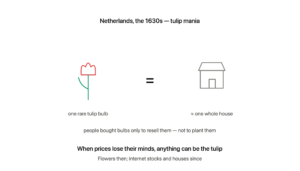
The clearest illustration in history is almost unbelievable. In the Netherlands in the 1630s, the price of tulip bulbs — ordinary flower bulbs — soared to extraordinary heights. At the peak of “tulip mania,” a single rare bulb could reportedly cost as much as a house.
Why? Not because tulips had suddenly become useful or valuable, but because prices kept rising, and everyone wanted in. People bought bulbs not to plant, but to sell later at a profit. As long as prices climbed, everyone felt like a genius. Then, one day, buyers vanished, confidence evaporated, and prices collapsed almost overnight. Fortunes built on flowers disappeared. The pattern set then has repeated ever since, whether the object of mania is flowers, internet stocks, or houses.
The predictable stages of a bubble
Remarkably, bubbles tend to follow a recognizable pattern. Understanding these stages helps you spot the madness while it is happening, rather than only in hindsight.
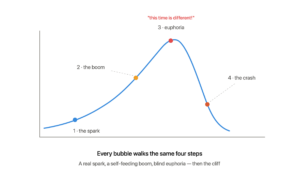
Stage one: the spark. Something genuinely promising appears — a new technology, a hot market, a real opportunity. Early buyers make real money on a real trend. This part is often justified.
Stage two: the boom. Prices rise, and word spreads. More people pile in, drawn by the gains they see others making. Rising prices attract more buyers, which pushes prices higher still, which attracts even more buyers. The cycle feeds itself.
Stage three: euphoria. Caution disappears entirely. Prices detach completely from reality. People borrow money to buy in, convinced prices can only go up. Anyone urging caution is dismissed as not understanding that “this time is different.” Ordinary people quit jobs to trade full-time. This is peak madness.
Stage four: the crash. Something shifts. A few people start selling to lock in profits. Prices wobble. Doubt creeps in. Then panic takes over: everyone rushes to sell at once, but there are no buyers left. Prices collapse far faster than they rose, and the bubble bursts, often destroying enormous wealth.
The psychology that drives it all
Bubbles are, at their core, a story about human emotion overpowering reason. Several deep psychological forces combine to create them, and recognizing these in yourself is the best protection against them.
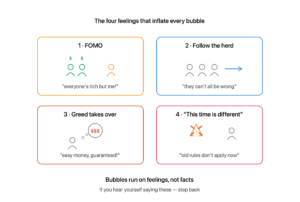
Fear of missing out. When you watch friends, neighbors, and strangers getting rich, the pressure to join in becomes overwhelming. Standing aside while others profit feels unbearable, so people abandon their judgment and pile in — often near the top.
Herd behavior. Humans instinctively follow the crowd. When everyone around us is buying, our brains take it as proof that it must be a good idea, even when the crowd is collectively wrong. Safety in numbers becomes danger in numbers.
Greed overriding caution. The dream of easy, rapid wealth is intoxicating. It pushes people to ignore obvious warning signs and to believe comforting stories about why the good times will never end.
“This time is different.” In every bubble, people convince themselves that the old rules no longer apply — that some new technology or new era justifies the insane prices. It almost never does. These four words are among the most expensive in the history of finance.
What happens when bubbles burst
The bursting of a bubble is not just a problem for those who gambled and lost. It can ripple out to damage the entire economy, as we saw with recessions in Recession vs Depression.
When a big bubble bursts, the sudden destruction of wealth makes people feel poorer, so they stop spending. Those who borrowed heavily to buy in are left with crushing debts and worthless assets. Banks that lent the money face huge losses and stop lending. The circular flow of the economy seizes up, and a downturn can follow.
The 2008 housing bubble is the defining modern example. House prices had detached from reality, fueled by easy borrowing and the belief that they could only rise. When they crashed, they took the global financial system down with them, triggering the worst recession since the Great Depression. A bubble in one market became a crisis for the entire world.
Can bubbles be spotted in advance?
Here is the frustrating truth: bubbles are easy to identify after they burst, but genuinely hard to call in the moment. During the boom, there are always convincing arguments for why the high prices are justified, and prices can stay irrational for far longer than seems possible.
Still, there are warning signs worth knowing. Be wary when prices are rising far faster than the underlying value could justify, when people are borrowing heavily to buy in, when ordinary conversation is dominated by getting rich from one hot asset, and when anyone urging caution is mocked with claims that “this time is different.” None of these guarantees a bubble, but together they are the classic fingerprints of one.
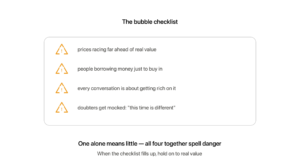
The wisest approach is not to try to perfectly time these manias, but to recognize the emotional forces at work and to stay grounded in the idea of real value — the same discipline that protects investors in calmer times.
Why this matters to you
Understanding bubbles protects you from one of the most reliable ways people lose money throughout history. Because the same pattern repeats across generations, knowing its stages and psychology gives you a rare kind of immunity. When you feel the pull of a red-hot market that “everyone” is getting rich from, you will recognize the warning signs for what they are.
It also helps you make sense of dramatic economic news. When you see a market soaring impossibly or crashing violently, you understand the human machinery behind it — the fear of missing out, the herd, the euphoria, and the inevitable reckoning. You can watch these events with perspective rather than panic.
Most valuably, it instills a healthy skepticism toward anything that promises easy, guaranteed, rapidly rising riches. History’s bubbles all whispered the same seductive promise, and they all ended the same way. Knowing that story is one of the most practical forms of financial wisdom there is — a quiet shield against the madness of crowds.
Difficult words, made simple
| Term | Plain-English meaning |
|---|---|
| Bubble | When a price rises far above real value on excitement and speculation |
| Crash | A sudden, sharp collapse in prices when a bubble bursts |
| Speculation | Buying something hoping to sell it higher, not for its real use |
| Greater fool | Someone you hope will buy your overpriced asset for even more |
| FOMO | Fear of missing out, which drives people to buy near the top |
| Herd behavior | Following the crowd instead of independent judgment |
| Euphoria | The peak stage of a bubble when caution disappears entirely |
The big takeaway
A bubble is what happens when prices float free of real value, lifted by excitement, speculation, and the belief that they will rise forever. Bubbles follow a predictable path — a genuine spark, a self-feeding boom, a euphoric peak, and a violent crash — driven by timeless human emotions like the fear of missing out, herd behavior, and the fatal belief that “this time is different.”
From tulips to houses, the same story has repeated for centuries, and when big bubbles burst, the damage can spread far beyond speculators to engulf the whole economy. Bubbles are hard to time precisely, but their warning signs are recognizable, and their deepest lesson is simple: stay grounded in real value, and be deeply skeptical of any market promising easy, endless, rapidly rising riches. That skepticism, learned from history, is one of the most valuable safeguards a person can carry.
Sources
Historical examples including tulip mania and the 2008 housing crisis are drawn from public economic history sources. This article is general educational information, not financial advice.
Related reading: Why Stock Prices Move and Recession vs Depression.
Growmmunity publishes explanations, not financial advice.