
Why Stock Prices Move: What Really Drives the Market Up and Down
Why stock prices move is one of the most fascinating puzzles in all of finance. One day a company’s stock jumps 8% on news that sounds minor. The next day it falls 5% even though the company reported record profits. To a newcomer, it can look completely irrational — a chaotic dance of numbers with no logic behind it. But there is logic, and once you understand it, the market’s daily swings start to make real sense.
Today we will unpack what actually moves stock prices — from cold hard profits to raw human emotion — using clear examples throughout. By the end, you will understand why a stock can fall on good news, why the market often seems to react before anything happens, and why fear and greed matter just as much as facts.
The foundation: it all comes back to supply and demand
At the most basic level, a stock’s price moves for exactly one reason: more people want to buy it than sell it, or vice versa. This is the supply and demand we met in Supply and Demand, applied to shares.

When buyers outnumber sellers, they compete for a limited number of shares, bidding the price up. When sellers outnumber buyers, they compete to offload shares, pushing the price down. Every price move, no matter how dramatic, is ultimately this simple imbalance playing out.

But this just moves the question one step back. What makes people want to buy or sell in the first place? That is where the real story lies, and it has several layers.
Layer one: the company’s actual performance
The most fundamental driver is how the company is genuinely doing. This is called its fundamentals — the real, measurable health of the business.
When a company earns more profit, wins new customers, launches a successful product, or grows its sales, it becomes more valuable. Owning a piece of it is worth more, so demand rises and the price climbs. When a company’s profits shrink, it loses market share, or a product flops, it becomes less valuable, and the price falls.
Four times a year, public companies report their financial results — their earnings. These earnings reports are among the biggest moving events for any stock, because they reveal whether the business is actually performing better or worse than people expected. A strong report often lifts the stock; a weak one often sinks it.
Layer two: expectations, not just reality
Here is the twist that confuses so many beginners: the stock market runs on expectations, not just current facts. A stock’s price already reflects what people expect to happen. So what moves it is not the news itself, but how the news compares to those expectations.
This explains the great mystery — why a company can report record profits and still see its stock fall. If investors expected even higher profits, then a merely great result is a disappointment, and the stock drops. The company did well, but not as well as the price had already assumed.
The reverse happens too. A struggling company can report shrinking profits and see its stock rise, simply because the results were not as bad as feared. The market had braced for disaster, and mere bad news came as relief.

The key phrase professionals use is that markets have “priced in” expectations. Today’s price already contains everyone’s best guess about the future. Only surprises — results that differ from what was expected — move the price. This one insight resolves most of the market’s apparent madness.
Layer three: the bigger economic picture
Individual companies do not exist in a vacuum. The whole economy pushes and pulls on every stock at once, which is why entire markets often rise or fall together.
Interest rates are a powerful force, as we saw in Interest Rates Explained. When rates rise, borrowing gets costlier and safer investments like bonds become more attractive, which tends to pull money away from stocks and push prices down. When rates fall, money often flows back into stocks, lifting prices.
Economic health matters broadly. Signs of a growing economy — strong employment, healthy spending — tend to lift stocks, because companies should earn more in good times. Fears of a recession tend to drag stocks down.
Big events ripple across everything. Wars, pandemics, elections, oil shocks, and major policy changes can move entire markets in a day, because they change the outlook for nearly every company at once.
Layer four: human emotion
Finally, we reach the most unpredictable force of all: raw human psychology. Markets are made of people, and people are driven by two powerful emotions — fear and greed.
When prices are rising and everyone is optimistic, greed can take over. People rush to buy so they do not miss out, pushing prices higher than the fundamentals justify. This is how bubbles form. When prices are falling and fear spreads, people panic-sell to avoid further losses, pushing prices lower than the fundamentals justify. This is how crashes happen.
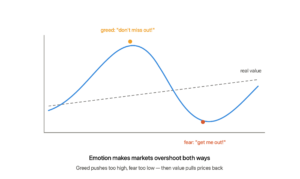
These emotional swings explain why markets often overshoot in both directions — rising too high in good times and falling too low in bad ones. In the short term, emotion can overwhelm logic entirely. A stock can soar or collapse on pure sentiment, disconnected from the actual business, at least for a while. Understanding that markets are emotional, not perfectly rational, is one of the most valuable lessons a beginner can learn.
Short term vs long term: two different games
Putting it all together reveals a crucial truth: stocks behave differently over different timeframes.

In the short term, prices are driven heavily by emotion, news, and shifting expectations. Day to day, the market can seem random and irrational, swinging on rumors and moods. Trying to predict these short-term moves is extraordinarily difficult, even for professionals.
In the long term, prices tend to follow the fundamentals — the real earnings and growth of companies. Over years and decades, a genuinely good business tends to see its stock rise, and a genuinely failing one tends to see its stock fall, no matter how much noise happened along the way. As the famous saying goes, in the short run the market is a voting machine driven by sentiment, but in the long run it is a weighing machine driven by real value.
Why this matters to you
Understanding why stocks move protects you from the two biggest mistakes beginners make. When you know that short-term swings are often driven by emotion and expectations rather than fundamentals, you are less likely to panic-sell in a crash or greedily chase a bubble. You can see the fear and greed for what they are.
It also helps you read the news wisely. When a stock falls on good news, you now understand it probably means the good news was not good enough versus expectations — not that the world has gone mad. When markets swing wildly on a single headline, you recognize the emotional machinery at work.
Most importantly, it teaches patience. Knowing that the market is a voting machine in the short run but a weighing machine in the long run helps you tune out the daily noise and focus on what truly matters over time. That perspective alone separates calm, informed observers from anxious ones — and it starts simply with understanding what really makes prices move.
Difficult words, made simple
| Term | Plain-English meaning |
|---|---|
| Fundamentals | The real, measurable health of a company, like profits and sales |
| Earnings | A company’s profits, reported four times a year |
| Priced in | When a price already reflects what people expect to happen |
| Expectations | What investors believe will happen in the future |
| Sentiment | The overall mood or emotion of investors |
| Volatility | How much and how fast prices swing up and down |
| Correction | A significant fall in prices, often around 10% |
The big takeaway
Stock prices move because of supply and demand, but what drives that buying and selling runs deeper: the company’s real performance, the gap between results and expectations, the broader economy, and the powerful emotions of fear and greed. The single most important insight is that markets run on expectations — only surprises move prices, which is why a stock can fall on good news that simply was not good enough.
In the short term, emotion and expectations rule, making the market look chaotic and unpredictable. In the long term, real value wins out, and genuinely strong companies tend to rise. Holding both of these truths at once — the noisy short run and the rational long run — is the key to understanding the market without being ruled by it. Once you see these forces clearly, the market’s daily dance stops looking like madness and starts looking like something you can actually read.
Sources
This article explains standard principles of what drives stock price movements. It is general educational information, not financial advice.
Related reading: The Stock Market Explained and Interest Rates Explained.
Growmmunity publishes explanations, not financial advice.