
Tariffs Explained: What They Are and Who Really Pays for Them
Tariffs have moved from a dry corner of economics textbooks to the center of headlines around the world. Governments impose them, trading partners retaliate against them, and economists argue fiercely about them. Yet beneath all the noise lies a set of simple ideas that anyone can understand — and one question that matters more than any other: when a country puts a tariff on imported goods, who actually ends up paying for it?
Today we will explain exactly what a tariff is, why governments use them, what effects they really have, and who bears the true cost. We will keep everything clear and grounded in examples, and we will look at the real, current use of tariffs in the US economy as our anchor. This is a genuinely contested topic, so we will present the honest arguments on both sides.
What a tariff actually is
A tariff is simply a tax on imported goods — products brought into a country from abroad. When a good crosses the border into a country with a tariff, the importer must pay that tax to their own government before the product can be sold. Picture a toll booth at the border: every foreign product that drives through has to drop money in the basket before it can continue to the shops.
Imagine a country places a 25% tariff on imported washing machines. A washing machine that would have cost $400 to import now carries an extra $100 tax, bringing the cost to $500 before it even reaches the store. That tax goes to the government of the importing country. This is the whole mechanism: a tariff is a toll charged at the border on goods coming in.
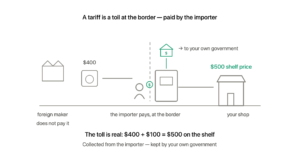
It is worth pausing on one crucial detail that is widely misunderstood. The tariff is paid by the importer — a company inside the country imposing it — not directly by the foreign producer. This single fact is the key to understanding who really pays, which we will come to shortly.
Why governments impose tariffs
Governments use tariffs for several reasons, and understanding them helps make sense of the debates. Each reason connects to the winners and losers of trade we explored in International Trade Explained.
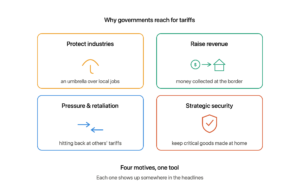
To protect domestic industries. This is the most common reason. By making imported goods more expensive, tariffs help local producers compete against cheaper foreign rivals. A country might use tariffs to protect its steelmakers, farmers, or manufacturers from being undercut by imports, aiming to save domestic jobs. Think of it as holding an umbrella over local factories while it rains cheap imports.
To raise revenue. Tariffs bring money into the government, since the tax is collected at the border. For much of history, tariffs were a major source of government income, and they still raise substantial sums today.
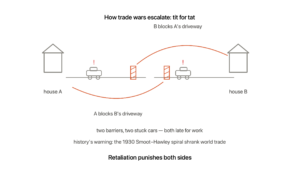
To respond to other countries. Tariffs are sometimes used as a tool of pressure or retaliation — to push another country to change its policies, or to answer tariffs that another country has imposed. This is how trade disputes can escalate into what people call “trade wars.” It works much like a feud between neighbors: you block my driveway, so I block yours — and soon both of us are late for work. The most famous cautionary tale is the Smoot–Hawley Tariff Act of 1930, when steep US tariffs triggered waves of foreign retaliation and world trade collapsed during the Great Depression.
For strategic reasons. A country may want to protect industries it considers essential to national security or long-term independence, ensuring it can produce critical goods domestically rather than relying entirely on foreign suppliers.
Who really pays for a tariff?
This is the heart of the matter, and the answer surprises many people. Although a tariff is aimed at foreign goods, much of its cost is typically paid by people within the country that imposes it.
Follow the chain, step by step, with our $400 washing machine. The foreign factory ships it. At the border, the importer — a domestic company — pays the $100 toll. The importer does not want to swallow that cost, so it passes it to the retailer in a higher wholesale price. The retailer does not want to swallow it either, so the shelf price rises. The cost travels down the line like a hot potato — and it usually lands in the hands of the last person in the chain: the shopper at the checkout. In effect, a tariff often acts like a tax on a country’s own citizens, paid through higher prices on the goods they buy.
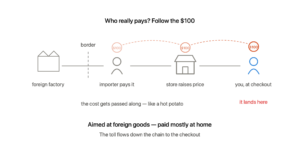
This is why economists frequently describe tariffs as a cost borne substantially at home. The foreign producer may lose some sales, but the immediate, direct cost of the tax lands on domestic importers and consumers. Recent independent analyses of US tariffs have estimated that they amount to an average tax increase of roughly several hundred dollars per household per year, precisely because those costs pass through to the prices people pay.
The current picture in the United States
Tariffs have become an especially prominent and evolving feature of US economic policy in recent years, and the situation as of 2026 illustrates how complex and contested they can be.
The average effective tariff rate in the US has risen substantially, reaching its highest level in decades — an estimated 6.6% in 2026, the highest since the late 1960s. These tariffs have raised large sums for the government, with customs duties bringing in hundreds of billions of dollars.
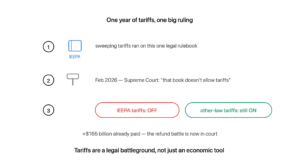
At the same time, the legal and political landscape has been turbulent. On February 20, 2026, the US Supreme Court ruled 6–3 in Learning Resources, Inc. v. Trump that the emergency-powers law known as IEEPA — the legal basis President Donald Trump‘s administration had used to impose its sweeping country-by-country tariffs — does not actually authorize a president to impose tariffs at all. Chief Justice John Roberts, writing for the majority, noted that the Constitution gives the tariff power to Congress alone. Think of it as a referee ruling that one of the game’s biggest plays was run from the wrong rulebook: that play had to stop — the IEEPA tariffs were switched off within days — but the game did not end, because the administration promptly shifted to other legal authorities to keep parts of its tariff policy in place, while courts now sort out whether roughly $165 billion in already-collected duties must be refunded to importers.
The result is a shifting, fragmented mix of tariffs applied to different products and countries, with ongoing legal challenges, negotiations, and adjustments. This live example shows that tariffs are not just an economic tool but a legal and political battleground, constantly in flux.
The honest debate: arguments on both sides
Tariffs are genuinely contested among economists and policymakers, and a fair explanation must present both cases rather than pretend the answer is simple.
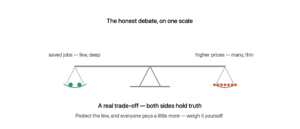
The case for tariffs. Supporters argue that tariffs protect domestic jobs and industries from being wiped out by cheaper foreign competition. They contend that some industries are too important — strategically or for national security — to lose, and that tariffs can pressure other countries into fairer trading arrangements. For communities devastated when factories close, protection can feel not just economic but essential to their survival.
The case against tariffs. Critics argue that tariffs raise prices for consumers, effectively taxing a country’s own citizens, and that they can hurt the broad economy more than they help specific industries. They point out that protected industries can grow less competitive over time without the pressure of competition — like a plant raised in a greenhouse, sheltered from every wind, that struggles the moment it is planted outside. They add that other countries usually retaliate with their own tariffs, harming exporters, and that the overall effect often makes a country poorer, not richer. Many economists lean toward this view, emphasizing the broad costs spread across all consumers.

The truth is that both sides capture something real. Tariffs can genuinely protect specific jobs and industries, while genuinely raising costs for everyone else — the same tension between concentrated benefits and broad costs that runs through the whole story of trade. Reasonable people weigh these trade-offs differently, which is exactly why the debate endures.
Why this matters to you
Tariffs affect you directly, wherever you live, because they influence the prices of the goods you buy. When your country imposes tariffs, or when tariffs are placed on your country’s exports, the effects ripple into shop prices, the health of local industries, and the jobs around you. Understanding tariffs lets you see why certain prices rise and why trade disputes make headlines.
It also equips you to read one of the most heated debates in modern economics with clear eyes. When you hear politicians promising that tariffs will bring back jobs, or economists warning they will raise prices, you now understand that both can be partly true at once. You can weigh the concentrated benefits against the broad costs yourself, rather than accepting either side’s slogans.
Most importantly, tariffs are a perfect example of a theme at the heart of understanding the economy: there are rarely simple answers, only trade-offs. A policy that helps one group can cost another, and wisdom lies in seeing the whole picture. Grasp how tariffs really work — what they are, who pays, and what they trade off — and you hold a genuinely powerful tool for understanding the economic news that shapes your world.
Difficult words, made simple
| Term | Plain-English meaning |
|---|---|
| Tariff | A tax on goods imported into a country |
| Importer | The company that brings foreign goods into a country and pays the tariff |
| Domestic industry | Companies that produce goods within a country |
| Protectionism | Using tools like tariffs to shield local industries from competition |
| Retaliation | When one country answers another’s tariffs with its own |
| Trade war | An escalating cycle of tariffs between countries |
| Customs duties | Another name for taxes collected on imported goods |
| IEEPA | A US emergency-powers law at the center of the 2026 Supreme Court tariff ruling |
The big takeaway
A tariff is a tax on imported goods, paid at the border by the domestic importer — not directly by the foreign producer. Governments use tariffs to protect local industries, raise revenue, pressure other countries, and safeguard strategic sectors. But the crucial insight is that much of a tariff’s cost is typically paid at home, flowing through to consumers as higher prices, which is why tariffs are often described as a tax on a country’s own citizens.
Tariffs are genuinely debated: they can protect specific jobs and industries while raising costs for everyone else, embodying the same tension between concentrated benefits and broad costs that runs through all of trade. The current use of tariffs in the US — rising rates, a landmark Supreme Court ruling, and a rapid shift to new legal footings — shows how economically and politically charged they remain. Understanding what tariffs are, who really pays, and what they trade off gives you a clear-eyed way to read one of the defining economic debates of our time.
Sources
US tariff figures, including the 2026 average effective tariff rate and household cost estimates, are drawn from public reporting and independent analyses such as the Tax Foundation, the Yale Budget Lab, and the Penn Wharton Budget Model as of 2026. Details of the Supreme Court’s February 2026 decision in Learning Resources, Inc. v. Trump are drawn from the Court’s published opinion and public legal analyses. This article presents the widely discussed arguments on tariffs and remains politically neutral. It is general educational information, not financial advice.
Related reading: International Trade Explained.
Growmmunity publishes explanations, not financial advice.