
International Trade Explained: Why Countries Buy and Sell to Each Other
International trade shapes almost everything in the modern world, from the phone in your pocket to the coffee in your cup to the clothes you are wearing right now. Nearly all of it involves goods that crossed borders, made from materials sourced across multiple countries. Yet the basic question underneath it all is rarely explained clearly: why do countries trade with each other at all, and is it actually good for them?
Today we will answer that question from the ground up. We will explain why trade exists, the surprising logic that makes it beneficial even in unexpected cases, who wins and who loses, and why trade is both one of the great engines of human prosperity and one of the most fiercely debated topics in economics. As always, we keep everything grounded in simple examples.
Why countries trade at all
At its simplest, international trade happens for the same reason you do not grow your own food, sew your own clothes, and build your own phone. It would be wildly inefficient. Instead, you do your job, earn money, and buy those things from others who make them well. Countries do exactly the same thing on a grand scale.
No country can produce everything it needs efficiently. Some nations have oil; others have none. Some have vast farmland; others have little. Some have huge skilled workforces or advanced technology; others specialize in different strengths. Trade lets each country focus on what it does best and swap for the rest, so everyone ends up with more than they could produce alone.

Think of it like a neighborhood where one person is a skilled baker and another a skilled mechanic. Rather than each struggling to do both jobs badly, the baker bakes, the mechanic fixes cars, and they trade. Both end up better fed and better transported than if they had tried to do everything themselves. Trade between countries follows the very same logic.
The powerful idea of comparative advantage
Here is where economics reveals something genuinely surprising — an idea that seems almost counterintuitive until you see it clearly. Countries benefit from trade even when one of them is better at producing everything. This is the principle of comparative advantage, and it is one of the most important ideas in all of economics.
Let us make it concrete. Imagine a brilliant surgeon who is also, as it happens, the fastest typist in town. Should the surgeon do their own typing? No — because every hour spent typing is an hour not spent doing surgery, which is far more valuable. It makes sense for the surgeon to focus entirely on surgery and hire an assistant to type, even if the assistant is slower. Both are better off: the surgeon earns more doing what is most valuable, and the assistant has a job.

Countries work the same way. Even if one country could produce both cars and clothing more efficiently than another, it still benefits by focusing on whatever it does relatively best — say, cars — and letting the other country make the clothing. By each specializing where their advantage is greatest, both countries end up with more overall. This is why trade can benefit both sides even when they are far from equal. It is not about being the best at everything; it is about focusing where your edge is largest.

The benefits trade brings
When countries trade freely, several powerful benefits tend to follow, which is why trade has expanded so dramatically over the past century.

Lower prices. Trade lets goods be produced wherever it is cheapest and most efficient, which lowers prices for consumers. Much of the affordability of modern goods, from electronics to clothing, flows from global trade.
More variety. Trade brings you products from around the world you could never get otherwise — foreign foods, foreign technology, foreign everything. The astonishing variety in a modern store is a gift of trade.
Greater efficiency. By letting each country specialize in its strengths, trade makes the whole world’s production more efficient, creating more total wealth than isolated economies could.
Competition and innovation. Exposure to global competition pushes companies to improve, innovate, and keep prices down, rather than growing lazy behind protected borders.
Who loses from trade
If trade were purely beneficial for everyone, it would not be so controversial. The honest truth is that while trade tends to benefit a country overall, it creates real losers alongside the winners — and this is the heart of the trade debate.
When a country starts importing cheaper goods from abroad, domestic industries that made those goods can suffer. Factories may close, and workers in those industries can lose their jobs, because they cannot compete with cheaper foreign production. For those workers and communities, trade is not an abstract benefit — it is a genuine loss, sometimes a devastating one.
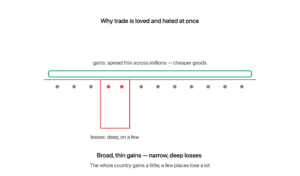
Here lies the central tension. Trade can make a country richer as a whole, with cheaper goods and greater efficiency spread across millions of consumers, while concentrating painful losses on specific industries and regions. The gains are broad but thin; the losses are narrow but deep. Managing this imbalance — helping those who lose while preserving the broad benefits — is one of the great challenges of economic policy, and one that stirs intense political debate.
Exports, imports, and the trade balance
A few key terms help you read trade news with confidence. Exports are goods a country sells to others. Imports are goods it buys from others. The difference between them is the trade balance.

When a country exports more than it imports, it has a trade surplus. When it imports more than it exports, it has a trade deficit. You will often hear these terms discussed as though a surplus is always good and a deficit always bad, but the reality is more nuanced. A trade deficit is not automatically harmful — it can reflect a strong economy whose consumers are wealthy enough to buy lots of goods from abroad. Reading the trade balance wisely means resisting the simple assumption that surpluses are victories and deficits are defeats.

Why this matters to you
International trade touches your life constantly, usually invisibly. The affordability and variety of what you buy owe an enormous amount to trade. The prices in your shops, the range of products available to you, and even the jobs in your region are all shaped by how your country participates in global trade.
Understanding trade also helps you make sense of some of the most heated debates in the news. When politicians argue about protecting industries, when factories close, when countries clash over imports and exports, the underlying story is the tension we explored: broad benefits set against concentrated losses. Knowing this lets you see past slogans to the real trade-offs involved.
Most of all, trade reveals the profound interconnectedness of our world. The simple act of buying an everyday object connects you to workers, resources, and companies across dozens of countries. Once you understand why nations trade and what it costs and gives, you see the hidden threads linking your daily life to the entire globe — and you understand one of the deepest engines of both prosperity and controversy in the modern economy.
Difficult words, made simple
| Term | Plain-English meaning |
|---|---|
| International trade | Countries buying and selling goods and services to each other |
| Comparative advantage | Focusing on what you do relatively best, even if not best at all |
| Specialization | Concentrating on producing what you are most efficient at |
| Exports | Goods a country sells to other countries |
| Imports | Goods a country buys from other countries |
| Trade balance | The difference between a country’s exports and imports |
| Trade deficit | When a country imports more than it exports |
The big takeaway
International trade exists because no country can produce everything efficiently, so nations specialize in their strengths and swap for the rest — ending up with more than they could alone. The surprising principle of comparative advantage shows that trade benefits both sides even when one is better at producing everything, because what matters is focusing where your edge is greatest. The result is lower prices, more variety, greater efficiency, and stronger innovation.
But trade is not painless. While it enriches a country overall, it concentrates real losses on specific industries and workers, creating a tension between broad, thin gains and narrow, deep losses that sits at the heart of every trade debate. Understanding this balance — the immense benefits alongside the genuine costs — lets you see both why trade has lifted global prosperity and why it remains so fiercely contested. It is one of the great forces weaving your daily life into the fabric of the entire world.
Sources
This article explains standard economic principles of international trade, including comparative advantage. It is general educational information, not financial advice.
Related reading: Supply and Demand and Exchange Rates Explained.
Growmmunity publishes explanations, not financial advice.