
Supply Chains Explained: The Invisible Journey Behind Everything You Buy
Supply chains are the hidden networks that bring almost every object in your life to you, yet most people never think about them until they break. The phone in your hand, the coffee in your cup, the clothes you are wearing — each one completed an extraordinary journey across multiple countries, companies, and continents before reaching you. When these networks work, they are invisible. When they fail, as the world dramatically learned in recent years, empty shelves and rising prices remind everyone just how much depends on them.
Today we will explain what a supply chain actually is, trace a simple example from start to finish, explore why these networks became so global and so fragile, and understand why a disruption on one side of the world can empty shelves and raise prices on the other. As always, we build everything from clear, everyday examples.
What a supply chain actually is
A supply chain is the entire journey a product takes, from raw materials to the finished item in your hands. It is the full sequence of steps — extracting, making, moving, and selling — that turns basic ingredients into something you can buy.
Think of the word literally: a chain, made of links. Each link is a step in the journey, and each depends on the one before it. Raw materials are gathered, turned into parts, assembled into products, shipped across the world, and finally sold in a store or delivered to your door. Every link must hold for the product to reach you.

This connects directly to the trade and specialization we explored in International Trade Explained. Because different countries specialize in different things, a modern supply chain often stretches across many nations, each contributing the piece it makes best.
Following a simple example: a loaf of bread
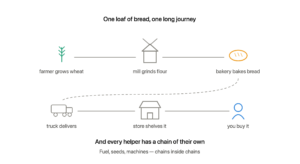
Let us trace something ordinary to see how many links a supply chain contains. Consider a loaf of bread on a supermarket shelf.
It begins with a farmer growing wheat, using seeds, fertilizer, machinery, and fuel — each of which has its own supply chain. The wheat is harvested and sold to a mill, which grinds it into flour. The flour is transported to a bakery or factory, where it is combined with other ingredients — yeast, salt, water, each arriving through its own chain — and baked into bread. The bread is then packaged, loaded onto trucks, delivered to a store, stocked on shelves, and finally sold to you.
That is a simplified version, and already it involves farmers, millers, bakers, packagers, truckers, and retailers, plus everyone supplying their fuel, machinery, and materials. Now imagine the supply chain for something truly complex, like a smartphone, which contains parts from dozens of countries — and you begin to grasp the staggering, invisible web behind modern life.
Why supply chains went global
Supply chains were not always so international. For much of history, goods were made close to where they were sold. Over recent decades, they stretched across the world for powerful reasons rooted in the economics we have already covered.
Cost. Companies moved production to wherever each step could be done most cheaply and efficiently. Making a product might mean sourcing materials from one country, parts from another, and assembly in a third, because that combination costs the least.
Specialization. As we saw with comparative advantage, countries and regions became expert at particular things — one place at growing coffee, another at making microchips, another at assembling electronics. Global supply chains let companies tap the best of each.
Efficiency. Advances in shipping, especially the humble shipping container, and in communication made moving goods and coordinating across the world astonishingly cheap and fast. This allowed chains to spread ever wider in pursuit of savings.

The result was a global system of remarkable efficiency that helped keep prices low for decades. But that efficiency came with a hidden cost: fragility.
Why efficiency made supply chains fragile
Here is the crucial trade-off at the heart of modern supply chains. In the relentless pursuit of low costs, companies made their chains extremely efficient — but efficiency and resilience often pull in opposite directions.
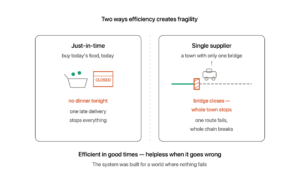
Many companies adopted what is called “just-in-time” production, keeping almost no spare inventory and having parts arrive exactly when needed, not before. This saves the cost of storing extra stock. Think of a kitchen that buys today’s ingredients today, every day: no waste, no crowded pantry — but if the store closes for one morning, there is no dinner tonight. That is just-in-time. It means there is no cushion. If one delivery is late, production stops immediately, because there is no reserve to fall back on.
Chains also became long and tightly linked, often depending on a single supplier or a single route for a critical part. Relying on one supplier is like a town with only one bridge: perfectly fine, until the day the bridge closes. This was cheap and efficient in good times. But it created hidden vulnerabilities: if that one supplier or route failed, the whole chain could break. The system was optimized for a world where nothing goes wrong — and the world does not always cooperate.
When the chain breaks: the ripple effect
Because each link depends on the ones before it, a problem at any point ripples down the entire chain, like a line of dominoes: tip one over on the far side of the world, and the last domino falls in your local store. This is why a disruption in one place can cause shortages and price rises far away.
The world saw this vividly during the global pandemic and the disruptions that followed. Factories closed in one country, and products went missing from shelves on the other side of the planet. A shortage of tiny computer chips halted production of cars, forcing factories to sit idle and sending car prices soaring. Ports became clogged — a classic bottleneck — ships waited for weeks, and the cost of shipping a container multiplied. And in 2021, a single enormous vessel, the Ever Given, ran aground in the Suez Canal and blocked one of the world’s busiest trade routes, disrupting global commerce for days.
Each of these was a broken link, and each rippled outward. The lesson was unmistakable: in a tightly connected global system, a problem anywhere can become a problem everywhere. The very efficiency that kept prices low had also made the system brittle.

How supply chains connect to inflation
Supply chain disruptions tie directly back to Inflation Explained. When supply chains break, fewer goods reach the market, and as we know from supply and demand, scarcer goods mean higher prices.

The inflation surge of recent years was, in large part, a supply chain story. Disrupted chains meant products were harder to make and move, so supply fell just as demand recovered. Too much money chasing too few goods pushed prices up sharply. Understanding supply chains, then, is understanding one of the deepest engines behind the prices you pay.
How the world is responding
Having learned how fragile their chains were, companies and countries began rethinking the pure pursuit of efficiency. Several shifts are underway, and they reveal the new priorities.
Many companies are building in more resilience — holding larger inventories as a cushion, or using several suppliers instead of relying on just one, so a single failure cannot break the chain. Extra inventory works like a spare tire: dead weight on most trips, priceless on the day of a flat. This costs more but reduces risk. Some are bringing production closer to home, a trend sometimes called “reshoring,” to shorten chains and reduce dependence on distant suppliers. Others are diversifying across more countries so they are not overly reliant on any single one.

The common thread is a rebalancing — trading a little of the old efficiency for greater security. It is a live example of a theme running through economics: there is rarely a perfect answer, only trade-offs between competing goods like cost and resilience.
Why this matters to you
Supply chains shape your life far more than their invisibility suggests. They determine whether the products you want are available and affordable. When they work smoothly, you enjoy an astonishing abundance of goods from around the world at low prices. When they break, you feel it directly through empty shelves, longer waits, and higher costs.
Understanding supply chains also helps you read the news with far more insight. When you hear about chip shortages, port congestion, factory closures, or shipping disruptions, you now understand these are broken links that will ripple outward into the prices and availability of everyday things. You can see the connection between a distant disruption and the cost of your next car, phone, or grocery run.
Most of all, supply chains reveal the breathtaking interconnectedness of the modern world. The simple act of buying almost anything links you to a vast, invisible web of people, places, and processes spanning the globe. Once you see that web, you never look at an ordinary object quite the same way again — and you understand one of the most powerful, hidden forces shaping the economy and your daily life.
Difficult words, made simple
| Term | Plain-English meaning |
|---|---|
| Supply chain | The full journey of a product from raw materials to your hands |
| Link | A single step in the supply chain, like making or shipping a part |
| Just-in-time | Keeping little spare stock, with parts arriving exactly when needed |
| Resilience | A chain’s ability to keep working when something goes wrong |
| Reshoring | Bringing production back closer to home |
| Diversifying | Spreading reliance across many suppliers or countries |
| Bottleneck | A narrow point where the flow of goods gets stuck |
The big takeaway
A supply chain is the invisible journey every product takes from raw materials to your hands, made of links that each depend on the one before. Over decades, these chains stretched across the world in pursuit of low costs, specialization, and efficiency — a system that kept prices low but grew fragile, with little cushion when something went wrong.
When a link breaks, the disruption ripples down the whole chain, causing shortages and higher prices far from the original problem, as the world learned dramatically in recent years. Now companies are trading a little efficiency for more resilience. Understanding supply chains reveals the hidden web behind everything you buy — and one of the most powerful forces quietly shaping prices, availability, and the deeply connected world we all live in.
Sources
This article explains standard principles of how supply chains work, drawing on widely reported events of recent years, including the 2021 Suez Canal obstruction and the global chip shortage. It is general educational information, not financial advice.
Related reading: International Trade Explained and Inflation Explained.
Growmmunity publishes explanations, not financial advice.