
Emerging Markets Explained: The Fast-Growing Economies Shaping the Future
Emerging markets are among the most important and least understood parts of the global economy. These are the fast-growing, still-developing economies — places like India, Brazil, Indonesia, and many others — that are home to most of the world’s people and much of its future growth. They offer enormous opportunity and enormous risk in equal measure, and understanding them is essential to grasping where the global economy is heading.
Today we will explain what an emerging market actually is, why these economies grow so fast yet swing so wildly, why they are so sensitive to decisions made in places like Washington, and why they matter to the entire world — including you, wherever you live. As always, we build everything from clear examples.
What an emerging market actually is
An emerging market is a country whose economy is developing rapidly but has not yet reached the wealth and stability of the most advanced nations. It sits in the middle of a spectrum — no longer poor and undeveloped, but not yet as rich and settled as countries like the United States, Germany, or Japan.
Think of it as an economy in its energetic, growing years. Advanced economies are like established adults — wealthy, stable, but growing slowly. The least developed economies are just starting out. Emerging markets are in between: growing fast, full of potential, but still maturing, and sometimes unsteady on their feet.
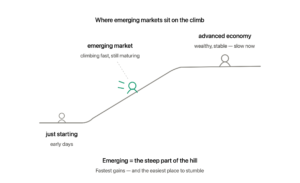
Countries commonly described as emerging markets include large, dynamic economies across Asia, Latin America, Africa, the Middle East, and Eastern Europe. Together they represent the majority of the world’s population and a rapidly rising share of its economic activity.
Why emerging markets grow so fast
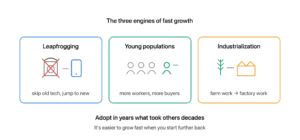
The defining feature of emerging markets is rapid growth. As we saw in GDP Explained, while advanced economies might grow around 2% a year, emerging markets can grow much faster. Several forces drive this.
Catching up. It is often easier to grow quickly when starting from a lower base. Emerging economies can adopt technologies, methods, and ideas that advanced countries spent decades developing, leapfrogging ahead rather than inventing everything from scratch. A country can jump straight to mobile phones without ever building extensive landline networks, for example.
Young, growing populations. Many emerging markets have large numbers of young people entering the workforce. More workers and more consumers naturally fuel economic growth, giving these countries a demographic engine that older, advanced economies lack.
Industrialization and urbanization. As emerging economies shift from farming toward factories, services, and cities, productivity rises. Millions of people moving into more productive work is a powerful driver of rapid growth.
This fast growth is what makes emerging markets so exciting. It is also, as we will see, tied to what makes them so risky.
Why emerging markets are so volatile
The flip side of high growth is high volatility. Emerging markets can rise dramatically, but they can also fall hard and fast. Understanding why reveals a great deal about how the global economy works.
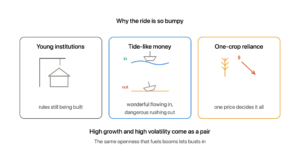
Less stability and maturity. Emerging economies often have younger institutions, less developed financial systems, and sometimes more political uncertainty. This makes them more prone to sudden swings than settled, advanced economies.
Dependence on foreign money. Emerging markets often rely heavily on investment flowing in from abroad to fund their growth. This foreign money behaves like the tide: as it flows in, it lifts every boat in the harbor — and when it rushes out, it can leave them stranded on the sand. Wonderful on the way in, dangerous on the way out, because it can leave quickly at the first sign of trouble.
Reliance on commodities. Many emerging economies depend heavily on selling raw materials — oil, metals, crops. It is like a farm that grows only one crop: in years when the price is high, there is a feast; when the price collapses, there is nothing to fall back on. When global prices are high, these economies boom. When prices crash, they can suffer badly, since so much depends on a few exports.
Why they are so sensitive to the Fed
Here is one of the most important things to understand about emerging markets, and it ties directly back to Why Fed Decisions Move the Whole World. Emerging markets are extraordinarily sensitive to decisions made by the US Federal Reserve.
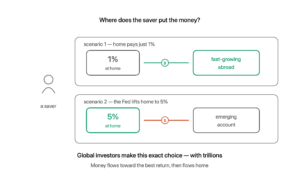
Recall the core mechanism: money flows toward the best returns. Picture a saver with two choices: a safe home account paying 1%, or an exciting faraway account that is growing fast. At 1% at home, the choice is easy — the money goes abroad chasing better returns. But the moment the home account starts paying 5%, the same saver quietly moves the money back to safety. Global investors make exactly this choice, with trillions.
So when US interest rates are low, money floods into fast-growing emerging markets, fueling their booms. But when the Fed raises rates, US investments become more attractive, and money rushes back out of emerging markets toward the safer United States.
This sudden outflow can be devastating. As money leaves, an emerging market’s currency weakens, its borrowing costs rise, and if it owes debts in dollars, those debts become much harder to repay. A decision made in Washington can trigger a crisis thousands of miles away. This is why investors and governments in emerging markets watch the Fed even more nervously than people in advanced economies do.
The history of booms and busts
This pattern of money rushing in and then out has produced dramatic cycles throughout modern history. Emerging markets have experienced spectacular booms followed by painful crises, often driven by exactly the flows we have described.
In past decades, waves of foreign money flooded into emerging economies during good times, fueling rapid growth and rising markets. Then, when global conditions shifted — often when US rates rose or confidence fell — the money fled, triggering currency collapses, debt crises, and deep recessions in the affected countries. The 1997 Asian financial crisis, which devastated several fast-growing economies, is a classic example of this boom-and-bust rhythm.
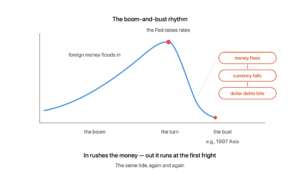
These cycles are not a thing of the past. The same fundamental dynamic — the powerful, fickle flow of global money toward and away from emerging markets — continues to shape their fortunes today, which is part of why they remain both promising and perilous.
The opportunity and the risk
Emerging markets present one of the clearest risk-return trade-offs in the entire global economy, echoing what we learned in Risk and Return.
The opportunity is immense. These are the fastest-growing economies, home to rising middle classes, expanding industries, and much of the world’s future demand. For decades to come, a large share of global growth is expected to come from emerging markets, making them central to the world’s economic future.
The risk is equally real. Their volatility, sensitivity to foreign money, political uncertainties, and vulnerability to global shocks mean they can deliver sharp losses as well as spectacular gains. Higher potential returns come, as always, with higher risk. This is the fundamental bargain of emerging markets, and it captures in miniature the core logic of investing itself.

Why this matters to you
Emerging markets matter to everyone, wherever they live. They are increasingly the engine of global growth, so their health affects the entire world economy — including the demand for goods, the prices of commodities, and the direction of global markets. When emerging markets boom, they lift the world; when they stumble, the effects ripple outward.
They also shape the products and prices around you. Much of what the world manufactures happens in emerging economies, so their stability influences the cost and availability of goods everywhere. And their growing populations of consumers are becoming some of the most important markets for companies worldwide.
Understanding emerging markets completes a crucial part of the global economic picture. You now see not just the advanced economies at the center, but the fast-growing, dynamic, sometimes turbulent economies rising around them — deeply connected to the decisions of the Fed, the flows of global money, and the prices of commodities. Grasping how they work reveals where much of the world’s economic future is being written, and why the fortunes of distant, fast-growing nations are woven into the fabric of the entire global economy.
Difficult words, made simple
| Term | Plain-English meaning |
|---|---|
| Emerging market | A fast-growing, still-developing economy, between poor and advanced |
| Advanced economy | A wealthy, stable, slower-growing country like the US or Japan |
| Volatility | How sharply and quickly an economy or market swings |
| Capital flows | Money moving between countries seeking returns |
| Commodities | Raw materials like oil, metals, and crops |
| Leapfrogging | Skipping older technology to jump straight to newer methods |
| Demographics | The makeup of a population, such as how young or old it is |
The big takeaway
Emerging markets are the world’s fast-growing, still-developing economies — home to most of humanity and much of its future growth. They grow quickly by catching up to advanced economies, harnessing young populations, and industrializing, which makes them full of opportunity. But that same dynamism brings volatility: they are less stable, dependent on foreign money, often reliant on commodities, and extraordinarily sensitive to the decisions of the US Federal Reserve.
The result is a powerful pattern of booms and busts, as global money rushes in during good times and flees at the first sign of trouble. Emerging markets embody the risk-return trade-off at the heart of economics — enormous potential paired with genuine danger. Understanding them reveals where much of the world’s economic future is unfolding, and how deeply the fortunes of fast-growing distant nations are woven into the global economy that shapes us all.
Sources
This article explains standard principles of emerging market economies, drawing on widely documented historical episodes including the 1997 Asian financial crisis. It is general educational information, not financial advice.
Related reading: Why Fed Decisions Move the Whole World and Risk and Return.
Growmmunity publishes explanations, not financial advice.