
Tariffs Explained: How They Came Back Even After a Court Said No
In 2026, the US Supreme Court ruled that a set of tariffs were unlawful and had to stop. Yet within months, those tariffs were back — rebuilt in a new form that analysts say is even harder to challenge. To understand why this matters, and how it affects prices around the world, let’s start from the very beginning.
First, What Is a Tariff?
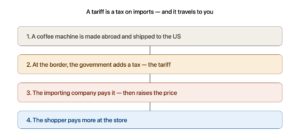
A tariff is simply a tax on goods coming into a country from abroad.
Imagine a coffee machine made in another country and shipped to the US to be sold. When it arrives at the US border, the government adds a tax on top of its price. That tax is the tariff.
Here’s the part people often miss: the company importing the coffee machine pays that tax first — but it usually doesn’t swallow the cost. Instead, it raises the machine’s price so the shopper covers it. So although tariffs target foreign goods, the person who often ends up paying is the everyday consumer at the store. That’s why economists frequently call tariffs “a tax on consumers.”
How It All Started: Trump’s Original Tariffs
When Trump returned to the presidency, one of his first major moves was to impose a large wave of tariffs on goods coming in from many countries around the world. The goal was to make foreign products more expensive in the US market, encouraging Americans to buy domestically made goods instead — and to pressure trading partners into renegotiating trade terms.
To do this quickly, Trump used something called “emergency economic powers” — a special authority that allows a US president to take fast action when there is a declared national economic emergency. Think of it like a presidential shortcut: instead of going through the usual long process of trade negotiations or congressional approval, the president can act almost immediately by declaring an emergency.
Using this shortcut, Trump imposed sweeping tariffs on dozens of trading partners in a short period of time. It was fast, broad, and controversial — and it drew immediate legal challenges from businesses hurt by the rising costs.
Why the Supreme Court Said No
The core question the Supreme Court had to answer was simple: did the president actually have the right to use “emergency powers” this way?
The answer, in February 2026, was no — and here’s why, explained plainly.
The emergency powers law was written to handle genuine national crises — sudden, unexpected threats to the economy, like a foreign attack or a financial collapse. Think of it like a fire extinguisher: it’s there for real fires, not for remodeling the kitchen.
The court found that Trump had stretched this tool far beyond its intended purpose. Using “emergency powers” to broadly reshape trade policy with dozens of countries — not as a short-term response to a sudden crisis, but as a long-term strategy — went beyond what the law was designed to allow. In legal terms, the president had exceeded his authority.
The ruling didn’t say tariffs themselves were wrong. It said this particular method of imposing them was unlawful. That distinction matters, because it left open the possibility of doing the same thing through different legal channels — which is exactly what happened next.
Blocked by One Road, the Administration Took Two Others
Think of it like a road with a checkpoint. The Supreme Court closed one road — the “emergency powers” shortcut. But there were other roads to the same destination, and the administration simply took them.
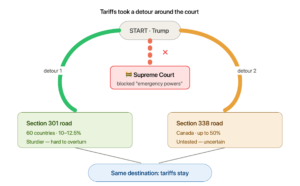
Specifically, Trump turned to two different laws:
- Section 301 of the Trade Act of 1974 — used to place new tariffs of 10% to 12.5% on goods from 60 economies, following official investigations into forced-labor concerns. Analysts say this route is sturdier: courts have allowed Section 301 before, so it is less likely to be overturned.
- Section 338 of the Tariff Act of 1930 — a rarely used, “untested” law, applied to hit many Canadian goods with tariffs as high as 50%. One analyst called this an “uncertainty generator” — essentially using tariffs as punishment for a specific grievance.
The takeaway from experts is blunt: these moves show that the president’s tariffs “are not going away as long as he is in the White House.”
Not One Flat Number — It Depends on the Country
A common misunderstanding is that “a tariff” is a single rate applied to everyone equally. In reality, the rate varies enormously depending on the country and the law used.
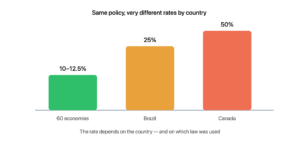
Under this round: 60 economies face roughly 10–12.5%, Brazilian products were hit with 25%, and many Canadian goods face up to 50%. Same overall policy, very different rates.
A Simple Way to Picture It
Imagine a nightclub with different cover charges at the door. Regulars pay a small fee, some guests pay more, and one particular group is charged a steep price because the owner has a specific complaint with them. The “rules” are the same club, but what you actually pay depends on who you are and what the owner thinks of you. Tariffs work similarly — the rate you face depends on your country and the specific reason the tariff was imposed.
Why Tariffs Are So Hard to Undo
You might assume a future leader could simply cancel these tariffs. In practice, it’s much harder — and here’s an everyday way to understand why.
Think about a streaming service that raises its monthly price. At first you notice and grumble. But after a year, that higher price feels normal, and the company has come to rely on that extra revenue. Rolling it back would mean giving up money it now depends on — so it rarely happens.
Governments face the same pull. Once tariffs bring in revenue, that money gets built into the budget. Removing it means giving up income the government has grown used to. This is exactly why, after Trump’s first term, his successor Joe Biden — from the opposing party — kept the China tariffs in place rather than scrapping them. Once tariffs settle in, they tend to stay.
Winners and Losers: Who Gains and Who Pays
Tariffs never affect everyone equally. They create clear winners and losers.
| Who Tends to Benefit | Who Tends to Pay |
|---|---|
| Domestic producers whose foreign rivals become pricier | Consumers, who face higher prices at the store |
| The government, which collects the tariff revenue | Importing companies caught between costs and customers |
| Industries the tariffs are designed to protect | Targeted countries like Brazil (25%) and Canada (50%) |
The Two-Front Squeeze on Other Countries
There’s an added difficulty for trading partners. One expert described countries as fighting a “two-front trade war” — dealing with US tariffs on one side and China’s export restrictions (such as limits on rare-earth materials) on the other. Instead of focusing on a single challenge, many nations must now manage pressure from two directions at once.
Yet despite their frustration, these countries have shown no signs of retaliating. Why? Because striking back with their own tariffs would risk triggering even higher US tariffs in response — a fight most would rather avoid. It is a bit like being overcharged by a powerful landlord: you may be unhappy, but openly picking a fight could leave you worse off.
Why This Matters to You — Wherever You Live
Even if you are not American, tariffs shape the prices you see. If a country you buy products from faces higher US tariffs, global supply chains shift in ways that can reach your shelves too. And the bigger principle is universal: when governments tax trade, the cost usually travels down the chain until it lands on ordinary shoppers.
The deeper lesson here is not about one president or one country. It is that big policy decisions are rarely stopped by a single ruling — they adapt, find new paths, and settle into the prices we all pay, quietly and durably.
Difficult Words, Made Simple
| Term | Plain-English Meaning |
|---|---|
| Tariff | A tax on goods imported from another country |
| Emergency economic powers | A legal shortcut letting a president act fast during a declared national crisis |
| Section 301 / 338 | Different US laws that allow tariffs through normal legal channels |
| “Untested” law | A rarely used law whose limits courts have not clearly defined |
| Trading partner | A country that regularly buys from and sells to another |
| Retaliation | When a country hits back with its own tariffs in response |
| Rare-earth materials | Special minerals vital for electronics, which China largely controls |
The Big Takeaway
Trump’s original tariffs were blocked because the legal shortcut he used — emergency powers — was stretched beyond its intended purpose. But the administration adapted, switching to other laws that analysts expect to hold up better in court. The tariff wall is back, in a sturdier form.
And underneath the political headlines sits a simple truth worth remembering: a tariff is a tax, and taxes on trade tend to travel — quietly, steadily — all the way down to the price you pay at the store. At Growmmunity, that is what we care about most: not the politics, but how a distant policy decision reaches your everyday life.
Source
This article is based on reporting by Beiyi Seow for AFP, published on Yahoo Finance UK. Read the original report here: Trump tariff wall set to stay after Supreme Court blow: analysts.
All figures come from that reporting. The coffee machine, nightclub, landlord, and streaming-service scenarios are simplified illustrations created to explain the concepts. This is general information, not financial or political advice. Growmmunity presents economic explanations without endorsing any political position.
Growmmunity publishes explanations, not financial advice.