
A Guaranteed 8% Raise That Almost Nobody Takes
Here’s a puzzle. In the United States, there’s a way to make your government retirement check grow by a guaranteed 8% every year — backed by the federal government, with no risk. And yet only about 4 out of every 100 retirees actually take it.
Why would people walk away from free, guaranteed money? The answer is one of the most revealing lessons in all of personal finance, and it applies far beyond the US. Let’s break it down from the very beginning.
First, What Is Social Security?
Social Security is a monthly check the US government pays to retired people. You pay into it through taxes during your working years, and once you retire, it pays you back a monthly income for the rest of your life.
Here’s the key part that confuses most people: you get to choose when to start receiving it, and that choice changes how big every future check will be — permanently.
- Start at 62 (the earliest age) → you get a smaller monthly check, but it begins right away.
- Start at 67 (the “full retirement age”) → you get the standard amount.
- Start at 70 (the latest that pays extra) → you get a much larger monthly check, but it begins later.
There’s no rule forcing you to stop working or to skip payments. The decision is entirely yours: take a smaller check now, or wait for a bigger one later.
The 8% Deal, Explained Simply
For every year you wait past your full retirement age (up to 70), your monthly benefit grows by about 8%. For someone whose full retirement age is 67, waiting until 70 makes the check roughly 24% larger — for life.
And it compounds. Each year the government also adds a cost-of-living adjustment (it was 2.8% in 2026) to keep up with inflation. Because that adjustment is calculated on a bigger base, waiting makes every future raise bigger too. On paper, waiting looks like an incredible deal.
So Why Do 96% of People Not Wait?
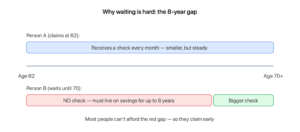
Because there’s a catch that the “8%” number hides: to wait until 70, you have to survive up to eight years with no Social Security check at all.
You could start collecting at 62. If you choose to wait until 70 instead, that’s eight years (62 to 70) where the government sends you nothing — but your rent, food, and bills don’t stop. You have to cover all of it yourself, from savings, a job, a pension, or a working spouse.
The average American household spends about $78,535 per year. Eight years of that gap is a huge amount to bridge. And most people simply don’t have the savings to do it — the personal savings rate has fallen to just 2.8%.
Meet Two People Making the Choice
Let’s make this concrete with two simple, imagined examples.
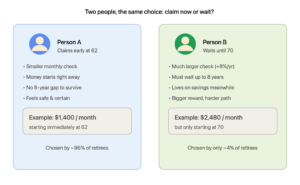
Person A — claims early at 62
Person A reaches 62 with modest savings and doesn’t feel secure enough to go years without income. So they claim right away. Their check is smaller — say, around $1,400 a month in this example — but it starts immediately. They never have to face a scary gap with no income. For them, “a smaller check I can count on today” beats “a bigger check I have to survive eight years to unlock.”
Person B — waits until 70
Person B has a paid-off home, a healthy savings cushion, and perhaps a spouse still working. They can afford to live without a Social Security check from 62 to 70. So they wait. When their check finally begins at 70, it’s dramatically larger — around $2,480 a month in this example — and it stays that high for the rest of their life, growing with every future adjustment.
Notice the difference. Both people are being reasonable. Person A isn’t foolish, and Person B isn’t simply “smarter.” The gap between them isn’t intelligence — it’s resources. Person B could afford to wait. Person A couldn’t. That single difference explains almost the entire 4% vs 96% split.
How People Actually Do the Math
The decision usually comes down to two honest questions:
- “Do I have enough saved to live for up to 8 years without this check?” If no, waiting isn’t really an option — you claim early out of necessity.
- “How long do I expect to live?” Waiting only pays off if you live long enough to collect those bigger checks for many years. Someone in poor health may rationally prefer money now.
There’s also a feelings factor. In mid-2026, US consumer confidence hit a historic low (an index reading of 49.5). When people feel uncertain about the economy — or about the program itself — a check they can hold today feels far safer than a promise that requires eight more years of careful planning to unlock.
The Lesson That Applies to Everyone, Everywhere
You may not be American, and you may never touch US Social Security. But this story captures something universal about money and human behavior.
Again and again, we face a version of the same choice: a smaller reward now, or a bigger reward if we can wait. Waiting almost always pays more on paper — a savings account left untouched, an investment held for years, a pension started later. But waiting requires one thing many people don’t have: the ability to get through the gap in between.
The real insight here isn’t “always wait for the bigger reward.” It’s this: the best financial choice on paper is only available to people who can afford to make it. Building a savings cushion isn’t just about the money itself — it’s about buying yourself the freedom to choose the better option when the time comes.
Difficult Words, Made Simple
| Term | Plain-English Meaning |
|---|---|
| Social Security | A monthly check the US government pays to retirees for life |
| Full retirement age | The age (around 67) at which you get your standard benefit |
| Delayed retirement credit | The ~8% yearly boost for waiting past full retirement age |
| Cost-of-living adjustment (COLA) | A yearly raise added to keep up with inflation |
| Savings rate | The share of income people set aside instead of spending |
| Bridging the gap | Covering living costs during years with no benefit check |
The Big Takeaway
Waiting until 70 to claim Social Security offers a guaranteed 8% yearly boost — a deal that looks unbeatable on paper. Yet only 4% of retirees take it, not because they don’t understand the math, but because bridging eight years without a check is a luxury most households can’t afford.
The number to remember isn’t 8%. It’s the quiet truth underneath it: the smartest financial moves tend to reward those who already have a cushion — which is exactly why building one, wherever you live, is so worth it.
Source
This article is based on reporting by David Beren for 24/7 Wall St., published on Yahoo Finance. Read the original report here: Waiting on Social Security Pays a Guaranteed 8% a Year. Only 4% of Retirees Ever Collect the Age-70 Check.
All figures come from that report. Person A and Person B, and the dollar amounts used for them, are simplified illustrations created to explain the concept — actual benefit amounts vary by individual earnings history. This is general information, not financial advice. For decisions about your own retirement, consult a qualified professional.
Growmmunity publishes explanations, not financial advice.