
Japan AI Adoption: Why the Country That Needs It Most Is Using It the Least
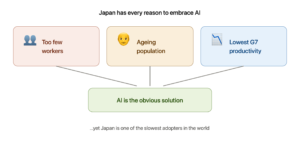
Japan AI adoption is one of the most striking paradoxes in the global economy right now. Japan is a country running short on workers, dealing with a rapidly ageing population, and sitting at the bottom of the G7 for workplace productivity. If any country needs artificial intelligence to fill the gap, it’s Japan. And yet, compared to the US, UK, and Singapore, Japanese workplaces are barely using it.
One BBC correspondent captured the situation with a sharp image: Japan’s response to AI resembles a traditional Noh play, the slow, masked theatre form where all the characters agree that action is urgently needed, solemnly repeat the call — and then nobody moves. Great for drama. Terrible for fixing a productivity crisis.
So what’s actually going on? And why does it matter beyond Japan?
What Is AI in a Workplace Context?
AI — Artificial Intelligence — is software that can learn from data and carry out tasks that used to need a human. In the workplace, this means tools that can write emails, summarise long documents, answer customer queries, analyse spreadsheets, or schedule work — often in seconds, and without breaks.
For a country short on workers, this sounds like an obvious solution. The puzzle is why Japan hasn’t grabbed it.
The Numbers Are Hard to Ignore
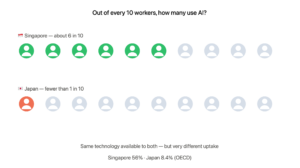
According to an OECD report, just 8.4% of Japanese workers use AI as part of their job. That puts Japan well behind the UK at 32%, the US at 50%, and Singapore — which ranks second globally and first in Asia for AI adoption — at 56%, where the majority of workers use AI multiple times a week.
Japan’s government claims that 75% of Japanese companies are now “using AI,” up from 11% five years ago. But critics say the headline is misleading: in most of those companies, only a small number of staff actually use it, and usually only for minor tasks like writing or summarising. The adoption is surface-level, not embedded.
Four Reasons Japan Is Holding Back
1. A near-zero tolerance for mistakes
Austin Xu, co-founder of US AI startup Kuse AI, recently opened an office in Japan to sell AI tools to local businesses. What he encountered was a cultural gap that surprised him.
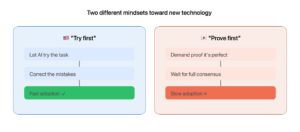
In Japan, he explains, companies are unwilling to let AI handle anything customer-facing unless it can be proven reliable beyond doubt. Some would rather leave a role unfilled than risk a machine making an error. The prevailing attitude is: show me proof first, then we’ll consider it.
In the US, by contrast, the approach is almost the opposite — AI tools are introduced as assistants, allowed to try things, and corrected when they get something wrong. The two styles reflect genuinely different relationships with uncertainty and error.
2. Consensus culture slows every decision
Japanese companies are well known for their consensus-driven approach to decisions. Before anything significant changes, there is a strong expectation that agreement must be reached across departments and levels of management. This culture has real strengths — it creates alignment and avoids conflict — but it also means that fast-moving technologies like AI face an unusually long path to adoption.
Professor Parrisa Haghirian of Kyoto University of Advanced Science explains it directly: “The challenges of adopting AI are the same as the challenges of adopting any change in Japanese firms. This is why AI use is still quite limited and cautious, especially in the workplace.” Japanese firms, she adds, are highly sensitive to error, uncertainty, and reputational risk — all of which AI still carries.
3. Old technology can’t run new technology
Beneath the cultural barriers sits a practical one: around 60% of Japanese companies are running computer systems that are more than 20 years old. Some hospitals have not even completed the shift from paper patient records to digital ones. One hospital employee described the situation as “like the Stone Age.”
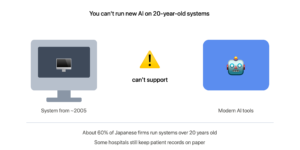
AI needs modern digital infrastructure to operate on. Trying to introduce advanced AI into a company running on two-decade-old systems is the equivalent of trying to install the latest software on hardware that simply can’t support it. Before Japan can run with AI, much of its underlying infrastructure needs to be replaced — and that takes time, money, and technical expertise the country is already short of. Japan is facing a shortfall of nearly 800,000 IT professionals by 2030.
4. Protecting jobs takes priority over efficiency
Perhaps the most revealing reason is one that isn’t about technology at all. Japan’s government and its companies are under strong social pressure to maintain full employment. Aggressively adopting AI would displace or significantly change many roles, which is politically and socially uncomfortable in a country where long-term job stability has historically been an unspoken agreement between employers and workers.
As Professor Yasushi Ogasawara of Meiji University puts it: “The government is talking about AI, re-skilling, digital skills, but in reality, it is difficult to adapt human resources to digital skills because the top priority is to maintain full employment.” The productivity argument and the employment argument pull in opposite directions, and for now, employment is winning.
Signs That Things Are Beginning to Shift
Change in Japan is slow by design — but it is happening.
The government passed an AI Promotion Act last year, designed to encourage businesses to invest in AI through light-touch regulation. Tokyo has also set out the ambitious goal of making Japan “the world’s most AI-friendly country.”
In the private sector, larger companies are beginning to factor AI literacy into how they hire new graduates. Uta Yamaguchi, who joined major trading company Kanematsu in April, uses AI regularly for drafting emails, summarising documents, and recording meetings. “Many of my colleagues use it a lot,” she says.
The catch, as she notes, is that the kind of AI that autonomously handles complex, multi-step tasks — common in some US workplaces — is still virtually unheard of in Japan. AI is being used as a helper, not yet as a genuine participant in the workflow.
Why This Matters Beyond Japan
Japan’s situation is a concentrated version of a question every economy is navigating: how do you embrace a technology that improves productivity when it also threatens livelihoods, when your institutions move slowly, and when your infrastructure isn’t ready?
The stakes are visible in the numbers. Countries that embed AI widely and early are likely to pull ahead on output, wages, and competitiveness. Those that delay — even for understandable reasons — risk a widening gap that becomes harder to close over time. For Japan, a country already struggling with the economic consequences of its demographics, the cost of moving slowly could be significant.
For anyone watching their own career or their own economy, Japan’s story is a useful reference point. AI literacy — the ability to understand and work alongside AI tools — is quickly becoming a baseline skill in high-performing economies. The gap between Japan’s 8.4% and Singapore’s 56% didn’t emerge from a single decision. It emerged from hundreds of small choices, cultural habits, and institutional defaults. And it widened quietly, year by year.
Difficult Words, Made Simple
| Term | Plain-English Meaning |
|---|---|
| AI adoption | How widely a technology is being used in practice |
| OECD | A club of 38 wealthy countries that share economic data and research |
| Productivity | How much output is produced per hour of work |
| Consensus culture | A way of working where decisions need broad agreement before moving forward |
| Digital literacy | The ability to use computers and digital tools confidently |
| AI literacy | Understanding how AI works and being able to use it effectively at work |
| Full employment | A situation where nearly everyone who wants a job has one |
The Big Takeaway
Japan needs AI more than almost any wealthy country — and is using it less than almost any of them. The reasons are real and layered: a culture that demands certainty before change, institutions built around consensus, infrastructure that hasn’t caught up, and a genuine social commitment to protecting employment. None of these are irrational. But together, they are producing a gap that is already large and still growing.
Whether Japan finds a way to close it — and how — is one of the more important economic stories in Asia. The answer will tell us a lot about how countries navigate the tension between innovation and the human cost of disruption.
Source
This article is based on reporting by Michael Fitzpatrick for BBC News. Read the original report here: Why Japanese firms are being so slow to use AI.
All statistics and quotes are drawn from that report and the sources cited within it. This is general information, not financial or career advice. For decisions about your own career or investments, consult a qualified professional.
Growmmunity publishes explanations, not financial advice.