
AI Tokenomics Explained: Why Companies Keep Getting Surprised by Their AI Bills
AI tokenomics is one of the most important and least understood economic shifts happening in business right now. Companies around the world spent heavily on artificial intelligence over the past year — and then found themselves unable to answer a basic question: what did we actually get for the money? That gap gave rise to a new field called tokenomics, and it is changing how businesses think about AI spending.
First: what is a token?
Before anything else, we need to understand what a “token” actually is — because this word is at the heart of everything.
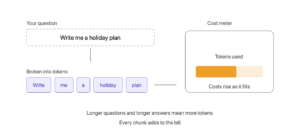
When you type a question into an AI tool like ChatGPT, Claude, or Gemini, the AI doesn’t read your words the way a human does. It breaks your text into small units called tokens. A token is roughly equivalent to a word or part of a word. Your question gets turned into tokens, the AI processes them, and its answer comes back as tokens too.
Why does this matter? Because AI companies charge by the token. Every time you ask a question, every time the AI responds, tokens are being consumed — and the meter is running. Most people never see this meter. They just use the AI and wait for the bill at the end of the month. That is where the problem begins.
The problem nobody saw coming
When companies first started rolling out AI tools to their employees, the focus was on productivity. Use AI, save time, move faster. Cost was almost an afterthought.
But tokens add up. An employee using an AI coding assistant dozens of times a day burns through far more tokens than anyone had budgeted for. Multiply that by hundreds or thousands of employees, across different departments using different AI tools, and the numbers quickly become very large — and very hard to track.
Will Venters, Associate Professor of Digital Innovation and Information Systems at the London School of Economics, describes the challenge directly: “People are finding it really hard to manage that cost. It is a non-deterministic output, so it is a non-deterministic value.”
In plain English: AI does not give the same answer to the same question every time, and it does not use the same number of tokens every time. That unpredictability makes budgeting feel like trying to plan for a water bill when the tap might run for five minutes or five hours — you simply do not know until it stops.
Real companies, real surprises
This is not a theoretical problem. Two major companies discovered it the hard way.

Uber apparently burned through its entire AI coding token budget — money set aside for a full year — within just a few months. The engineers were not doing anything wrong. They were using the tools they had been given. But nobody was watching the meter closely enough, and the year’s budget disappeared in a fraction of the time expected.
Microsoft had to step in and restrict its engineers’ use of some third-party AI coding tools. Again, the issue was not behaviour — it was visibility. When individual token consumption is invisible, cumulative costs can spiral before anyone notices.
Howard Rubin, an economist who advises companies on technology spending, described the broader situation plainly: companies are handling AI budgets “with little grounding.” Many executives pushed their teams to adopt AI widely, and now finance departments are left trying to trace where the spending actually went.
Why tokenomics was created
The gap between what companies spent and what they got led economists and technologists to ask a new set of questions: How do you measure the value of an AI interaction? How do you compare the cost of one AI provider against another? How do you build a budget for something you cannot fully predict?
These questions gave rise to tokenomics — a new field that studies how computing power sold in tokens is bought, used, and converted into actual business value. Think of it as the science of making AI spending legible: turning an invisible, unpredictable cost into something that can be tracked, planned, and compared.
The field took a formal step forward on 4 August 2026, when the Linux Foundation — the nonprofit that stewards major open-source computing standards — launched the Tokenomics Foundation, backed by 30 founding member organisations. Its goal is to build shared benchmarks so that companies can compare AI providers the way they already compare cloud computing costs: side by side, on a common standard.
What tokenomics actually changes

Before tokenomics became a discipline, most companies were essentially flying blind. They had AI budgets, but no reliable way to know day-to-day how those budgets were being consumed, which teams were the heaviest users, or whether the spending was producing returns.
With tokenomics frameworks in place, the goal is to give companies real-time visibility into token usage — by team, by function, by project. It also aims to produce common benchmarks, so a company can meaningfully compare whether Provider A or Provider B offers better value for a particular task. Right now, that kind of comparison is almost impossible because every AI company prices and measures tokens differently.
As J.R. Storment, the Tokenomics Foundation’s executive director, described it: the aim is to let companies compare AI providers the way they already compare cloud computing costs. Cloud computing went through exactly this evolution — chaotic, hard-to-understand pricing that eventually became standardised and comparable. Tokenomics is trying to do the same for AI.
How fast is token consumption growing?
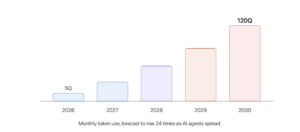
The scale of what is coming makes the problem feel even more urgent. Morgan Stanley forecasts that global token consumption will grow 24 times between 2026 and 2030, reaching 120 quadrillion tokens per month. This growth is driven largely by the shift toward AI agents — AI systems that do not just answer a single question, but autonomously carry out complex, multi-step tasks. An AI agent doing research, drafting a report, and sending emails on your behalf uses far more tokens than a simple chat interaction. As more companies adopt agents, the token meter spins much faster.
Where is tokenomics being used today?
Tokenomics is emerging across virtually every sector that has adopted AI at scale. Here is how different industries are applying it:
| Sector | How tokenomics is used |
|---|---|
| Tech companies | Tracking which coding assistants consume the most tokens and whether productivity gains justify the cost |
| Legal departments | Measuring cost per document reviewed by AI vs the hourly rate of a paralegal |
| HR and recruitment | Setting per-hire AI budgets and tracking whether automation saves money overall |
| Healthcare | Weighing token costs against the sensitivity and stakes of processing patient data |
| Finance | Ensuring AI risk-modelling costs are allocated to the right business units and measured against returns |
| Cloud providers | Adopting common token cost standards so customers can compare AI workloads across platforms |
What this means for individuals
If you use AI tools personally — for writing, research, or work — the tokenomics problem scales down to you too. Free-tier AI tools have token limits. Paid subscriptions include a certain volume of usage. When you hit that limit, you either pay more or wait. Most users do not think about this until they suddenly find an AI tool running slower or asking them to upgrade.
As AI becomes more embedded in daily life, understanding that every AI interaction has a cost — even if you do not see it directly — is a form of financial literacy for the modern world. The companies building tokenomics frameworks are trying to make that cost visible. For individuals, the lesson is simpler: use AI deliberately, not just habitually.
Difficult words, made simple
| Term | Plain-English meaning |
|---|---|
| Token | A small unit of text that AI processes and charges for |
| Tokenomics | The study of how AI tokens are bought, used, and converted into value |
| AI agent | An AI that autonomously carries out multi-step tasks, not just single answers |
| Non-deterministic | Producing different outputs each time — hard to predict or budget for |
| Benchmark | A shared standard that lets you compare different providers fairly |
| Linux Foundation | A nonprofit that sets open-source technology standards used across the industry |
The big takeaway
AI tokenomics emerged because companies discovered that spending money on AI and understanding that spending are two very different things. The invisible nature of token consumption — running in the background every time someone asks an AI a question — turned into a genuine financial management problem at scale.
Tokenomics is the field trying to make the invisible visible: to give companies the same clarity over AI spending that they already have over electricity, cloud storage, or staff costs. As token consumption heads toward a 24-fold increase by 2030, getting this right will matter more and more — not just for corporations, but for anyone navigating a world where AI is everywhere and its costs are built into everything we use.
Source
This article is based on reporting by BBC News and additional coverage from IBTimes UK and CBC News. Read the original BBC report here: Tokenomics: Why making AI pay is tricky.
All figures and quotes are drawn from those reports and the sources cited within them. This is general information, not financial advice. For decisions about AI investment or technology spending, consult a qualified professional.
Growmmunity publishes explanations, not financial advice.
1 thought on “AI Tokenomics: Why Companies Keep Getting Surprised by Their AI Bills”