
Bonds Explained: The IOUs That Quietly Run the World
Bonds are the most important part of the financial world that almost nobody understands. They are bigger than the stock market, they set the interest rate on your mortgage, they fund entire governments, and when they wobble, the whole economy pays attention. Yet to most people, “the bond market” sounds like a boring corner of finance best left to experts.
It is not boring, and you do not need to be an expert. A bond is one of the simplest ideas in all of finance: it is just a loan, written down. Today we will explain bonds from the ground up, using everyday examples, and by the end you will understand why this quiet market quietly runs the world.
What a bond actually is
A bond is an IOU — a promise to repay borrowed money, with interest. That is genuinely all it is.
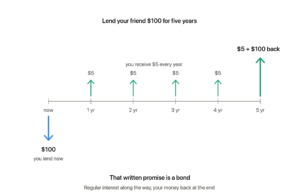
Imagine your friend needs $100 today and offers you a written deal: if you lend them the $100 now, they will pay you $5 each year for five years, and then return your full $100 at the end. That written promise is, in essence, a bond. You have lent money, and in exchange you receive regular interest payments plus your original money back at a set future date.
When a government or a large company needs to borrow money, it does exactly this, but on a giant scale and with many lenders at once. Instead of borrowing from one friend, it issues bonds to thousands of investors. Each investor hands over money now in return for the promise of regular payments and full repayment later. A bond is simply that promise, bought and sold.
The three key parts of every bond
Every bond has three basic features, and once you know them, you can read any bond.
The face value is the amount that will be repaid at the end — the $100 in our example. It is the size of the loan.
The coupon is the regular interest payment — the $5 a year. The name comes from a time when bonds were paper documents with detachable coupons you clipped and redeemed for your interest.
The maturity is the date the loan ends and the face value is repaid — five years in our example. Some bonds mature in months; others, like certain government bonds, run for thirty years.
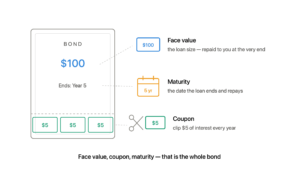
Put simply: you lend the face value, collect coupons along the way, and get your money back at maturity. That is the whole structure.
Who issues bonds, and why
Two main types of borrowers issue bonds, and understanding why they do it clarifies the whole market.
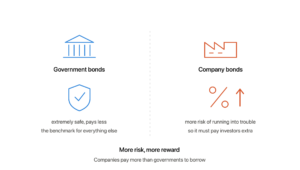
Governments issue bonds to fund their spending when taxes are not enough. When the US government needs money for roads, defense, or social programs, it issues Treasury bonds. These are considered among the safest investments in the world, because the US government is extremely unlikely to fail to repay. Government bonds are so central that their interest rates act as a benchmark for almost everything else.
Companies issue bonds to raise money for expansion — building factories, developing products, or growing the business — without taking out a traditional bank loan or selling shares. A company bond usually pays more interest than a government bond, because a company is more likely to run into trouble than a government, and investors demand extra reward for that extra risk.
The idea that confuses everyone: prices and yields move in opposite directions
Here is the one concept that makes people’s eyes glaze over — but with the right example, it becomes obvious. When bond prices go up, bond yields go down, and vice versa. They move like a see-saw.
Let us walk through it slowly. Suppose you buy a bond for $1,000 that pays $50 a year. Your return — the yield — is 5% ($50 out of $1,000).
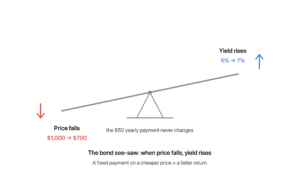
Now imagine interest rates in the economy rise, and newly issued bonds start paying $70 a year. Suddenly your old bond, paying only $50, looks unattractive. If you want to sell it, no one will pay full price for a bond that pays less than new ones. So the price of your bond falls — say to $700. But here is the key: it still pays $50 a year. And $50 on a $700 price is now a yield of about 7%. The price fell, and the yield rose.
The reverse happens too. If interest rates fall and new bonds pay only $30, your old bond paying $50 becomes a prize, and people will pay more than $1,000 for it. The price rises, and the yield falls. This see-saw is the single most important mechanic in the bond market, and it is why bond prices move every time interest rate expectations change.
Why bonds matter to the whole economy
Bonds might sound like a concern only for investors, but they shape the entire economy — and your life — in ways you may not realize.
They set your mortgage rate. Long-term interest rates, including many mortgage rates, are closely tied to government bond yields. When bond yields rise, borrowing costs across the economy tend to rise with them. The bond market, not just the central bank, helps decide what you pay to borrow.
They fund governments. Countries rely on bond markets to finance themselves. If investors lose confidence in a government and demand much higher yields to lend to it, that government’s borrowing costs can spiral, forcing painful spending cuts or tax rises. The bond market acts as a kind of judge of government finances.
They signal the economy’s mood. Because bonds are traded constantly by huge, sophisticated investors, bond yields reflect the market’s collective view of the future — where inflation, growth, and interest rates are heading. This is why economists watch bond yields as one of the clearest signals of what the financial world expects next.
Bonds vs stocks: a quick contrast
People often confuse bonds and stocks, but they are fundamentally different, and the difference is easy to grasp.

A bond makes you a lender. You are owed money, you receive fixed payments, and you get repaid first if the company runs into trouble. Bonds are generally safer but offer more limited returns.
A stock makes you an owner. You own a slice of the company, you share in its profits and its growth, but you also share in its losses, and you are paid last if things go wrong. Stocks are generally riskier but offer greater potential rewards.
In short: bonds are loans with steady, predictable returns; stocks are ownership with unpredictable but potentially larger returns. Most investors hold some of both to balance safety and growth.
Difficult words, made simple
| Term | Plain-English meaning |
|---|---|
| Bond | A loan you give to a government or company, in return for interest |
| Face value | The amount repaid to the bondholder at the end |
| Coupon | The regular interest payment a bond makes |
| Maturity | The date the bond is fully repaid |
| Yield | The return a bond gives, as a percentage of its price |
| Treasury bond | A bond issued by the US government, seen as very safe |
| Default | When a borrower fails to repay a bond |
The big takeaway
A bond is just a loan, written down and traded. You lend money, collect regular interest, and get repaid at a set date. Governments use bonds to fund themselves, companies use them to grow, and the interest rates on these bonds ripple out to set the cost of borrowing across the whole economy — including your mortgage.
The one mechanic worth remembering is the see-saw: when bond prices rise, yields fall, and when prices fall, yields rise. Because the bond market is enormous and constantly trading, its movements reveal what the smartest money in the world expects about inflation, growth, and interest rates. Understanding bonds turns the quietest, most overlooked corner of finance into one of the clearest windows on the economy’s future.
Sources
This article explains standard bond market principles. It is general educational information, not financial advice.
Related reading: Interest Rates Explained.
Growmmunity publishes explanations, not financial advice.