
Central Banks Around the World: How Different Countries Manage Their Money
Central banks around the world all do a similar job — managing a country’s money — but they are far from identical. The US Federal Reserve gets most of the global attention, but every major economy has its own central bank, each with its own priorities, its own challenges, and its own personality. Understanding how they compare is like learning that every country has a heart, but each beats to a slightly different rhythm.
Today we take a tour of the world’s most important central banks, see what makes each one distinct, and learn why their differences matter to the global economy. We will keep everything grounded in simple comparisons so the big picture stays clear.
What every central bank has in common
Before the differences, let us pin down what they all share. As we saw in The Federal Reserve Explained, a central bank is the institution that manages a country’s money and financial system. Nearly all of them share the same basic toolkit.
They set interest rates to steer the economy. They aim to keep prices stable, usually targeting around 2% inflation. They act as a lender of last resort in a crisis. And most of them are designed to be at least somewhat independent from day-to-day politics, so they can make hard decisions without political interference.

Think of them as the world’s economic thermostats. Each one is trying to keep its own economy at a comfortable temperature — not too hot with inflation, not too cold with recession. What differs is the climate each one is working in, and the choices each makes.
The Federal Reserve: the one everyone watches
We have covered the Fed in depth, but it belongs in any world tour because of its unique global role. Because the dollar is the world’s currency, the Fed is effectively the world’s most powerful central bank, whether it intends to be or not.
Its dual mandate — stable prices and maximum employment — is actually somewhat unusual. Many other central banks focus primarily on just one goal: controlling inflation. This gives the Fed a slightly wider, more flexible remit than most of its peers, and its decisions ripple worldwide in the way we explored in Why Fed Decisions Move the Whole World.
The European Central Bank: one bank, many countries
The European Central Bank, or ECB, faces a challenge no other major central bank does: it manages a single currency, the euro, for twenty different countries.
Imagine trying to set one interest rate that works equally well for a booming economy like Germany and a struggling one like Greece at the same time. What helps one may hurt the other. A rate low enough to support a weak economy might overheat a strong one, and vice versa. This is the ECB’s constant balancing act, and it makes its job uniquely difficult.
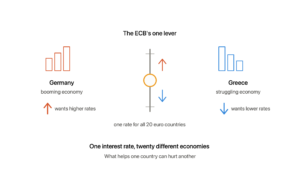
Unlike the Fed, the ECB has traditionally focused on a single primary goal: keeping inflation close to 2%. It was created relatively recently, in 1998, and its history has been shaped by the challenge of holding a diverse group of economies together under one monetary roof.
The Bank of Japan: the deflation fighter
The Bank of Japan, or BOJ, spent decades fighting the opposite of most central banks’ usual enemy. While others worried about prices rising too fast, Japan battled prices that would not rise at all — the deflation we explored in Deflation Explained.
For more than thirty years after its 1990 asset bubble burst, Japan struggled with stagnation and falling prices. To fight it, the BOJ pioneered tools the rest of the world would later borrow: rates held at zero for years, and massive money creation to try to spark spending. For a long time, the BOJ was the great experimental laboratory of modern central banking, testing what happens when the usual tools reach their limits.
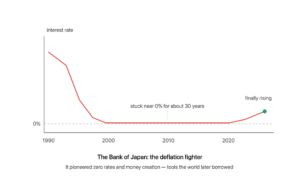
Only recently has Japan shown real signs of escaping deflation, with prices and wages finally rising again — a shift that took an entire generation to achieve.
The Bank of England: the old pioneer
The Bank of England, founded in 1694, is one of the oldest central banks in the world and served as a model for many that came later. It manages monetary policy for the United Kingdom and, like the ECB, focuses primarily on hitting an inflation target of around 2%.
As the central bank of a major financial hub, the Bank of England carries influence beyond the size of the UK economy, since London remains one of the world’s key centers of global finance.
Why central banks differ so much
If they share the same toolkit, why do central banks behave so differently? Several factors shape each one’s character.

Different economies, different problems. A country that imports most of its energy worries more about currency weakness and imported inflation. A country with an ageing population, like Japan, worries more about stagnation. Each central bank is responding to its own economy’s particular pressures.
Different mandates. Some central banks, like the Fed, must balance jobs and prices. Others focus almost entirely on inflation. This shapes how aggressively they respond to different threats.
Different levels of independence. Some central banks operate with strong independence from their governments. Others face heavier political influence, which can affect how freely they make unpopular decisions.
Different tools and constraints. A country with its own freely traded currency, like the US or UK, has more freedom than one that must defend a fixed exchange rate or manage large foreign debts.
How they influence each other
Central banks do not operate in isolation. They watch each other constantly, because in a connected world, one bank’s decisions affect the others.
When the Fed raises rates and the dollar strengthens, other central banks often feel pressure to raise their own rates too, to stop money from flooding out of their countries and to defend their currencies. When a major central bank cuts rates, it can give others room to do the same. This constant, often unspoken coordination — and sometimes competition — shapes the global flow of money.
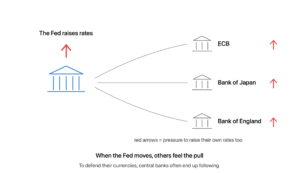
During major global crises, the biggest central banks have even acted together deliberately, coordinating rate cuts or emergency support to stabilize the world financial system. In an interconnected economy, no central bank is truly an island.
Why this matters to you
Understanding that different central banks have different priorities helps you read global economic news with far more insight.
When you see that the ECB and the Fed are moving in different directions, you now understand it may reflect the different economies they serve, not a mistake by one of them. When Japan does something unusual with its rates, you know it may be rooted in its long battle with deflation. And when your own country’s central bank raises rates seemingly in response to the Fed, you understand the currency pressures likely driving that choice.
Central banks are the hidden steering wheels of national economies. Knowing that each one is navigating its own particular road — with its own map, its own weather, and its own destination — turns a confusing world of competing headlines into a set of stories you can actually follow.
Difficult words, made simple
| Term | Plain-English meaning |
|---|---|
| Central bank | The institution that manages a country’s money and banks |
| Federal Reserve | The central bank of the United States |
| ECB | The European Central Bank, managing the euro for many countries |
| Bank of Japan (BOJ) | Japan’s central bank, long focused on fighting deflation |
| Inflation target | The rate of inflation a central bank aims for, often 2% |
| Mandate | The official goals a central bank is required to pursue |
| Independence | A central bank’s freedom to act without political interference |
The big takeaway
Every major economy has a central bank, and while they share the same basic job — managing money, steering interest rates, aiming for stable prices — each one is shaped by the unique economy it serves. The Fed balances jobs and prices while influencing the whole world. The ECB juggles twenty countries under one currency. The Bank of Japan spent decades fighting deflation. The Bank of England carries centuries of history and global financial weight.
These differences are not flaws. They reflect the reality that each economy faces its own climate and its own challenges. And because these banks watch and influence each other constantly, understanding their distinct personalities is a key step toward reading the global economy as the connected, dynamic system it truly is.
Sources
Details on the world’s central banks are drawn from public institutional sources and economic history as of 2026. This article is general educational information, not financial advice.
Related reading: The Federal Reserve Explained and Why Fed Decisions Move the Whole World.
Growmmunity publishes explanations, not financial advice.