
Taxes Explained: Understanding the Money That Funds Everything Around You
Taxes are the money that governments collect to pay for the shared things a society needs — roads, schools, hospitals, defense, and much more. Nearly everyone pays them, in one form or another, throughout their entire life. Yet taxes remain one of the most confusing and least understood parts of personal finance, often surrounded by anxiety and mystery. Understanding the basics of how taxes work — what kinds exist, how they are calculated, and why they matter — is an essential piece of financial literacy that helps you navigate your money with far more confidence.
Today we continue our personal finance journey by demystifying taxes. We will explain what taxes are, the main types you will encounter, how income tax generally works, and why understanding them matters for your everyday financial life. We will keep this general and educational, since specific tax rules vary greatly from place to place. As always, we keep everything clear and practical.
What taxes actually are
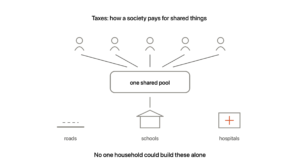
A tax is a compulsory payment to the government, used to fund public services and the functioning of society. When you pay taxes, you are contributing to a shared pool that pays for things individuals could not easily provide alone.
Think of taxes as the collective way a society pays for its shared needs. No single household could build a road, run a hospital, or fund a fire service on its own — but everyone contributing a portion makes all of it possible. Roads, schools, hospitals, emergency services, defense, and countless other public goods cost money, and taxes are how that money is raised. In this sense, taxes are the price of the shared infrastructure and services that make a functioning society possible. Whatever one’s views on the right level of taxation — a matter of ongoing political debate everywhere — this basic purpose is universal.
Because taxes fund government, they also connect to the broader economy we explored earlier. Government spending, funded largely by taxes, is one of the components of GDP, and decisions about taxing and spending are among the most important a government makes. Understanding taxes, then, connects your personal finances to the wider economic picture.
The main types of taxes

Taxes come in several forms, and you likely encounter more of them than you realize. Understanding the main types helps you see where your money goes.
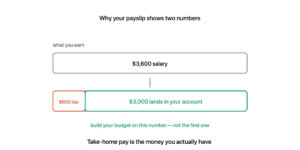
Income tax is a tax on the money you earn, typically from work. It is often the most significant tax individuals pay, and usually the one people mean when they talk about “doing their taxes.” It is also why your payslip shows two different numbers: if your salary is $3,600 a month and $600 goes to tax, the $3,000 that actually lands in your account is what you truly have to work with.
Consumption taxes are taxes on things you buy, added to the price of goods and services. These go by different names in different places — sales tax, VAT, GST — but the idea is the same: a portion of what you spend goes to the government. If a $100 item carries a 10% consumption tax, you hand over $110 and $10 of it is tax. You pay these constantly, often without noticing, since they are usually built into or added at the price you see.
Property taxes are taxes on property you own, especially real estate, usually paid regularly based on the property’s value. Homeowners encounter these as an ongoing cost of owning property — one that continues long after any mortgage is paid off.
Other taxes exist too, on things like investment gains, business profits, and specific goods. But for most individuals, income and consumption taxes are the ones felt most directly and frequently.
How income tax generally works
Income tax is worth understanding in a little more depth, since it is usually the largest and most talked-about tax. While specific rules vary widely, some general principles apply in many places.
A very common structure is what is called a progressive system, where higher levels of income are taxed at higher rates. The key idea, often misunderstood, is that these higher rates usually apply only to the income within each band, not to all your income.
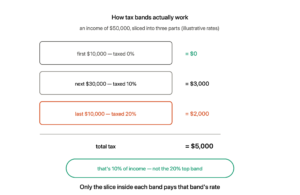
Numbers make this instantly clear. Imagine a simple system with three bands: the first $10,000 of income is taxed at 0%, income from $10,000 to $40,000 at 10%, and anything above $40,000 at 20%. (These are invented figures for illustration — real systems differ everywhere.) Now take someone earning $50,000. They do not pay 20% on everything. Instead:
Their first $10,000 is taxed at 0%, so nothing. The next $30,000 is taxed at 10%, so $3,000. Only the final $10,000 sits in the top band and is taxed at 20%, so $2,000. Their total tax is $5,000 — which is 10% of what they earned, not 20%.
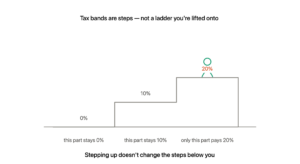
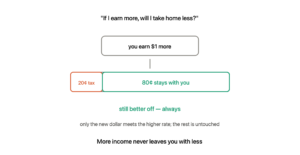
Think of the bands as steps rather than a ladder you are lifted onto. Climbing onto a higher step does not change the steps you already stood on. This is why earning more never leaves you worse off overall — a very common worry that simply is not true. If that same person earned one extra dollar, only that dollar would be taxed at 20%, leaving them 80 cents better off. More income always means more money in hand, even if a slice of it is taxed at a higher rate.
Many systems also allow certain deductions or allowances — amounts of income that are not taxed, or that reduce your taxable income. These vary enormously by place and situation, but the general idea is that your taxable income may be less than your total income once these are applied. Understanding that such allowances exist can help you avoid overpaying and make use of legitimate provisions available to you.
Why understanding taxes matters
Understanding taxes, even at a basic level, has real practical benefits for your financial life. It helps you avoid surprises, plan sensibly, and keep more of what you are entitled to.
Knowing roughly how taxes work helps you understand your actual take-home pay — the money you truly have after tax — which is essential for budgeting, as we saw earlier. A budget built on your gross salary rather than your take-home pay is a budget that will never balance. Many people are confused by the gap between what they earn and what they receive; understanding taxes explains it. It also helps you plan for tax obligations rather than being caught off guard by them, which matters especially for the self-employed and freelancers, who must set aside tax money themselves rather than having it deducted automatically — and this is another reason an emergency fund and a clear plan matter so much.
Understanding taxes also helps you take advantage of legitimate allowances and provisions designed to reduce what you owe. Around the world, tax systems often include incentives — for saving for retirement, for instance — that let your money grow through compound interest with less tax along the way. Being informed helps ensure you neither overpay nor miss opportunities the system legitimately offers.
Taxes and the bigger picture
Beyond your personal finances, understanding taxes helps you make sense of one of the most important and debated topics in public life. Taxation sits at the heart of countless political and economic discussions, and understanding the basics lets you follow these debates with more insight.
How much a government should tax, who should be taxed, and how the money should be spent are among the most contested questions in every society. These are genuinely difficult questions involving real trade-offs — between funding services and leaving money in people’s pockets, between different ideas of fairness, between competing priorities. Reasonable people disagree deeply, and these debates reflect different values rather than simple right answers.
Our aim here is not to take sides in these debates, but to give you the understanding to follow them thoughtfully. When you understand what taxes are, how they work, and what they fund, you can engage with these important questions as an informed citizen, forming your own views on matters that affect everyone. That understanding is part of being economically literate in the fullest sense.
Why this matters to you
Taxes affect your money throughout your entire life, shaping how much you actually take home, what your purchases really cost, and what you owe on property and other things. Understanding them, even in general terms, removes a major source of confusion and anxiety, replacing mystery with at least a basic clarity about where your money goes and why.
This understanding has practical payoffs. It helps you budget accurately using your real after-tax income, plan for tax obligations, and take advantage of legitimate provisions that can save you money. Even a basic grasp of taxes can help you avoid costly surprises and make more informed financial decisions throughout your life.
Most of all, understanding taxes completes an essential part of your financial education and your understanding of the world. Taxes connect your personal finances to the functioning of society and the broader economy, funding the shared things everyone relies on. By understanding them, you become better equipped to manage your own money, to follow the great public debates about taxation thoughtfully, and to navigate one of the most universal and important aspects of financial life with knowledge instead of confusion.
Difficult words, made simple
| Term | Plain-English meaning |
|---|---|
| Tax | A required payment to government that funds public services |
| Income tax | A tax on the money you earn |
| Consumption tax | A tax added to things you buy, such as sales tax, VAT, or GST |
| Property tax | A tax on property you own, like a home |
| Progressive tax | A system where higher income is taxed at higher rates |
| Tax band (bracket) | A slice of income taxed at its own rate |
| Deduction / allowance | Income that isn’t taxed or that lowers your taxable amount |
| Take-home pay | The money you actually receive after tax |
The big takeaway
Taxes are compulsory payments to government that fund the shared things a society needs, from roads to schools to defense. They come in several forms — income tax on what you earn, consumption taxes on what you buy, property taxes on what you own, and others. Income tax often works through a progressive system, where higher rates apply only to the income within each band. On a simple three-band example, someone earning $50,000 pays $5,000 in total — an effective rate of 10%, not the 20% of their top band. Earning more never leaves you worse off overall.
Understanding taxes helps you know your real take-home pay, budget accurately, plan for what you owe, and take advantage of legitimate allowances. It also connects your personal finances to the broader economy and to one of public life’s most important debates. While the right level of taxation is a genuine question on which reasonable people differ, understanding the basics lets you manage your money and follow those debates as an informed, economically literate citizen.
Sources
This article explains general principles of taxation for educational purposes. The tax bands and figures used are invented illustrations, not the rules of any particular country. Specific tax rules, rates, and systems vary greatly by country and change over time; consult official sources or a qualified professional for your situation. This article remains politically neutral and is not financial or tax advice.
Related reading: Budgeting Explained and GDP Explained.
Growmmunity publishes explanations, not financial advice.