
What Is an Economy?
What is an economy? It is a question most people never actually stop to answer, even though the word shows up in the news every single day. Economies grow, shrink, overheat, slow down, crash, and recover — but what exactly is the thing doing all of that?
This is the first article in our series taking you from complete beginner to confident reader of economic news. We will build everything from the ground up, using the United States as our anchor — because whether you live in America or not, the US economy shapes the prices you pay, the job market you work in, and the value of the money in your pocket. By the end of this piece, you will understand what an economy actually is, how it works, and why the American one matters so much to everyone else.
The simplest possible definition
An economy is just all the buying, selling, working, and producing that happens in a place. That is genuinely it.
When you buy a coffee, that is economic activity. When the café pays its barista, that is economic activity. When the barista uses that wage to pay rent, that is economic activity. When the landlord uses the rent to buy groceries, that is economic activity.
Now multiply that by hundreds of millions of people, all doing it simultaneously, every single day. That enormous, endlessly moving web of transactions is what we call an economy.
The word comes from an ancient Greek term meaning “household management.” Originally, it described running a single home: what to grow, what to trade, how to allocate limited resources. A national economy is the same idea, scaled up to millions of households making those decisions at once.
The one idea that explains everything: money moves in a circle
Here is the most important concept in this entire article, and it is one most people never learn explicitly.

One person’s spending is another person’s income.
Read that again, because almost everything else in economics flows from it. When you spend money at a restaurant, that money does not disappear. It becomes the restaurant’s revenue. Part of it becomes the chef’s wages. The chef spends it at a shop, where it becomes the shopkeeper’s income. And around it goes.
This is why economists talk about the “circular flow.” Money is not consumed like fuel — it circulates. The same dollar can pass through dozens of hands in a year, creating income for each person along the way.
This single insight explains a great deal about how economies behave:
When people spend more, businesses earn more, so they hire more people, who then have more money to spend, which makes businesses earn even more. The circle speeds up. This is what economists mean by an economy “growing.”
When people spend less, businesses earn less, so they cut hours or lay people off, and those people spend even less, which makes businesses earn even less. The circle slows down. This is the beginning of a recession.
Notice something important: the same mechanism runs in both directions. There is nothing inherently stabilising about it. This is precisely why governments and central banks intervene — to stop the circle from spinning too fast (causing inflation) or grinding to a halt (causing unemployment).
Why we care so much about the United States
You might reasonably ask: why does an article for a global audience keep talking about America?
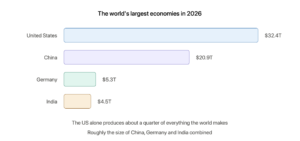
Because the numbers are hard to ignore. In 2026, the US economy is roughly $32.4 trillion — larger than China, Germany, and India combined. The US alone accounts for approximately a quarter of everything the world produces.
But sheer size is only part of the story. Three other factors make the American economy uniquely influential:
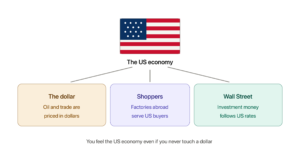
The dollar is the world’s money. Oil is priced in dollars. International trade is largely settled in dollars. Central banks around the world hold dollars as reserves. When the value of the dollar shifts, prices shift globally — even between two countries that have nothing to do with America.
American consumers buy the world’s products. The US consumer economy is worth roughly $19 trillion on its own. Factories in Vietnam, Mexico, and China exist in large part to serve American shoppers. When those shoppers slow down, factories on the other side of the planet feel it within months.
American financial markets set the global tone. Wall Street remains the world’s dominant capital market. When US interest rates rise, investment money flows out of other countries and into the US — which can weaken currencies and destabilise economies thousands of miles away.
This is why understanding the American economy is not an American concern. It is the single most useful lens for understanding the global one.
The four engines that drive an economy
When economists measure an economy, they break it into four parts. Understanding these four will let you make sense of almost any economic headline.
| Engine | What it means | Everyday example |
|---|---|---|
| Consumer spending | What ordinary people buy | Groceries, rent, phones, haircuts |
| Business investment | What companies spend to grow | New factories, software, equipment |
| Government spending | What the state buys and builds | Roads, schools, defence, healthcare |
| Net exports | Exports minus imports | Goods sold abroad vs bought from abroad |
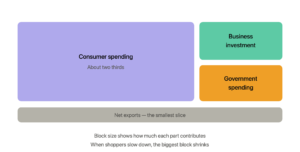
In the United States, the first engine dominates. Consumer spending makes up roughly two thirds of the entire American economy. This is a genuinely important fact, and it explains something you will see constantly in the news.
When a report shows that American retail sales fell, markets react immediately — not because a single month of shopping matters in isolation, but because consumer spending is the main engine. If it stutters, the whole machine is at risk of slowing.
How economies get bigger over time
An economy grows when it produces more than it did before. There are only a few fundamental ways this happens:

More workers. A growing population, or more people entering the workforce, means more hands producing things. This is why countries with ageing populations — like Japan, and increasingly Europe — struggle to grow.
Better tools and technology. One worker with a machine produces far more than one worker without it. This is called productivity, and it is the single most important driver of long-term prosperity.
Better organisation. Improved education, clearer laws, more efficient markets, and reliable institutions all let the same people and tools produce more.
The US economy grew about 2.3% in 2026. That number may sound small, but sustained growth compounds enormously over decades. An economy growing 2% per year roughly doubles in size every 35 years.
What can go wrong
Economies are not naturally stable. Three problems appear again and again, and each of them will get its own article later in this series:
Inflation happens when prices rise faster than incomes, so your money buys less than it used to. US inflation was around 3.2% in 2026, well below its 2022 peak of 9.1% but still meaningful.
Recession happens when the circular flow slows sharply — people spend less, businesses cut jobs, and the downward spiral feeds itself.
Inequality happens when the gains from growth flow mainly to some people while others see little benefit. An economy can grow impressively on paper while many households feel no improvement at all.
Managing these three tensions — growth, stability, and fairness — is essentially what economic policy is.
Why this matters to you personally
Understanding what an economy is changes how you read the world.
When you see a headline saying “US consumer confidence fell,” you now know it means Americans expect to spend less, which will slow the circular flow, which may lead businesses to hire less — which affects job markets far beyond America.
When you hear “the dollar weakened,” you now know that prices for imported goods will shift, and that this reaches your shopping receipt even if you have never held a dollar.
And when someone tells you the economy is “doing well,” you now know the right follow-up question: doing well for whom, and measured how?
That is the whole purpose of this series. Not to make you an economist, but to make economic news readable — so that headlines stop being noise and start being information you can actually use.
Difficult words, made simple
| Term | Plain-English meaning |
|---|---|
| Economy | All the buying, selling, working, and producing in a place |
| Circular flow | The idea that one person’s spending becomes another’s income |
| GDP | The total value of everything an economy produces in a year |
| Consumer spending | Money ordinary households spend on goods and services |
| Productivity | How much output each worker produces per hour |
| Reserve currency | A currency that countries worldwide hold and trade in |
| Recession | A period when economic activity shrinks significantly |
The big takeaway
An economy is not an abstract force operating somewhere above ordinary life. It is ordinary life — millions of people working, buying, and selling, with money circulating endlessly between them.
The United States sits at the centre of the global version of this system, not because Americans are special, but because of scale, the dollar’s role, and the size of American consumer demand. Understanding how the US economy works gives you a reliable starting point for understanding almost any economic story anywhere in the world.
In the next article, we tackle something even more fundamental: what money actually is, and why a piece of paper with a number printed on it has any value at all.
Sources
Economic figures cited in this article come from the International Monetary Fund World Economic Outlook, the World Bank, and the US Bureau of Economic Analysis, as compiled by public data sources in 2026.
This article is general educational information, not financial advice. For decisions about your own money, consult a qualified professional.
Growmmunity publishes explanations, not financial advice.
20 thoughts on “What Is an Economy?”