
Exchange Rates Explained: Why Currencies Rise, Fall, and Matter to You
Exchange rates quietly shape the price of an enormous share of what you buy, yet most people only think about them when planning a holiday abroad. The rate that decides how many dollars your currency buys — or how much foreign money your dollars command — influences the cost of your fuel, your electronics, your coffee, and even the health of the industries you work in. It is one of the most important numbers in the global economy, hiding in plain sight.
Today we will explain what an exchange rate really is, why currencies constantly rise and fall against each other, what makes them move, and why all of this matters far more to your daily life than you might expect. As always, we will build it up with clear, everyday examples.
What an exchange rate actually is
An exchange rate is simply the price of one currency measured in another. It tells you how much of one country’s money you need to buy another country’s money.
Imagine you are traveling and want to swap your money for US dollars. If the exchange rate means you need 1,300 of your local currency units to get one US dollar, that is the price of a dollar for you. If tomorrow you only need 1,200 to get the same dollar, dollars have become cheaper for you — or, put the other way, your currency has become stronger.

This is the key idea: currencies are priced against each other, and those prices move constantly. Just like the stock prices we explored earlier, exchange rates change every second, driven by the endless buying and selling of currencies around the world.
Strong and weak currencies: what they mean
You will often hear that a currency is “strong” or “weak.” These words simply describe whether a currency is worth more or less compared to others.
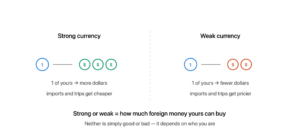
A strong currency buys more foreign money than before. If your currency strengthens against the dollar, each unit of your money now buys more dollars, which makes everything priced in dollars — imported goods, overseas trips, foreign products — cheaper for you.
A weak currency buys less foreign money. If your currency weakens against the dollar, each unit buys fewer dollars, so imported goods and foreign travel become more expensive.
Crucially, neither strong nor weak is simply “good” or “bad.” As we will see, a strong currency helps some people and hurts others, and the same is true of a weak one. It all depends on who you are and what you buy or sell.
Why exchange rates move: supply and demand again
At heart, exchange rates move for the same reason all prices move: supply and demand, which we covered in Supply and Demand. A currency is just another thing that gets bought and sold, and its price rises when demand for it grows and falls when demand shrinks.
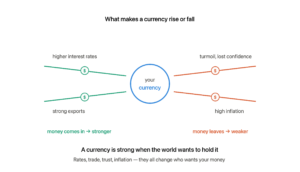
So what makes people want more or less of a currency? Several powerful forces are at work.
Interest rates. This is one of the biggest drivers, and it connects directly to what we learned about the Fed. When a country raises its interest rates, its currency often strengthens, because investors around the world want to move money there to earn those higher returns — and to do so, they must buy that currency. This is exactly the mechanism behind why Fed decisions ripple worldwide, as we explored in Why Fed Decisions Move the Whole World.
Trade. When a country exports lots of goods, foreign buyers must acquire its currency to pay for them, which increases demand and can strengthen the currency. When a country imports heavily, it must sell its own currency to buy foreign money, which can weaken it.
Confidence and stability. Money flows toward safety. A country seen as politically stable and economically healthy attracts investment, strengthening its currency. Turmoil, high inflation, or uncertainty can send money fleeing, weakening it.
Inflation. A currency losing value quickly to high inflation, as we saw in Inflation Explained, tends to weaken against currencies with more stable prices, because its purchasing power is eroding.
Who wins and who loses when a currency changes
Here is where it gets practical, because a moving exchange rate creates winners and losers at the same time. This is why governments and businesses watch currencies so closely.
When a currency weakens: Exporters win. Their goods become cheaper for foreign buyers, so they sell more abroad. A country’s tourism can boom, as visitors find it cheap to visit. But importers and consumers lose, because everything bought from abroad — fuel, electronics, foreign food — becomes more expensive, which can fuel inflation.
When a currency strengthens: Importers and consumers win. Foreign goods, travel, and products become cheaper, and imported inflation eases. But exporters struggle, because their goods become more expensive for foreign buyers, potentially hurting sales and jobs in export industries.
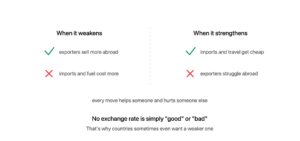
This tension explains a surprising fact: sometimes a country actually wants a weaker currency to help its exporters, while at other times it wants a stronger one to keep prices low. There is rarely a simple “best” level, because any exchange rate helps some parts of the economy while hurting others.
Fixed vs floating currencies
Not all currencies are left to move freely, and understanding the two main approaches clarifies a lot of global economic news.
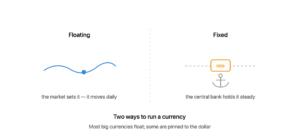
Most major currencies, like the US dollar, the euro, and the yen, are floating. Their exchange rates are set entirely by supply and demand in global markets, rising and falling freely every day. No one sets the price; the market does.
Some countries instead choose a fixed or managed exchange rate, deliberately keeping their currency at or near a set value against another currency, often the dollar. To do this, their central bank actively buys and sells currency to hold the rate steady. This can provide stability and predictability, but it requires large reserves and can be difficult to defend if markets push hard in the other direction.
Why this matters to you
Exchange rates affect you far more than the occasional holiday. If you live in a country that imports much of its energy, food, or technology, a weakening currency quietly raises the price of your daily life, even if nothing else changes. When your central bank makes decisions, part of what it is weighing is the effect on your currency and therefore on your cost of living.
Exchange rates also shape the industries around you. A strong currency can make it harder for your country’s exporters to compete, affecting jobs. A weak one can boost those exporters but squeeze household budgets. Behind many headlines about trade, competitiveness, and the cost of living sits the quiet influence of the exchange rate.

Most importantly, understanding exchange rates reveals a deep truth about our connected world: no economy stands alone. The value of your money is constantly measured against everyone else’s, shaped by interest rates, trade, confidence, and the endless global flow of money. Once you see this, a whole layer of the world economy — usually invisible — comes clearly into view.
Difficult words, made simple
| Term | Plain-English meaning |
|---|---|
| Exchange rate | The price of one currency measured in another |
| Strong currency | A currency that buys more foreign money than before |
| Weak currency | A currency that buys less foreign money than before |
| Appreciation | When a currency rises in value against others |
| Depreciation | When a currency falls in value against others |
| Floating rate | An exchange rate set freely by market supply and demand |
| Fixed rate | An exchange rate deliberately held at a set value |
The big takeaway
An exchange rate is simply the price of one currency in terms of another, and like any price, it moves on supply and demand. Interest rates, trade, confidence, and inflation all push currencies up and down, making them strong or weak against one another. Crucially, no exchange rate is simply good or bad — a weak currency helps exporters but raises the cost of imports, while a strong one does the reverse, creating winners and losers at the same time.
Because so much of what you buy is connected to foreign trade, the exchange rate quietly shapes your cost of living, your country’s industries, and its place in the global economy. Understanding it lifts the veil on one of the most powerful yet overlooked forces in the world — the constantly shifting value of money itself, measured against all the money in the world.
Sources
This article explains standard principles of how exchange rates work. It is general educational information, not financial advice.
Related reading: Supply and Demand and Why Fed Decisions Move the Whole World.
Growmmunity publishes explanations, not financial advice.