
Why Fed Decisions Move the Whole World: The Ripple That Reaches Everyone
Why Fed decisions move the whole world is one of the most important questions in global economics — and one of the most surprising. When a committee in Washington changes a single interest rate, the effects are felt by a farmer in Brazil, a homeowner in Turkey, a business owner in Indonesia, and a saver in South Africa. None of them are American. None of them have any say in the decision. Yet all of them feel it.
How can one country’s central bank hold this much power over the entire planet? The answer is a story about the US dollar, and once you understand it, a huge amount of global economic news suddenly makes sense. We will build it up step by step, with simple examples all the way through.
Start with one simple fact: the dollar is the world’s money
Everything begins here. The US dollar is not just America’s currency — it is the currency the whole world uses to do business with itself.
Consider a few examples. When a company in Thailand buys oil, it usually pays in dollars, not Thai baht. When Argentina borrows money from international lenders, the loan is often in dollars. When Kenya buys wheat on global markets, the price is quoted in dollars. Central banks around the world keep large piles of dollars as their savings, the way you might keep a rainy-day fund.
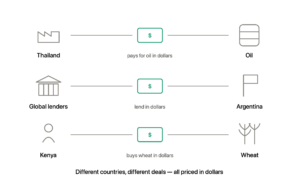
So even countries with their own perfectly good currencies rely on dollars for international trade, borrowing, and savings. This makes the dollar the bloodstream of the global economy. And the Federal Reserve, as we saw in The Federal Reserve Explained, controls the supply and price of dollars. Control the world’s money, and you influence the world.
The key idea: money flows toward higher returns
Here is the second building block, and it is beautifully simple. Money, like water, flows toward wherever it can earn the most.
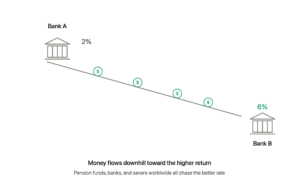
Imagine you have savings, and Bank A offers 2% interest while Bank B offers 6%. You move your money to Bank B. Now scale that instinct up to the entire world. Giant investors — pension funds, banks, wealthy individuals — constantly move trillions of dollars around the globe, chasing the best return for the risk.
Now connect this to the Fed. When the Fed raises US interest rates, American investments — like ultra-safe US government bonds — start paying more. Suddenly, parking money in the United States becomes more attractive than before. So global money begins flowing toward the US and away from other countries. This single movement is the engine behind almost everything that follows.
What happens to other countries when the Fed raises rates
Let us follow the chain of consequences with a simple imagined example. Picture a mid-sized country — we will call it Landia — with its own currency, the lira.
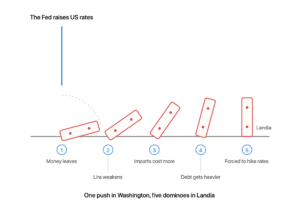
Step one: money leaves. The Fed raises US rates. Global investors pull their money out of Landia to chase the now-higher returns in the safer US. To leave, they sell their Landian liras and buy US dollars.
Step two: Landia’s currency weakens. Because everyone is selling liras, the lira falls in value — this is just supply and demand, which we covered in Supply and Demand. Too many liras for sale, not enough buyers, so the price drops.
Step three: imports get expensive. A weaker lira means Landia must pay more for everything it imports — oil, food, medicine, machinery — because those are priced in dollars. Prices rise across Landia. The country imports inflation, even though its own economy did nothing to cause it.
Step four: Landia’s debt gets heavier. If Landia borrowed money in dollars, as many countries do, that debt just became much harder to repay. The country earns liras but owes dollars, and each dollar now costs more liras than before.
Step five: Landia is forced to react. To stop money from fleeing and to defend its currency, Landia’s own central bank may feel forced to raise its interest rates too — even if its economy is weak and really needs low rates. So a decision made in Washington effectively forces Landia to tighten its own economy, hurting its businesses and citizens.
Notice what just happened: nobody in Landia voted for any of this, yet their prices, their debt, and their interest rates all moved because of a decision made thousands of miles away.
And when the Fed cuts rates, it flows the other way
The process runs in reverse too, and this is the good news side of the story.
When the Fed lowers US interest rates, American investments pay less. Global money goes looking for better returns elsewhere — and it flows out of the US and into other countries, especially faster-growing ones that offer higher returns.
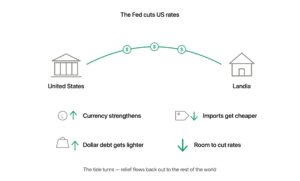
For a country like our imaginary Landia, this is a relief. Money flows in, its currency strengthens, imported goods get cheaper, its dollar debt becomes easier to repay, and its central bank has room to lower its own rates to support growth. This is exactly the pattern many analysts expected heading into 2026, as expectations shifted around the path of US rates and investors began looking again toward faster-growing economies outside America.
Real history: this has happened again and again
This is not just theory. The pattern has repeated throughout modern history, often painfully.
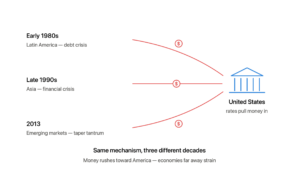
In the early 1980s, the US raised rates dramatically to crush inflation, and the resulting flood of money toward America helped trigger a debt crisis across Latin America. In the late 1990s, shifting global money flows contributed to the Asian financial crisis, which devastated economies like Thailand, Indonesia, and South Korea. In 2013, merely a hint from the Fed that it might slow its money-printing sent money rushing out of emerging markets so fast that the episode earned its own nickname: the “taper tantrum.”
Each time, the mechanism was the same one we traced with Landia. Higher US rates or a stronger dollar pulled money toward America and strained economies far from its shores. History does not repeat exactly, and some emerging economies have grown more resilient, but the underlying force is remarkably consistent.
Why this matters to you personally
Even if you never buy a US bond or hold a single dollar, this affects your daily life.
If you live outside the US, a strong dollar driven by Fed policy can raise the price of your fuel, your imported groceries, your electronics, and your overseas holidays, because so many of those things are priced in dollars behind the scenes. It can affect whether your country’s central bank raises or lowers the rates on your mortgage and savings. It can shape whether businesses in your country are hiring or cutting back.
And it explains one of the great puzzles of the world economy: why so many countries watch the Fed more nervously than they watch their own central banks. When the most important number in global finance is set in Washington, everyone downstream has to pay attention. Understanding this ripple is understanding one of the deepest truths about how our interconnected world really works.
Difficult words, made simple
| Term | Plain-English meaning |
|---|---|
| Reserve currency | A currency the whole world uses for trade and savings, like the dollar |
| Capital flows | Money moving between countries in search of better returns |
| Currency depreciation | When a currency falls in value against others |
| Imported inflation | Rising prices caused by a weaker currency making imports costlier |
| Dollar-denominated debt | Money a country owes that must be repaid in US dollars |
| Emerging markets | Faster-growing but less established economies, like Brazil or Indonesia |
| Taper tantrum | The 2013 panic when the Fed hinted it would slow its support |
The big takeaway
The Fed moves the whole world because it controls the world’s money. Since the dollar is used everywhere for trade, borrowing, and savings, the price the Fed sets on dollars — the US interest rate — pulls global money toward or away from America like a tide. When rates rise, money floods toward the US, weakening other currencies, raising their import costs, and straining their debts. When rates fall, the tide turns and money flows back out to the rest of the world.
This is why a country with its own currency and its own central bank still watches Washington so closely. The Fed’s decisions are, in effect, decisions for everyone. Once you see this single mechanism — money flowing toward the best return, guided by the world’s most important interest rate — a vast amount of global economic news clicks into place.
Sources
Historical episodes and 2026 capital flow patterns are drawn from public economic history sources, the Bank for International Settlements, and market reporting as of 2026. This article is general educational information, not financial advice.
Related reading: The Federal Reserve Explained and Supply and Demand.
Growmmunity publishes explanations, not financial advice.