
Dollar Dominance: Why the World Runs on US Dollars
Dollar dominance is one of the most powerful and least understood facts about the modern world. The US dollar is not just America’s money — it is, in a very real sense, the world’s money. It is used to price oil, to settle international trade between countries that have nothing to do with America, and to store the savings of nations across every continent. This single fact gives the United States extraordinary power and shapes the lives of billions of people who have never held a dollar.
Why does the whole world run on one country’s currency? How did this happen, what does it mean, and could it ever change? Today we will explain the story of dollar dominance from the ground up, with clear examples throughout, because understanding it is understanding one of the deepest structures of the global economy.
What “dollar dominance” actually means
Dollar dominance means the US dollar is the currency the world relies on for its most important economic activities, far beyond America’s own borders.
Consider what this looks like in practice. When a country buys oil on the global market, it usually pays in dollars, even if neither the buyer nor the seller is American. When two nations trade goods across the world from the US, they often settle the deal in dollars. When central banks around the globe store their national savings — their reserves — they hold enormous piles of dollars. And when a company or country in a distant land borrows internationally, that loan is frequently in dollars.
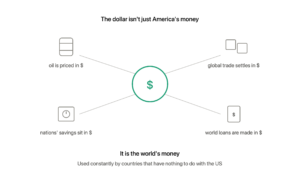
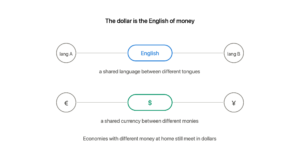
In other words, the dollar is the common language of global money. Just as English often serves as a shared language between people whose native tongues differ, the dollar serves as the shared currency between economies that use entirely different money at home. This is what we glimpsed in Why Fed Decisions Move the Whole World, and now we look at why it exists.
How the dollar became the world’s currency
The dollar’s dominance was not inevitable. It grew out of history, and understanding that history makes the whole system clearer.
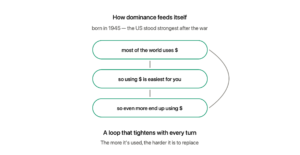
After the Second World War, the United States emerged as by far the strongest economy on earth, largely undamaged while much of the world lay in ruins. In the decades that followed, global trade and finance increasingly organized themselves around the dollar, because America had the biggest economy, the deepest and most trusted financial markets, and the most stable institutions.
Over time, this created a self-reinforcing cycle. Because so many countries used dollars, it made sense for others to use them too — it was simply the most convenient and widely accepted option. The more the dollar was used, the more useful it became, and the harder it was for any alternative to compete. Dominance, once established, tends to feed on itself.
Why the world keeps choosing the dollar
Habits from history explain how it started, but the dollar remains dominant today for solid, practical reasons.
Trust and stability. The US has a long track record of honoring its debts and maintaining relatively stable institutions. Countries and investors trust that dollars will hold their value and be honored, which is essential for a currency the whole world relies on.
Enormous, open markets. America’s financial markets are the largest and most liquid in the world. You can buy and sell vast quantities of US assets, like Treasury bonds, easily and at any time. This depth makes the dollar extremely convenient to hold and use at scale.
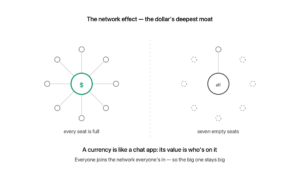
The network effect. This is the most powerful reason of all. Because everyone else already uses dollars, using dollars yourself is simply easier. If you want to buy oil, trade globally, or hold reserves, dollars work everywhere. This shared convenience locks the system in place, much like everyone using the same popular app because everyoneelse already does.
Theextraordinary power this gives America
Being the issuer of the world’s currency hands the United States advantages no other country enjoys — a set of privileges so significant they have been called an “exorbitant privilege.”

Cheaper borrowing. Because the world constantly wants dollars and safe dollar assets, there is always strong demand for US government debt. This lets America borrow money more cheaply and easily than almost any other nation, funding itself on favorable terms.
Global reach of its policies. Because so much of the world’s money flows through the dollar system, US decisions carry worldwide weight. When America adjusts its interest rates, the effects ripple across the globe, as we have seen. And because dollar transactions often pass through the US financial system, America can use access to that system as a powerful tool of foreign policy.
Insulation from currency crises. Many countries fear a collapse in their currency, especially if they owe debts in dollars. The US largely escapes this danger, because it borrows in its own currency — the very currency the world craves.
The responsibilities and criticisms
Dollar dominance is not without downsides and controversy, and a fair picture must include them.
Some argue the system gives America too much power over a global economy that all nations share. When US policy sends the dollar surging, other countries can suffer through no fault of their own, as their import costs and debt burdens rise. Critics say it is uncomfortable for the whole world to depend so heavily on the decisions of a single nation’s central bank.
There are responsibilities too. The country at the center of the system must maintain the trust and stability that make its currency worth holding. Serious mismanagement, instability, or a loss of confidence could, over time, weaken the very dominance the system depends on. With great privilege comes the burden of remaining reliable.
Could the dollar ever be replaced?
This is one of the most debated questions in global economics, and the honest answer is nuanced.
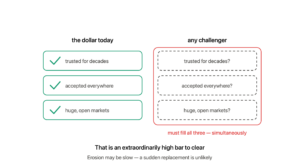
Various alternatives are sometimes suggested — other major currencies, or newer forms of money. Some countries actively seek to reduce their reliance on the dollar. Yet displacing it is extraordinarily difficult, precisely because of the network effect. For the world to switch, an alternative would need to be as trusted, as widely accepted, and as convenient as the dollar already is — and that is a very high bar to clear.
Most economists believe that while the dollar’s dominance could gradually erode over long periods, and its share of global activity may shift, no sudden replacement is likely in the foreseeable future. Change, if it comes, is more likely to be slow than sudden. For now, and for the time being, the world still runs on dollars.
Why this matters to you
Dollar dominance affects your life whether or not you ever touch a dollar. It is the reason a decision by the US central bank can change your country’s import prices, your currency’s value, and your cost of living. It helps explain why the whole world watches American economic policy so nervously, and why events in the US send ripples to every corner of the globe.
Understanding it reveals the hidden architecture beneath the world economy. So much of what happens — currency swings, global trade, international borrowing, the outsized attention paid to the Fed — makes sense only once you grasp that a single currency sits at the center of it all. The dollar is the sun around which much of the financial world orbits.
Above all, this is the clearest illustration of a truth this series returns to again and again: to understand the world economy, you must understand America, because through the dollar, America’s economy is woven into the fabric of everyone else’s. See the dollar’s dominance clearly, and a vast amount of the global economy finally comes into focus.
Difficult words, made simple
| Term | Plain-English meaning |
|---|---|
| Dollar dominance | The world’s reliance on the US dollar for trade, savings, and pricing |
| Reserve currency | A currency that central banks hold as their savings |
| Reserves | The foreign money a country keeps as a financial cushion |
| Liquidity | How easily an asset can be bought or sold without moving its price |
| Network effect | When something becomes more useful the more people use it |
| Exorbitant privilege | The special advantages the US gains from issuing the world’s currency |
| Treasury bond | US government debt, seen as a very safe dollar asset |
The big takeaway
Dollar dominance means the US dollar serves as the world’s money — pricing oil, settling global trade, storing nations’ savings, and funding international borrowing, far beyond America’s borders. It arose from history, when the US emerged as the dominant postwar economy, and it endures today because of trust, deep markets, and above all the network effect: everyone uses dollars because everyone else does.
This gives America extraordinary advantages, from cheap borrowing to global influence, while drawing criticism that one nation holds too much sway over a shared world economy. Though the dollar’s dominance could slowly erode, no sudden replacement appears likely, because the very network that sustains it is so hard to dislodge. Understanding this single fact unlocks a deep truth about our world: the dollar sits at the center of global finance, which is precisely why understanding America is the key to understanding the economy of everyone else.
Sources
This article explains the widely documented role of the US dollar in the global economy, drawing on standard economic history and public sources. It is general educational information, not financial advice.
Related reading: Why Fed Decisions Move the Whole World and Exchange Rates Explained.
Growmmunity publishes explanations, not financial advice.