
Tipflation Explained: Why the Tip Screen Is Everywhere — and Why Fewer People Are Tipping
Tipflation is the word America invented for a very specific modern moment: the tablet swivels toward you at a coffee counter, three buttons glow — 20% · 25% · 30% — and a person watches you decide. Multiply that moment across takeout windows, self-checkout kiosks, and delivery apps, and you get a genuine economic phenomenon with its own vocabulary: tipflation (suggested percentages climbing), tip creep (prompts spreading to places that never asked before), guilt tipping (paying because refusing feels cruel), and the backlash that names this whole story: tip fatigue.
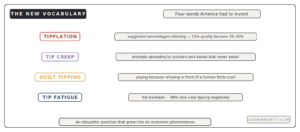
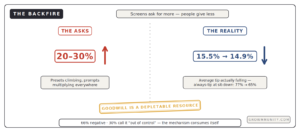
The numbers say the fatigue is real. A Bankrate survey found about 66% of Americans now view tipping negatively, with roughly 30% calling tipping culture “out of control.” The share who always tip sit-down servers has slid to 65%, down from 77% before the pandemic. And here’s the twist that makes this an economics story rather than an etiquette column: as the screens ask for more, people are actually tipping less — the average tip percentage has drifted down to about 14.9%, from 15.5% a couple of years earlier. This guide explains the machine behind the swiveling screen: the behavioral economics of those three buttons, who’s really being asked to pay whose wages, and why the whole system may be bending under its own weight — in plain English. (New to economics? Start with What Is an Economy?)
First: how did the tip screen get everywhere?
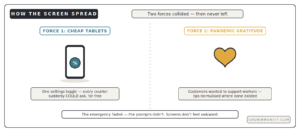
Two forces collided. The first was technology: cheap tablet payment systems made adding a tip prompt effortless — one settings toggle, no tip jar required — so every counter, kiosk, and app suddenly could ask, and asking costs the business nothing. The second was the pandemic: customers genuinely wanted to support service workers through the crisis, normalising tips in places they’d never existed. When the emergency faded, the prompts didn’t. Screens don’t feel awkward, so they never stopped asking.
Then inflation arrived and made everyone price-sensitive at the exact moment the asks multiplied. A 25% suggestion on a $7 latte lands differently when the latte itself already costs 30% more than it used to — the odometer effect from our groceries explainer, with a gratuity stacked on top.
The three buttons: a masterclass in nudge economics
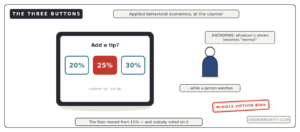
Those preset percentages are not decoration — they’re applied behavioral economics, and knowing the tricks changes how the screen feels.
Anchoring: whatever numbers appear define “normal.” Many screens now start at 18% or 20%, quietly retiring the historic 15% — sometimes it’s not even on screen, hidden behind “custom tip.” The floor moved, and nobody voted on it.
The middle-option bias: presented with three choices, people disproportionately pick the middle one. Set the menu at 20/25/30 and the “modest” choice became 25% — a number that was generous a decade ago.
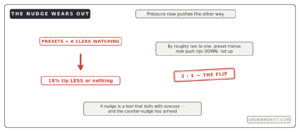
Social pressure as a pricing tool: the screen turns, the queue waits, the worker watches. Bankrate found the design now backfires: 18% of adults tip less or nothing when shown preset options with a clerk standing there — and by roughly two to one, presets now push people to tip less, not more. The nudge is wearing out from overuse.
The deeper question: whose wage is it, anyway?
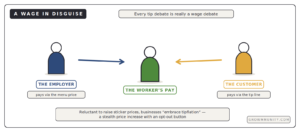
Strip away the etiquette and tipping is a wage arrangement — one where the customer, not the employer, pays a chunk of the worker’s income, transaction by transaction. That design explains the boom: analysts note that in an inflationary economy with a tight labour market, businesses reluctant to raise menu prices further can instead “embrace tipflation” — inviting customers to voluntarily cover more of labour costs while the sticker price stays put. The tip screen, in other words, is partly a stealth price increase with an opt-out button.
That’s also why the fatigue matters beyond annoyance. Food economist Michael von Massow’s warning captures the stakes: at minimum, tip fatigue means customers leave these interactions with negative feelings — at worst, they tip less or stop altogether. The falling averages suggest the second stage has begun, and the people caught in the middle are the workers whose take-home pay depends on a mechanism customers increasingly resent. (One recent policy wrinkle affects that pay directly: eligible workers can deduct up to $25,000 of qualified tip income from federal taxes for the 2025-2028 tax years — a reminder that tips are now serious enough money to be tax policy.)
Two honest views: modern tip jar or guilt tax?
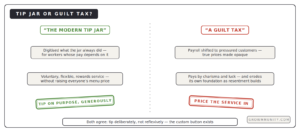
The “modern tip jar” view: the screen just digitised what the counter jar always did, for workers whose wages genuinely depend on it. Tipping stays voluntary — the suggestion is not a rule — it lets customers reward good service directly, and in a tight labour market it flexibly tops up pay without forcing menu prices (and therefore everyone’s bill) higher. Fatigue is an argument for tipping on purpose — generously where earned — not for abolishing the thank-you.
The “guilt tax” view: a wage system that depends on anchoring tricks and social pressure is a broken mechanism wearing a bow. It shifts payroll from employers to guilt-tripped customers, makes the true price of everything opaque, pays workers unevenly by charisma and luck rather than work, and — as the data now shows — erodes its own foundation as resentment builds. Most of the world simply prices service into the bill; the screen’s overreach is making that alternative look better by the month.
What both sides tell a beginner to do is identical: tip deliberately, not reflexively. The suggestion is a suggestion; the custom button exists; generosity aimed at actual service beats guilt aimed at a tablet.
Difficult words, made simple
| Term | Plain-English meaning |
|---|---|
| Tipflation | Suggested tip percentages climbing — 15% quietly becoming 20-30% |
| Tip creep | Prompts spreading to counters, kiosks and apps that never asked before |
| Guilt tipping | Tipping because refusing in front of a human feels cruel |
| Tip fatigue | The backlash — 66% now view tipping negatively |
| Anchoring | The numbers shown define “normal” — move the buttons, move the norm |
| Middle-option bias | Given three choices, most pick the centre — so the centre gets raised |
| Default / preset | The pre-filled suggestion — the most powerful button in behavioral economics |
| Tipped wage | Pay structure where customers fund much of a worker’s income directly |
| Stealth price increase | Costs moved into the tip line so the sticker price can stay still |
| Custom tip | The type-your-own option — always there, often hidden |
The big takeaway
Tipflation is what happens when a social custom gets an operating system. Cheap tablets made asking free, behavioral nudges made asking profitable, a pandemic made asking sympathetic, and inflation made every ask sting — until the mechanism started consuming its own goodwill: suggestions up, actual tipping down, two-thirds of the country annoyed, and workers exposed in the middle.
Three ideas worth keeping. First, defaults are decisions someone made for you — the three buttons are a designed choice architecture, and recognising the design breaks its spell. Second, a tip is a wage in disguise: every debate about the screen is really a debate about who should pay for service — the employer in the price, or you at the checkout. Third, voluntary systems run on goodwill, and goodwill is a resource that overuse depletes — which is why the most interesting question isn’t whether to press 20%, but how long a system this strained keeps working at all.
New to economics? Start with What Is an Economy? — then read Inflation Explained and Why Are Groceries So Expensive? for the price-sensitivity that lit this fuse.
Sources
This article synthesizes reporting and research from Kiplinger, Yahoo Finance (Bankrate survey), and the Michigan Journal of Economics:
• Kiplinger: Tipflation: Why It Feels Like You’re Being Asked to Tip on Everything
• Yahoo Finance: Fewer Americans are tipping, Bankrate survey finds
• Michigan Journal of Economics: The Tipping Trap
Additional figures from Bankrate’s tipping surveys, Capterra’s tip-fatigue research, and industry tip-rate data as cited within those pieces; background at Tipflation (Wikipedia). This article explains the mechanism and presents both views without endorsing either. This is general information, not financial advice.
Growmmunity publishes explanations, not financial advice.