
Budgeting Explained: The Simple Skill That Puts You in Control of Your Money
Budgeting is the single most important skill for taking control of your money, and yet it is one that almost no one is ever taught. At its heart, a budget is simply a plan for your money — a way of deciding where it should go before it disappears. It is not about restriction or deprivation, as many people fear. It is about awareness and control, about making your money serve your goals instead of wondering where it went. Master this one skill, and every other part of your financial life becomes easier.
Today we begin a new chapter in our journey. Having spent our earlier articles understanding how the economy works, we now turn to something more personal: how to manage your own money within it. And it all starts with budgeting. We will explain what a budget really is, how to build one simply, the common approaches, and why this humble tool is so powerful. As always, we keep everything clear and practical.
What a budget actually is
A budget is a plan that matches the money coming in against the money going out, so you can decide in advance how to use it. It answers a simple question: where should my money go?
Think of it like a plan for any limited resource. If you had a limited amount of water for a garden, you would decide which plants to water rather than pouring it randomly and hoping for the best. Money works the same way. Without a plan, it tends to leak away on small, forgotten things — three subscriptions you no longer use at $10 each is $360 a year, quietly gone. With a plan, every dollar has a purpose you have chosen.
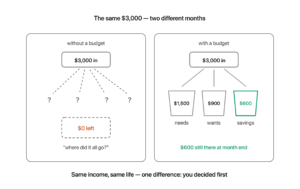
The foundation of any budget is understanding two things: your income (the money you receive) and your expenses (the money you spend). Once you can see both clearly, you can begin to shape where your money flows. That visibility alone is transformative — most financial stress comes from not knowing, and a budget replaces not knowing with knowing.
The two halves: income and expenses
Every budget rests on comparing income and expenses, so let us understand each clearly.
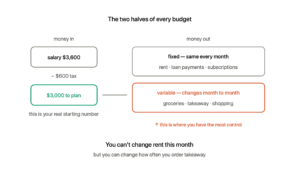
Income is all the money coming in — most commonly your wages or salary, but also any other money you receive regularly. For a budget, it helps to know your income after tax, since that is what you actually have to work with. If your salary is $3,600 a month but $600 goes to tax, your budget starts at $3,000, not $3,600.
Expenses are all the money going out, and they come in two useful categories. Fixed expenses stay roughly the same each month — rent, loan payments, subscriptions. Variable expenses change from month to month — groceries, entertainment, shopping. Separating the two is powerful, because your variable expenses are usually where you have the most control and can adjust most easily. You cannot change your rent this month, but you can change how often you order takeaway.
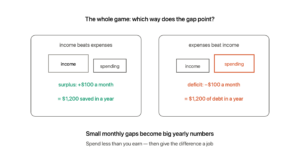
The goal of a budget is simple to state: spend less than you earn, and give the difference a purpose. When income exceeds expenses, you have a surplus to save or invest. When expenses exceed income, you have a deficit, which over time means debt — being short by just $100 a month becomes $1,200 of debt in a year. A budget makes this balance visible so you can steer it deliberately.
A simple way to start: the 50/30/20 approach
One of the most popular and beginner-friendly budgeting methods is the 50/30/20 approach, which divides your after-tax income into three simple buckets. It is a helpful starting framework, not a rigid rule.
50% for needs. About half your income goes to essentials you cannot avoid — housing, food, utilities, transport, minimum debt payments. These are the things you truly need to live and function.
30% for wants. Around a third goes to the things you enjoy but could live without — dining out, entertainment, hobbies, non-essential shopping. This is the flexible part, and where most people find room to adjust.
20% for savings and debt. The remaining fifth goes toward building your future — saving, investing, or paying down debt beyond the minimums. This is the portion that, over time, transforms your financial life.
Put real numbers on it and it becomes concrete. On a $3,000 monthly income after tax, that is $1,500 for needs, $900 for wants, and $600 for savings and debt. That $600 a month is $7,200 a year — the seed of an emergency fund, or the start of the compound growth we explored earlier.
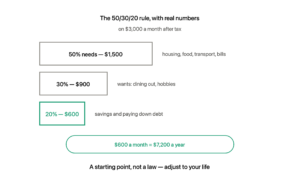
These percentages are a guide, not a law. Your situation may need different proportions, and that is fine. The value of the framework is that it gives beginners a simple, memorable starting point rather than a blank page.
How to build your first budget
Building a budget is more straightforward than most people expect. It comes down to a few clear steps that anyone can follow.
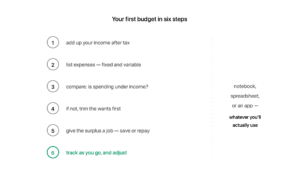
First, add up your monthly income after tax, so you know what you have to work with. Second, list your expenses, separating fixed from variable, and be honest — small forgotten costs add up. Third, compare the two: is your spending less than your income? Fourth, if not, look to your variable expenses and wants for places to adjust. Fifth, decide in advance what to do with any surplus, giving it a job like saving or paying down debt. Finally, track as you go, checking whether reality matches your plan and adjusting as needed.
The tools can be as simple as a notebook, a spreadsheet, or a budgeting app — whatever you will actually use. The method matters far less than the habit. A simple budget you stick to beats a perfect one you abandon.
Why budgeting is so powerful
Budgeting may sound modest, but its effects are profound, because it changes your entire relationship with money.
It replaces anxiety with control. So much financial stress comes from uncertainty — not knowing whether you can afford something, or where your money went. A budget dissolves that fog, replacing worry with a clear picture. It also reveals opportunities, showing you exactly where your money goes and where small changes could free up meaningful amounts over time. It even helps you notice when inflation is quietly raising your regular costs, because you can see the same items costing more than they did last year.
Most importantly, budgeting is what makes every other financial goal possible. Saving for emergencies, paying off debt, investing for the future, building wealth through compound interest — all of it depends on consistently spending less than you earn, which is exactly what a budget helps you do. It is the foundation on which every other part of personal finance is built.
Why this matters to you
Budgeting is one of the most practical and empowering skills you can ever learn, and unlike much of economics, you can apply it immediately. It works regardless of how much you earn, because it is about managing whatever you have wisely rather than about having a lot. People with modest incomes who budget well often end up more financially secure than high earners who do not.
This skill directly shapes your ability to reach every goal that matters to you — whether that is escaping debt, building a safety net, buying a home someday, or simply feeling calm and in control of your money. It is the gateway to financial confidence, and it is entirely within your power to build.
Most of all, budgeting transforms money from a source of stress into a tool you command. Instead of money happening to you, you direct it toward what you value. That shift — from feeling controlled by your finances to being in control of them — is genuinely life-changing, and it begins with the simple, powerful act of making a plan. Everything else in personal finance builds from here.
Difficult words, made simple
| Term | Plain-English meaning |
|---|---|
| Budget | A plan for where your money should go |
| Income | The money you receive, such as wages |
| After-tax income | What actually reaches you once tax is taken out |
| Expenses | The money you spend |
| Fixed expense | A cost that stays about the same each month, like rent |
| Variable expense | A cost that changes month to month, like groceries |
| Surplus | Money left over when income beats expenses |
| Deficit | A shortfall when expenses beat income |
The big takeaway
A budget is simply a plan for your money — a way to decide where it goes before it disappears. It is not about restriction but about awareness and control, built on the simple foundation of understanding your income and your expenses, and spending less than you earn. Beginner-friendly frameworks like the 50/30/20 approach — needs, wants, and savings — give you an easy place to start.
Building your first budget takes just a few clear steps, and the habit matters far more than the tool. Budgeting is powerful because it replaces anxiety with control, reveals opportunities, and makes every other financial goal possible. It works at any income level and puts you in command of your money rather than the other way around. This is the foundation of personal finance, and everything else builds from here.
Sources
This article explains widely taught principles of personal budgeting. It is general educational information, not financial advice.
Related reading: Compound Interest Explained and Saving and Emergency Funds.
Growmmunity publishes explanations, not financial advice.