
Saving and Emergency Funds: Building the Safety Net That Protects Your Life
Saving money and building an emergency fund is the financial safety net that stands between you and disaster when life goes wrong — and life, sooner or later, always does. A car breaks down, a job is lost, a medical bill arrives, an appliance fails. For someone without savings, each of these can become a crisis that spirals into debt. For someone with an emergency fund, the same event is merely an inconvenience. This single difference — having a cushion of savings — is one of the most powerful sources of financial security and peace of mind there is.
Today we continue our personal finance journey by exploring why saving matters so much, what an emergency fund is, how much you should aim for, and how to build one even when money feels tight. Building on the budgeting we covered in Budgeting Explained, this is the next essential step toward financial stability. As always, we keep everything clear and practical.
Why saving matters so much
Saving is simply keeping some of your money rather than spending all of it, setting it aside for the future. It sounds obvious, yet it is the dividing line between financial fragility and financial security.
The reason saving is so powerful comes down to a simple truth: life is unpredictable. Unexpected expenses and emergencies are not rare exceptions — they are a normal, recurring part of life. The only question is when they will arrive, not whether. Someone who saves is prepared for this reality; someone who spends everything is perpetually one surprise away from trouble.
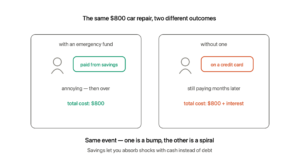
Consider the same $800 car repair arriving for two people. One pays from savings, is mildly annoyed, and moves on. The other puts it on a credit card and is still paying it off — with interest — months later. Same event, completely different outcome. Without savings, an unexpected cost often has to be covered by borrowing, and this is how many people fall into debt, not through recklessness but through being unprepared for the ordinary surprises of life. Savings break this cycle, letting you absorb life’s shocks with cash instead of debt. This connects directly to why budgeting matters: the surplus a budget creates is exactly what makes saving possible.
What an emergency fund is
An emergency fund is a specific pool of savings set aside for one purpose: to cover unexpected, essential costs when they strike. It is your financial shock absorber, your first line of defense against life’s surprises.
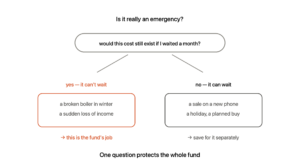
The key word is “emergency.” This money is not for holidays, shopping, or planned purchases. It is reserved for genuine, unexpected needs — a sudden loss of income, an urgent repair, a medical necessity. A useful test before touching it: would this cost still exist if I simply waited a month? A broken boiler in winter does not wait. A sale on a new phone does. Keeping the money separate, mentally and often physically in a different account, helps protect it from being spent on everyday temptations.
An emergency fund should be kept somewhere safe and easy to access quickly, since emergencies do not wait. This usually means a simple savings account rather than investments. The reason is the risk and return trade-off we explored earlier: investments can grow, but they can also fall in value at exactly the wrong moment, and emergencies have a habit of arriving when markets are down. The purpose of this money is security and availability, not growth. You want it to be there, in full, the moment you need it.
How much should you save?
A common and sensible guideline is to aim for an emergency fund covering three to six months of your essential living expenses. Let us understand why that range makes sense.
The logic is about how long you might need to cover yourself if your income suddenly stopped. Three to six months of essential expenses gives you a meaningful buffer to handle a job loss or major setback without immediately falling into crisis, buying you time to recover, find new work, or adjust.
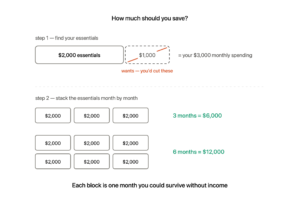
Put numbers on it and the target becomes clear. If your essential monthly costs — rent, food, utilities, transport, minimum debt payments — come to $2,000, then three months is $6,000 and six months is $12,000. Note that this is based on your essential expenses, the needs and not the wants, since in a real emergency you would cut back to essentials. If your total spending is $3,000 but $1,000 of that is dining out and entertainment, your emergency fund target is based on the $2,000, not the $3,000.
The right amount within that range depends on your situation. Someone with a very stable job and other support might lean toward three months; someone with unpredictable income or dependents might aim for six or more. And if these numbers feel impossibly large right now, do not be discouraged — the target is where you are heading, not where you must start.
How to build one, even when money is tight
Building an emergency fund can feel daunting, especially on a tight budget, but it is achievable through a simple, steady approach. The secret is that consistency matters far more than size.
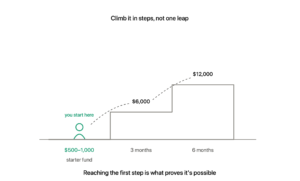
Start small and start now. Before aiming at the full three-to-six-month target, set a starter goal — something like $500 to $1,000, enough to absorb a small emergency without reaching for a credit card. Reaching that first milestone is what proves to you that this is possible, and a small emergency fund is vastly better than none.
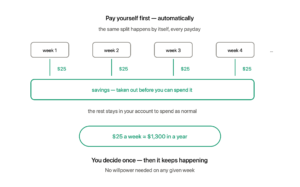
Make it automatic if you can, arranging for a small amount to move into savings each time you are paid, before you have a chance to spend it. Just $25 a week, moved automatically, becomes about $1,300 in a year without a single decision made in the moment. This “pay yourself first” approach is remarkably effective, because it treats saving as a priority rather than an afterthought. Use the surplus your budget reveals, and direct any windfalls — a bonus, a refund, a gift — toward the fund. Over time, these steady contributions add up to real security.
Saving beyond emergencies
While the emergency fund is the essential first goal, saving serves other purposes too, and understanding them helps you see the full picture.
Beyond emergencies, people save for specific goals — a home, a car, education, a special purchase — setting money aside steadily until they can afford these without debt. This kind of goal-based saving lets you buy important things with cash rather than borrowing, saving you the cost of interest.
Saving is also the bridge to investing and building long-term wealth. The money you save, once your emergency fund is secure, can begin working for you through compound interest, often through simple vehicles like the index funds we explored earlier. It is worth knowing, too, that cash sitting still slowly loses purchasing power to inflation — which is exactly why the emergency fund stays in cash for safety, while money beyond it is put to work. Saving, in this sense, is the foundation of your entire financial future: first protection, then growth. But it always begins with that essential safety net.
Why this matters to you
An emergency fund is one of the most powerful sources of security and peace of mind you can build. It transforms life’s inevitable surprises from potential catastrophes into manageable bumps. The knowledge that you could handle an unexpected expense without panic or debt brings a calm that touches every part of life, reducing the constant low-level stress that money worries create.
This safety net also protects all your other financial progress. Without it, a single emergency can wipe out your savings, derail your goals, or plunge you into debt, undoing months or years of effort. With it, your progress is protected, and you can pursue bigger goals from a position of stability rather than fragility.
Most of all, saving and building an emergency fund shifts you from living on the edge to living with a buffer — from vulnerability to resilience. It is perhaps the most important step in becoming financially secure, and it is achievable at almost any income through steady, patient effort. Starting small is completely fine. What matters is starting, and letting the safety net grow over time into the foundation of a stable and confident financial life.
Difficult words, made simple
| Term | Plain-English meaning |
|---|---|
| Emergency fund | Savings set aside for unexpected essential costs |
| Essential expenses | The needs you can’t avoid, like housing and food |
| Starter fund | A small first savings goal on the way to the full target |
| Pay yourself first | Saving a set amount before spending on anything else |
| Savings account | A safe, easy-to-access account for holding savings |
| Buffer | A cushion of money that absorbs financial shocks |
| Windfall | Unexpected money, like a bonus or gift |
| Goal-based saving | Saving steadily toward a specific planned purchase |
The big takeaway
Saving means keeping some of your money for the future, and an emergency fund is savings set aside for one job: covering life’s unexpected, essential costs. Because surprises are a normal part of life, this safety net is what separates financial security from fragility, letting you absorb shocks with cash instead of falling into debt.
A common guideline is three to six months of essential expenses — on $2,000 of essential monthly costs, that means $6,000 to $12,000 — kept somewhere safe and accessible. But the target is where you are heading, not where you must start. You build it by starting small with a starter goal, making it automatic, paying yourself first, and staying consistent, since the habit matters more than the size. An emergency fund brings peace of mind, protects all your other progress, and forms the foundation of your entire financial future. Start small, but start.
Sources
This article explains widely taught principles of saving and emergency funds. It is general educational information, not financial advice.
Related reading: Budgeting Explained and Compound Interest Explained.
Growmmunity publishes explanations, not financial advice.