
Credit Cards and Debt: How to Use Them Wisely and Avoid the Trap
Credit cards and debt are among the most useful and the most dangerous tools in all of personal finance. Used wisely, a credit card is convenient, safe, and can even build your financial reputation. Used carelessly, it can trap you in a cycle of debt that quietly drains your money for years. The difference lies entirely in understanding how they work — and this understanding is something almost no one is taught before they are handed their first card. Today we fix that.
Building on the credit score we explored in Credit Scores Explained, we now turn to the cards and debt that shape it. We will explain how credit cards actually work, why credit card debt is so dangerous, how the trap forms, and how to use these tools to your advantage instead of your harm. As always, we keep everything clear and practical.
How a credit card actually works
A credit card lets you borrow money to make purchases, up to a set limit, which you then repay later. Every time you use it, you are borrowing from the card company, who pays the merchant and expects you to pay them back.
Here is the crucial detail that determines everything. Each month you receive a statement showing what you borrowed, and you can choose how much to pay back. If you pay the full amount by the due date, you typically pay no interest at all — this window is called the grace period, and it means the borrowing was effectively free. But if you pay only part, that grace period is lost and you are charged interest on the rest. This is where the danger begins.
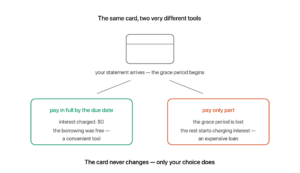
This creates two completely different ways to use the same card. Used one way — paying in full each month — it is a free, convenient tool. Used the other way — carrying a balance — it becomes an expensive loan. Understanding this fork in the road is the single most important thing about credit cards.
Why credit card debt is so dangerous
Credit card debt is uniquely dangerous because of one feature: the interest rates are extraordinarily high, typically far higher than almost any other kind of borrowing. This is what makes it so costly and so easy to get trapped by.
Recall what we learned about interest as the price of borrowing. Credit card rates — usually quoted as an APR, or annual percentage rate — are among the highest you will encounter, often several times higher than a mortgage or car loan. This means that when you carry a balance, the cost piles up quickly. A purchase you could not quite afford becomes even more expensive, as interest is added month after month.
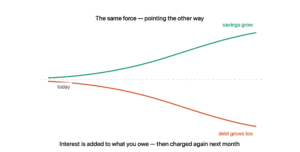
Worse, this interest compounds — you can end up paying interest on your interest, the same powerful force we saw building wealth in Compound Interest Explained, but now working against you. The very force that grows savings so powerfully over time can grow debt just as relentlessly. This is why credit card debt can feel like quicksand: the harder it is to escape, the deeper you sink.
How the debt trap forms
The credit card trap rarely announces itself. It forms gradually, through a process that feels reasonable at each step but leads somewhere dangerous. Understanding how it works is the best way to avoid it.
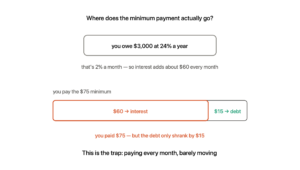
It often begins with paying only the “minimum payment” — the small amount the card requires each month. This feels manageable, but it is a trap by design. Put numbers on it and the problem becomes obvious. Suppose you owe $3,000 on a card charging 24% a year. That is 2% a month, so interest alone adds about $60 to your balance every single month. If your minimum payment is $75, then $60 of it disappears into interest and only $15 actually reduces what you owe. At that pace, the debt barely moves — while you feel like you are paying every month.
Meanwhile, if you keep spending on the card while carrying a balance, the debt grows faster than you can pay it down. The high interest, combined with ongoing spending and minimum payments, creates a cycle that is genuinely hard to escape. Many people find themselves paying substantial sums every month while their balance barely moves. This is the trap: not dramatic, but quietly relentless.
How to use credit cards wisely
The reassuring truth is that credit cards can be used entirely to your advantage, avoiding the trap completely, through a few clear rules. The tool is only dangerous when misused; used correctly, it is genuinely beneficial.
The golden rule is simple: pay your balance in full every month. Do this, and you get all the benefits of a credit card — convenience, safety, and building your credit score — while paying no interest at all. To make this sustainable, only charge what you can afford to pay back, treating the card as a convenient way to pay for things you already have the money for, not as a way to spend money you do not have. This is exactly where budgeting and an emergency fund do their quiet work: when a surprise cost has savings behind it, it never has to become a balance on a card.

If you already carry a balance, prioritize paying it down as quickly as you can, paying more than the minimum whenever possible, since every extra dollar reduces the costly interest. Here is a way to see just how valuable this is. Paying off a card charging 20% is mathematically the same as earning a guaranteed 20% return — with no risk at all. As we saw in Risk and Return, returns like that normally demand serious risk. Clearing high-interest debt is one of the few places in finance where a large, certain return is simply sitting there waiting.
The good side of credit cards
Used responsibly, credit cards genuinely offer real benefits, which is why they can be a positive tool rather than something to fear or avoid entirely.
They are convenient and widely accepted, often safer than carrying cash, and can offer protections on purchases. Crucially, using a credit card responsibly — charging modestly and paying in full — helps build the positive credit history and strong credit score we discussed, which can save you money on future borrowing. In this way, a well-used credit card actively improves your financial reputation.
The key is that all these benefits depend entirely on avoiding the interest trap. A credit card paid in full each month is a valuable financial tool. The same card carrying a balance is an expensive burden. The card does not change — only how you use it does. That distinction is entirely within your control.

Why this matters to you
Understanding credit cards and debt protects you from one of the most common and costly financial mistakes people make. Credit card debt traps millions of people, draining money that could have built savings, funded goals, or grown into wealth. Knowing how the trap works lets you sidestep it entirely, which can save you an enormous amount of money over your life.
This knowledge also lets you harness credit cards as a genuine benefit rather than a hazard. By following simple rules — paying in full, charging only what you can afford — you gain convenience, safety, and a stronger credit score, all at no cost. You turn a potentially dangerous tool into one that works for you.
Most of all, understanding this topic is about staying in control of your money rather than letting debt quietly control you. The difference between using credit cards wisely and falling into their trap comes down entirely to knowledge and habits — both of which are within your power. With that understanding, you can enjoy the real benefits these tools offer while avoiding the trap that catches so many, keeping your financial life free, flexible, and moving toward your goals rather than weighed down by costly debt.
Difficult words, made simple
| Term | Plain-English meaning |
|---|---|
| Credit card | A card that lets you borrow to pay, repaying later |
| Balance | The amount you currently owe on the card |
| Grace period | The window in which paying in full means no interest |
| APR | The yearly interest rate charged on what you owe |
| Minimum payment | The smallest amount you must pay each month |
| Carrying a balance | Not paying in full, so you’re charged interest |
| Compounding debt | Paying interest on your interest, so debt grows |
| Credit limit | The maximum you can borrow on the card |
The big takeaway
A credit card lets you borrow to make purchases, and everything depends on one choice: pay in full each month and it is a free, convenient tool; carry a balance and it becomes an expensive loan. Credit card debt is uniquely dangerous because its interest rates are extraordinarily high and compound against you — on a $3,000 balance at 24%, interest alone adds about $60 a month, which is why minimum payments barely dent what you owe.
The way to win is simple: pay your balance in full every month, charge only what you can afford, and if you already carry a balance, pay it down as fast as you can — clearing a 20% debt is like earning a guaranteed 20% return with no risk. Used wisely, credit cards offer real benefits: convenience, safety, and a stronger credit score, all at no cost. The card does not change; only how you use it does.
Sources
This article explains widely taught principles of how credit cards and debt work. Rates, terms, and minimum payment rules vary by card and country, and the figures used are illustrative examples. It is general educational information, not financial advice.
Related reading: Credit Scores Explained and Compound Interest Explained.
Growmmunity publishes explanations, not financial advice.