
US Sanctions on Iran Explained: What “Cutting a Country Off” Actually Means
The United States has announced its widest set of economic sanctions yet against Iran — and this time the measures reach beyond Iran itself, to any country, bank, or business that keeps trading with it. China, the largest buyer of Iranian oil, immediately called the move illegal and vowed to protect its own interests.
Headlines about sanctions are full of intimidating language: unilateral measures, secondary sanctions, financial channels, evasion networks. But the underlying idea is simpler than it sounds. A sanction is a country using access to its economy as a lever — saying, in effect, “you can trade with them, or you can trade with us, but not both.”
This guide walks through what was announced, why it is happening now, what the key terms mean, and why analysts disagree about whether it will work. (If economics is new to you, our beginner explainer What Is an Economy? covers the foundations this article builds on.)
First: what is a sanction?
A sanction is an economic penalty one country imposes on another to change its behaviour — without going to war. Instead of soldiers, the weapons are bank accounts, shipping routes, and trade permissions.
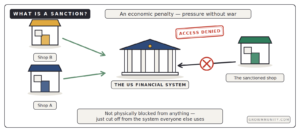
Here is an everyday way to picture it:
Imagine a neighbourhood where one shop owner — call him the Banker — handles everyone’s money. Every purchase, every payment, every loan runs through his ledger. One day the Banker decides he disapproves of what a particular family is doing. He announces: “I will no longer process payments for that family.”
Suddenly that family cannot pay for deliveries, cannot receive money from customers, cannot buy supplies. They are not physically blocked from doing anything — they just cannot use the system everyone else uses.
That is a sanction. And the reason the United States can do this at scale is a topic worth understanding on its own: the US dollar sits at the centre of global finance, so most international payments touch the American banking system at some point. Our explainer on Dollar Dominance covers exactly why that gives Washington so much leverage.
The crucial new twist: secondary sanctions
This is the single most important concept in this story, and it is what makes the latest announcement different from previous rounds.
Primary sanctions say: we will not trade with you.
Secondary sanctions say: and anyone who trades with you cannot trade with us either.
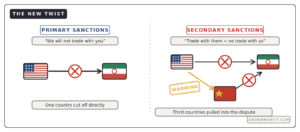
Back to the neighbourhood analogy. The Banker does not just refuse the family’s business. He tells everyone else on the street: “If you sell to that family, I will stop handling your money too.” Now the neighbours face a choice they never asked for. Most will quietly stop dealing with the family — not because they agree with the Banker, but because losing the Banker would hurt more.
US Treasury Secretary Scott Bessent made this reach explicit. He said any nation financially partnering with Iran would find itself isolated, and that President Donald Trump would be calling world leaders directly with requests to cut their dealings with Tehran. Asked specifically aboutChinese banks, Bessent said he wanted to be clear that no one is beyond the reach of US sanctions.
The Treasury says it has mapped the financial channels, facilitators, and networks Iran uses to keep selling oil despite existing restrictions, and has placed sanctions on roughly 60 entities, individuals, and vessels. Washington has branded the effort “Operation Economic Outcast” and described it as an economic D-Day.
The background: how did we get here?
If you are coming to this story fresh, the announcement makes far more sense with the previous six months in view.
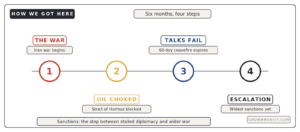
1. The war. The current crisis follows the outbreak of the Iran war roughly six months ago. Sanctions are not the opening move here — they are the latest instrument in an ongoing conflict.
2. The oil chokepoint. The conflict pushed oil prices up worldwide, with Tehran effectively blocking exports through the Strait of Hormuz — a narrow waterway that a large share of the world’s oil passes through. The United States has separately slowed traffic with its own naval blockade of Iran’s ports. We covered how this single stretch of sea moves global markets in Why European Stocks Fell Despite Great Profits.
3. Diplomacy stalled. Recent attempts to end the conflict through negotiation have failed. A 60-day ceasefire formally expired last week with no settlement in sight.
4. Iran was already sanctioned — heavily. This is a crucial point that headlines often skip. Iran has operated under extensive US sanctions for years. What is new is not sanctions themselves but their reach: the deliberate targeting of third countries and their banks.
So the sequence runs: war → oil disruption → failed ceasefire → escalation by economic means. Sanctions are what a government reaches for when diplomacy has stalled but it does not want to escalate militarily.
Why China is at the centre of this
China is not a bystander in this story — it is arguably the main audience for it.
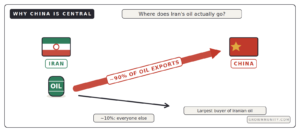
Roughly 90% of Iran’s oil exports go to China, according to David Oxley, chief climate and commodities economist at Capital Economics. That single number explains why the new measures were designed to reach beyond Iran’s borders. Sanctioning Iran alone, while its largest customer keeps buying, achieves relatively little.
Beijing’s response was immediate. Foreign ministry spokesman Lin Jian said China firmly opposes what it called illegal unilateral sanctions and would take all necessary measures to safeguard its rights. He added that cooperation between China and Iran has been conducted within the framework of international law and should not be interfered with.
That phrase — “unilateral sanctions” — is doing a lot of work, and it is worth unpacking, because it sits at the heart of a genuine international disagreement.
Unilateral vs multilateral: the argument beneath the argument
Multilateral sanctions are agreed by many countries together, typically through a body like the UN Security Council.
Unilateral sanctions are imposed by one country acting on its own.
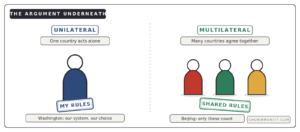
Ali Vaez, deputy director of the Middle East and North Africa Program at the International Crisis Group, described the Chinese position: Beijing generally complies with multilateral or international sanctions, but has consistently regarded sanctions imposed by the US alone as illegitimate.
Here the two sides genuinely disagree, and it is worth stating both fairly rather than picking one.
The case Washington makes: a country is entitled to decide who may use its financial system. If Iran’s oil revenue funds actions the US considers threatening, restricting that revenue is a legitimate alternative to military escalation — and one that puts pressure on a government rather than sending troops.
The case Beijing and others make: one country should not be able to dictate the trading decisions of sovereign nations that have broken no international law. On this view, using control of the financial system to compel third parties oversteps, whatever the underlying dispute.
Both positions are held sincerely by serious people, and neither is settled by the facts alone — it is a dispute about what the rules of international economics should be. Readers will land in different places, and that is a reasonable place for a disagreement of this kind to sit.
Why analysts doubt it will work
What makes this story unusual is that scepticism came not only from Iran and China, but from independent analysts — even before Beijing responded.
Oxley of Capital Economics expects the direct impact on Iran’s energy revenues to be modest, describing it as somewhat of a damp squib and predicting only limited short-term effect on Iranian energy flows. His reasoning is the 90% figure: China has not recognised US sanctions in the past and, in his assessment, is unlikely to be deterred now.
Vaez raised a second limitation. Iran’s neighbours — Pakistan, Turkey, Iraq — want good relations with Washington, but in his view cannot realistically afford to sever ties with Iran. Geography does not move. He also argued that economic pressure on Tehran does not achieve its goal, because the government is willing to absorb the pain and pass it on to ordinary Iranians.
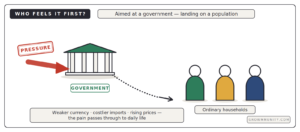
That last point is the most uncomfortable feature of sanctions as a tool, and it is why they remain contested even among people who agree on the underlying goal: the pressure is aimed at a government, but it lands on a population. When a currency collapses and imports become unaffordable, it is households that feel it first. If you want to understand that mechanism, our explainers on Inflation and Exchange Rates describe exactly what happens to daily life when money loses value.
Iran, for its part, projects readiness. Economy Minister Ali Madanizadeh said Tehran was fully prepared and predicted the measures would produce another defeat for the US, telling state television the government has a two-year plan to manage these events and had been expecting such a package for a long time.
The leverage Beijing holds in return
This is where the story stops being about Iran and becomes about something larger.
The announcement lands shortly before planned talks between Trump and Chinese President Xi Jinping next month. And Washington has reason to be cautious, because China holds a lever of its own: it processes the majority of the world’s rare earths and other critical minerals.
Rare earths are a group of metals essential to high-tech manufacturing — electric vehicle motors, wind turbines, smartphones, defence systems. They are not especially rare in the ground; the difficulty is refining them, and that refining capacity sits overwhelmingly in China. Beijing has already tightened export controls on rare earths during earlier trade negotiations with Washington.
So the two sides hold different kinds of chokepoint:
| Country | Its leverage | What it can restrict |
|---|---|---|
| United States | The dollar and the global financial system | Access to banking, payments, and dollar-denominated trade |
| China | Rare earth refining and critical minerals | Materials needed for electronics, EVs, and defence manufacturing |
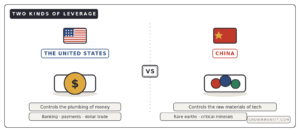
One controls the plumbing of money; the other controls the raw materials of technology. Neither can use its lever without cost to itself — which is precisely why both have historically been used sparingly, as threats more than as actions.
Who else is caught in the middle?
Secondary sanctions create pressure on countries that never chose a side. Alongside China, other trading partners potentially affected include India and Russia, neither of which had responded at the time of reporting.
Picture a shopkeeper who buys from two large suppliers who are feuding. She has no stake in the argument, but one supplier tells her she must stop buying from the other or lose her account. Whatever she chooses, she loses something — and she never had a say in the dispute.
That is the position secondary sanctions place third countries in, and it is why they generate friction well beyond the country actually being targeted.
Difficult words, made simple
| Term | Plain-English meaning |
|---|---|
| Sanction | An economic penalty used to pressure another country without military force |
| Primary sanctions | “We will not trade with you” |
| Secondary sanctions | “And anyone who trades with you cannot trade with us either” |
| Unilateral sanctions | Imposed by one country acting alone |
| Multilateral sanctions | Agreed by many countries together, usually through the UN |
| Strait of Hormuz | A narrow sea passage a large share of the world’s oil must travel through |
| Blockade | Physically restricting ships from entering or leaving a country’s ports |
| Rare earths | Metals essential to electronics and green technology, refined mostly in China |
| Sanctions evasion network | Intermediaries and vessels used to keep trading despite restrictions |
| Ceasefire | A temporary agreed halt to fighting — not a peace settlement |
Why this matters even if you live far away
It is tempting to file this under distant geopolitics. But the transmission mechanism into ordinary life is short.
Oil prices. Restricting the flow of oil from a major producer tends to push prices up. Fuel costs feed into delivery, heating, shipping, and eventually the price of goods with no obvious connection to oil at all.
Supply chains. If the dispute widens into rare earth restrictions, the effects reach electronics, electric vehicles, and renewable energy equipment.
Currency and inflation. Energy-driven price increases are one of the most common triggers for broader inflation, which is ultimately a question of what your money buys — the subject of our explainer What Is Money?.
A dispute over one country’s oil revenue does not stay contained to that country. It moves along the pipes of the global economy, and eventually shows up in prices most people never connect back to the original event.
The big takeaway
The United States has escalated from sanctioning Iran to sanctioning the world’s willingness to trade with Iran. That is a meaningfully different move, and it explains why the response came first from Beijing rather than Tehran.
Whether it works is genuinely uncertain, and reasonable analysts are sceptical for concrete reasons: China buys the overwhelming majority of Iran’s oil and has never recognised US sanctions; Iran’s neighbours cannot easily cut ties with a country on their border; and Tehran signals a willingness to absorb economic pain rather than change course. Supporters of the measures would counter that pressure works cumulatively, that mapping evasion networks raises costs even when it does not stop trade outright, and that the alternative to economic pressure is either doing nothing or escalating militarily.
Three things are worth watching from here: whether Chinese banks quietly comply even as Beijing objects publicly, how India and Russia respond, and whether next month’s Trump-Xi talks defuse the tension or harden it. Underneath the specific dispute sits a larger question that will outlast this story — how much power should come with being the country whose currency the world runs on?
New to economics? Start with our foundational guide, What Is an Economy? — it explains the basic machinery of trade, money, and prices that this story runs on.
Source
This article is based on reporting by BBC News. Read the original BBC report here: China hits out at ‘illegal’ new US sanctions on Iran and trading partners.
All figures and quotes are drawn from that report and the sources cited within it. This article aims to explain the economics of the dispute and to present the positions of the parties fairly; it does not endorse any government’s position. This is general information, not financial advice. For decisions about investments affected by geopolitical risk, consult a qualified professional.
Growmmunity publishes explanations, not financial advice.