
How the Fed Sets Rates: Inside the Meeting That Moves the World
How the Fed sets rates is one of the most consequential processes in the global economy, and it happens in a room most people will never see. Eight times a year, a small group of officials sits down, debates the state of the economy, and votes on a single number — the benchmark interest rate. That decision then ripples outward to mortgages, savings accounts, stock markets, and currencies across the entire world.
We have already covered what interest rates are and what the Federal Reserve does. Today we look inside the machinery: how the decision is actually made, who makes it, what they look at, and why markets hang on every word. As always, the US is our anchor.
The committee that decides: the FOMC
Interest rate decisions are not made by one person. They are made by a committee called the Federal Open Market Committee, usually shortened to the FOMC.
The FOMC brings together the Fed’s Board of Governors and a rotating group of regional Federal Reserve Bank presidents. Together, this group of officials debates and votes on the direction of interest rates. No single individual, not even the Fed Chair, can set rates alone — decisions are made collectively, by vote.

This committee structure is deliberate. Spreading the decision across a group of people with different perspectives and regional insights guards against any one person’s bias and produces more balanced judgments. When you hear that “the Fed raised rates,” it really means the FOMC voted to do so.
How often they meet
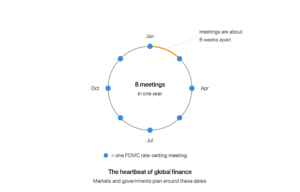
The FOMC holds eight scheduled meetings a year, roughly one every six weeks. Each meeting typically spans two days, during which members review the economy in depth before voting.
In genuine emergencies, the committee can also meet unscheduled, as it did during the 2020 pandemic when the economy demanded urgent action. But in normal times, the rhythm of eight meetings a year gives the calendar of global finance its heartbeat. Investors, businesses, and governments plan around these dates.
What the committee looks at
Before voting, FOMC members study an enormous range of economic data. They are trying to answer two linked questions rooted in the Fed’s dual mandate: is inflation under control, and is the job market healthy?
Among the many indicators they weigh, several stand out.
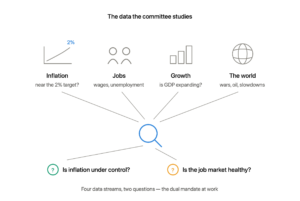
Inflation data tells them whether prices are rising too fast, too slowly, or near the 2% target. This is often the single most important input.
Employment figures reveal the health of the job market — how many people are working, how fast wages are rising, and whether unemployment is climbing.
Economic growth, measured by GDP as we saw in GDP Explained, shows whether the economy is expanding or contracting.
Global conditions matter too. Events abroad — a war, an oil shock, a slowdown in a major trading partner — can shape the committee’s thinking, since they ripple back into the US economy.
The decision and the dot plot
After debating the data, the committee votes. The outcome is usually one of three choices: raise the benchmark rate, cut it, or hold it steady. The change, when there is one, is typically small — often a quarter of a percentage point — because the Fed prefers to move carefully and observe the effects.
Alongside the decision, the Fed periodically publishes something markets scrutinize intensely: the dot plot. This is a chart where each committee member anonymously marks where they expect interest rates to be in the coming years. It offers a glimpse into the committee’s collective thinking about the future path of rates.
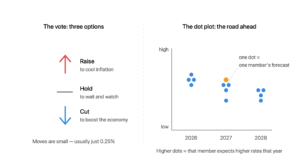
The dot plot is not a promise. It is a snapshot of expectations that can change as the economy evolves. But because it hints at where rates may be heading, investors pore over it for clues, and it can move markets as much as the rate decision itself.
Why every word matters
After each meeting, the Fed Chair holds a press conference and the committee releases a statement. Markets analyze these communications with extraordinary intensity — sometimes reacting more to the tone and wording than to the rate decision itself.
The reason is that investors are always trying to anticipate the future. If the Chair hints that more rate rises may be coming, markets adjust immediately, even before any actual change. A single shift in language — from describing inflation as “elevated” to “moderating,” for example — can send stocks and currencies moving in seconds.
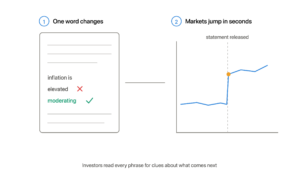
This is why Fed communication has become an art form in itself. Officials choose their words with great care, knowing that markets scrutinize every phrase for signals about what comes next. In recent years, under new leadership, the Fed’s post-meeting statements have at times been notably shorter and more closely watched than ever.
When the committee disagrees
The FOMC does not always vote unanimously. Members sometimes dissent, voting against the majority because they favor a different path. These disagreements are a normal and healthy part of the process, reflecting genuine uncertainty about the right course.
In 2026, for example, FOMC meetings saw multiple dissents, with some members preferring to raise rates while others wanted to hold or cut. Such splits reveal that even the world’s most powerful economic committee is often navigating genuinely difficult trade-offs, with reasonable people disagreeing about the best response. When dissents increase, markets take note — they can signal that a change in direction may be coming.
Why this process matters to you
The outcome of these meetings reaches directly into your life, wherever you live.
If you have a mortgage or are hoping to get one, the FOMC’s decisions influence your rate. If you have savings, they shape what you earn. If you invest, they move the markets your money sits in. And if you live outside the US, these decisions still affect your currency, your country’s borrowing costs, and the price of imported goods, because of the dollar’s central global role.
Understanding how the Fed sets rates turns these meetings from mysterious events into readable signals. When you know that eight times a year a committee weighs inflation against employment and votes on the price of money, the headlines that follow each meeting stop being noise. They become a window into the single most important decision in the global economy — and one that quietly shapes your financial life.
Difficult words, made simple
| Term | Plain-English meaning |
|---|---|
| FOMC | The Fed committee that votes on US interest rates |
| Board of Governors | The core leadership group of the Federal Reserve |
| Benchmark rate | The key interest rate the FOMC sets |
| Dot plot | A chart showing where members expect rates to go |
| Basis point | One hundredth of a percent; 25 basis points = 0.25% |
| Dissent | When a member votes against the committee’s majority |
| Monetary policy | A central bank’s use of rates to steer the economy |
The big takeaway
The Fed sets rates through the FOMC — a committee that meets eight times a year, studies the economy in depth, and votes on the single most important number in global finance. It weighs inflation against employment, moves carefully in small steps, and communicates its thinking through statements, press conferences, and the closely watched dot plot.
Every part of this process, down to the choice of a single word, is scrutinized by markets around the world, because the decision reaches into mortgages, savings, investments, and currencies everywhere. Knowing how this room full of officials reaches its verdict is knowing how the price of money itself is decided — and why, eight times a year, the whole financial world stops to listen.
Sources
Details on FOMC structure, meetings, and 2026 decisions are drawn from Federal Reserve releases and public reporting as of 2026. This article is general educational information, not financial advice.
Related reading: The Federal Reserve Explained and Interest Rates Explained.
Growmmunity publishes explanations, not financial advice.