
The Federal Reserve Explained: The Most Powerful Bank You Never See
The Federal Reserve is the most powerful economic institution in the world, and most people could not explain what it does. It sets the interest rates that shape your mortgage and savings. It can create money out of nothing. Its decisions move markets on every continent and influence the price of goods in countries that have no connection to America. Yet it is not a household name, and it is widely misunderstood.
Today we demystify it. What is the Federal Reserve, what does it actually do, why does it hold so much power, and why does the entire world watch its every move? As always, we start from the beginning.
What the Federal Reserve is
The Federal Reserve — usually shortened to “the Fed” — is the central bank of the United States. A central bank is not a normal bank. You cannot open an account there or apply for a loan. Instead, it is the institution responsible for managing a country’s money and overseeing its financial system.
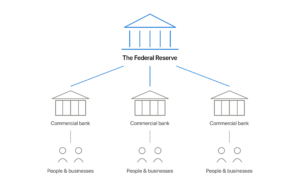
Think of the Fed as the manager of the entire US monetary system. It does not serve individual customers; it serves the economy as a whole. Where a commercial bank like Chase or Bank of America deals with the public, the Fed deals with the government, with commercial banks, and with the broad health of the nation’s money.
Created in 1913 after a series of banking panics, the Fed was designed to bring stability to a financial system that had repeatedly descended into crisis. More than a century later, it has become the single most influential economic actor on the planet.
What the Fed actually does
The Federal Reserve has several jobs, but two goals sit at the center of everything it does. These are known as its dual mandate.

Stable prices. The Fed aims to keep inflation low and steady, targeting around 2% a year, as we explored in Inflation Explained. Stable prices protect the value of money and the trust the whole system depends on.
Maximum employment. The Fed also tries to keep as many people employed as possible. A healthy economy is one where those who want to work can find jobs.
These two goals can pull in opposite directions, which is the central tension of the Fed’s work. Fighting inflation often means slowing the economy, which can cost jobs. Boosting employment can risk stoking inflation. Much of what the Fed does is a careful balancing act between these two mandates.
The Fed’s main tool: interest rates
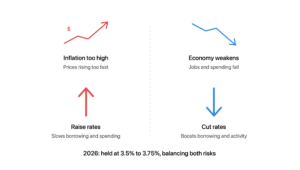
The Fed’s most important lever is the benchmark interest rate, which we covered in Interest Rates Explained. By raising or lowering this rate, the Fed influences borrowing, spending, and investment across the whole economy.
When inflation runs too hot, the Fed raises rates to cool things down. When the economy weakens and unemployment threatens to rise, it cuts rates to encourage activity. This single lever, adjusted a few times a year, ripples through mortgages, business loans, savings accounts, stock markets, and currencies around the world.
As of 2026, the Fed’s benchmark rate sits at roughly 3.5% to 3.75%, held steady across several meetings as policymakers weighed persistent inflation against a softening job market.
The Fed’s emergency tools
Beyond interest rates, the Fed has extraordinary powers it uses in a crisis — powers that make it unlike almost any other institution.
Creating money. The Fed can create new money electronically. During major crises, it has used this power to buy government bonds and other assets, injecting money into the financial system to keep it functioning. This is the tool known as quantitative easing, deployed heavily during the 2008 crisis and the 2020 pandemic.
Lender of last resort. When banks face collapse and no one else will lend to them, the Fed can step in to provide emergency funding. This role exists to stop a single bank failure from cascading into a full financial panic — the kind of chain reaction that turned a downturn into the Great Depression in the 1930s.

These powers are immense, which is precisely why they are used carefully and why the Fed’s independence is considered so important.
Who runs the Fed?
The Fed is led by a Board of Governors, and its most visible figure is the Chair. For years, the Fed was led by Jerome Powell, who guided the central bank through the 2020 pandemic and the inflation surge that followed.
Powell stepped down as Chair in 2026, though he chose to remain on the Board of Governors. He was succeeded as Chair by Kevin Warsh, a former Fed governor who took the helm during a period of unusual political pressure over interest rate policy.
Interest rate decisions themselves are made by a committee called the Federal Open Market Committee, which meets several times a year to vote on the direction of rates. It is these meetings that markets around the world watch so intently.
Why the Fed is independent
One of the most important features of the Federal Reserve is that it is designed to operate independently of day-to-day politics. Its leaders serve long terms, and it makes interest rate decisions without needing approval from the president or Congress.
The reason is a hard-learned lesson. Politicians facing elections are often tempted to want low interest rates and easy money to make the economy feel good in the short term, even if it stokes dangerous inflation later. An independent central bank can make unpopular but necessary decisions — like raising rates to control inflation — that a politically controlled one might avoid.
This independence is not absolute, and it is sometimes tested. Presidents have often expressed strong views about what the Fed should do, and 2026 saw notable political pressure over the direction of rates. The tension between central bank independence and political pressure is a recurring theme in economic history, and a live one today.
Why the whole world watches the Fed
The Fed is America’s central bank, so why does a decision in Washington move markets in Tokyo, London, and São Paulo?
The answer lies in the dollar’s role as the world’s dominant currency. Because so much global trade, borrowing, and saving happens in dollars, the price of dollars — set largely by the Fed’s interest rate — affects everyone.
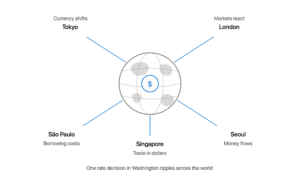
When the Fed raises rates, dollars become more attractive to hold, and money flows out of other countries and into US assets. This can weaken other currencies, raise borrowing costs abroad, and strain economies far from American shores. When the Fed cuts rates, the flow can reverse. In effect, the Fed sets monetary conditions not just for the US, but to a significant degree for the entire world — a reach we will explore further when we look at how Fed decisions move the global economy.
Difficult words, made simple
| Term | Plain-English meaning |
|---|---|
| Federal Reserve (the Fed) | The central bank of the United States |
| Central bank | The institution that manages a country’s money and banks |
| Dual mandate | The Fed’s twin goals of stable prices and maximum employment |
| Benchmark rate | The key interest rate the Fed sets to steer the economy |
| Quantitative easing | The Fed creating money to buy assets and support the economy |
| Lender of last resort | The Fed rescuing banks in a crisis to prevent wider collapse |
| FOMC | The committee that votes on US interest rate decisions |
The big takeaway
The Federal Reserve is the manager of America’s money — and, because of the dollar’s global role, a powerful influence on the money of the whole world. Through its control of interest rates and its ability to create money in a crisis, it works to keep prices stable and employment high, steering the economy between the twin dangers of inflation and recession.
Its independence from politics exists so it can make hard but necessary decisions, and its choices reach far beyond America’s borders. Understanding the Fed is understanding the invisible hand on the economy’s steering wheel — the institution that, more than any other, sets the conditions in which every other economic story unfolds.
Sources
Details on Federal Reserve policy, leadership, and benchmark rates are drawn from Federal Reserve releases and public reporting as of 2026. This article is general educational information, not financial advice.
Related reading: Interest Rates Explained and Inflation Explained.
Growmmunity publishes explanations, not financial advice.