
US-Canada Tariff War Explained: Why Two Friendly Neighbours Started Fining Each Other
The trade talks between the United States and Canada have collapsed. In August 2026, Canadian Prime Minister Mark Carney walked away from the negotiating table and announced that Canada would hit back at US goods “dollar for dollar.” The news is full of intimidating words — tariffs, retaliation, trade negotiations — but the heart of this story is surprisingly simple: two neighbours who traded freely for decades have suddenly started charging each other tolls.
If you are new to economic news, this guide walks you through what happened, why it happened, and what it means — with plain-language analogies at every step. (And if you are starting from zero, our beginner explainer What Is an Economy? covers the foundations that this article builds on.)
First: what is a tariff?
Before anything else, we need to understand this one word — because it is at the heart of everything.
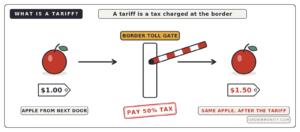
A tariff is a tax on goods coming in from another country. Here is an easy way to picture it:
Imagine a market in your neighbourhood. A merchant from the next town comes over to sell apples. Then the head of your neighbourhood makes a new rule: “Apples from the next town must pay a 50% entry fee before they can be sold here.” A $1 apple suddenly costs $1.50.
What happens next?
1. The out-of-town apples get expensive — so people buy fewer of them.
2. Local apple farmers benefit — their competition just got pricier.
3. But shoppers lose out — the cheap, tasty apples they used to enjoy now cost more.
That is a tariff in a nutshell: a shield that protects domestic industries, and at the same time a tax that quietly comes out of consumers’ wallets. Governments who impose tariffs are betting the first effect outweighs the second. Economists have argued about that bet for two hundred years.
The background: these two countries used to share a backyard
To understand why this fight is such a big deal, you need to know how unusual it is. The US and Canada share the longest border in the world, and for decades they traded with almost no tariffs at all, thanks to a free trade agreement called the USMCA (the US-Mexico-Canada Agreement).
Think of it like two houses with no fence between their backyards. For years, the neighbours wandered freely into each other’s yards, lending tools, buying and selling whatever they needed. Canada sold the US lumber, steel, auto parts, and oil. The US sold Canada cars, alcohol, and cheese. The two economies became so intertwined that a single car might cross the border several times before it was finished being built.
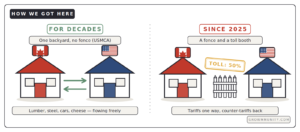
That cosy arrangement began to crack in January 2025, when President Donald Trump returned to office. Promising to protect American industry, he launched a sweeping programme of tariffs on countries around the world — and Canada was not spared. High tariffs landed on Canada’s most important exports: steel and aluminium, autos, and lumber.
From Canada’s point of view, the neighbour who had shared a backyard for decades suddenly built a fence and installed a toll booth. Canada responded with its own counter-tariffs, and most Canadian provinces went a step further: they pulled American alcohol off store shelves entirely — a consumer-level protest that said, in effect, “if you tax our goods, we won’t even sell your bourbon.”
That is the simmering feud that set the stage for this summer’s showdown.
What just happened: the collapse, step by step
Here is the timeline of the past few weeks, in order.
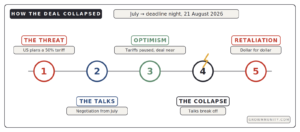
Step 1 — The threat. President Trump announced plans to impose a 50% tariff on nearly $20 billion (C$28 billion) worth of Canadian imports, with a deadline of 19 August.
Step 2 — The talks. Starting in July, negotiators from both countries entered intense discussions. The deal on the table reportedly looked like this: the US would cut tariffs on Canadian steel and aluminium from 50% to 25%, and on Canadian autos from 25% to 15%. In exchange, Canadian provinces would put American alcohol back on store shelves.
Step 3 — The optimism. Things looked promising. Trump even paused the threatened tariffs, saying the two sides were close to signing a deal that was “very good” for both countries.
Step 4 — The collapse. Then, minutes before the deadline, everything fell apart. Prime Minister Carney announced he was suspending negotiations and ordering his team back to Ottawa. His explanation: “Last-minute changes in the US proposed terms were unfair, uneconomic, and called into question the reliability of any deal.”
The US told a completely different story. Trade representative Jamieson Greer said Canada “declined to finalise the trade deal under the terms agreed earlier this week,” accusing Canada of making new demands and walking back earlier commitments.
Picture two people about to sign a contract, when suddenly both leap up from the table pointing at each other and shouting, “You changed the terms!” Who actually moved the goalposts? The two sides’ accounts are directly contradictory, and outsiders may never know for certain.
Step 5 — Tariffs and retaliation. With the talks dead, the US 50% tariffs took effect on Saturday. They cover a wide range of goods: wine, dairy, cement, clothing — and, in a symbolically painful touch, hockey equipment. Taxing hockey gear in Canada is a bit like taxing baseball gloves in America: it hits the national pastime. In response, Carney declared that Canada would impose reciprocal tariffs on US goods “dollar for dollar.”
What does “dollar for dollar” actually mean?
This phrase from the headlines sounds technical, but the idea is simple.
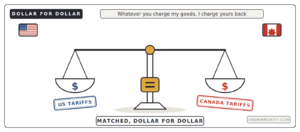
If a friend fines your belongings $100, you fine their belongings exactly $100 back. “Whatever you hit me with, I hit you with the same amount.” It is the trade-war version of an eye for an eye.
This kind of counter-punch is called a retaliatory tariff. The danger is that retaliation invites more retaliation, and the exchange escalates into a full tariff war. That risk is not hypothetical here: US trade representative Jamieson Greer has already warned that the US is “not going to tolerate” counter-tariffs. In other words, if Canada punches back, the US may punch back harder — and the cycle continues.
Why did this fight start in the first place? What each side wants
To understand any argument, look at what each side is asking for.
What the US wants from Canada:
• Remove Canada’s remaining retaliatory tariffs on American autos
• Adjust dairy quotas so more American cheese can enter the Canadian market
• End the ban on American alcohol sales imposed by most Canadian provinces
What Canada wants from the US:
• Drop or reduce the US tariffs on Canada’s key industries — steel and aluminium, autos, and lumber
Back to our neighbours: the house next door (the US) is saying, “Let us sell our cheese and whiskey in your yard again.” Your house (Canada) replies, “First, take down that toll booth you put on our hardware.” Each side insists the other must move first. Nobody moves. The deal dies.
Why dig up a law from 1930?
One detail in this story deserves special attention.
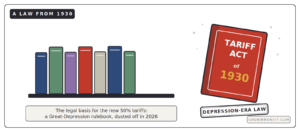
To impose the new 50% tariffs, President Trump invoked the Tariff Act of 1930 — a law written during the Great Depression, nearly a century ago.
Why does that matter? The high-tariff era of the early 1930s is one of history’s most cited cautionary tales. Steep American tariffs back then triggered waves of foreign retaliation, and global trade shrank dramatically while the world economy struggled. Most economists believe those tariffs made the Depression worse, not better.
Reviving a law from that era is like pulling your great-grandfather’s dusty rulebook out of the attic, blowing off the cobwebs, and declaring, “See? It says right here that I’m allowed to do this.” Legally, it may work. Historically, it is a striking choice — and it signals just how far outside normal trade practice this dispute has moved.
So who actually gets hurt?
Here is the uncomfortable truth about tariff wars: both sides pay.
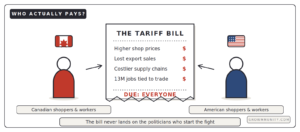
| Who | How they are affected |
|---|---|
| Canadian exporters | Their goods become more expensive in the US market, so they lose sales and competitiveness |
| American consumers | Prices rise on Canadian goods — lumber, dairy, hockey gear — pushing up the cost of living |
| American exporters | Canada’s retaliatory tariffs make US products more expensive north of the border |
| Manufacturers on both sides | Supply chains that cross the border repeatedly face higher costs at every crossing |
| Workers in both countries | The US Chamber of Commerce warns that 13 million American jobs depend on trade under the USMCA |
The auto industry is the clearest example of why this hurts so much. A single car is not built in one country. Parts cross the US-Canada border multiple times during production — an engine component might be forged in Canada, machined in Michigan, assembled into an engine in Ontario, and installed in a car in Ohio.
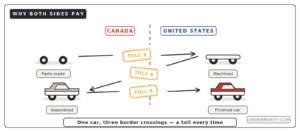
It is like making a sandwich where you bake the bread in your kitchen, slice the vegetables at your neighbour’s house, and come back to your kitchen to assemble it. Now imagine paying a toll every single time you step over the property line. The sandwich gets expensive fast — and so does the car.
This is exactly why businesses on both sides of the border spent weeks pleading for a deal. The US Chamber of Commerce warned that higher tariffs would damage both economies, raise costs for American families, and disrupt critical supply chains.
What do Canadians think?
Interestingly, Canadians themselves are split on how to respond. A recent poll by the Canadian firm Abacus Data found:
• Around 36% support retaliating against US tariffs — the “fight back” camp
• Around 30% want the government to keep negotiating — the “keep talking” camp
Political leaders, however, are rallying behind the tough approach. Doug Ford, the outspoken premier of Ontario — Canada’s largest province — declared that the prime minister has his full support for a strong response, “tariff for tariff, dollar for dollar.”
It is a familiar tension in any standoff: national pride says “don’t back down,” while economic reality whispers “the longer this lasts, the more it costs us.”
Difficult words, made simple
| Term | Plain-English meaning |
|---|---|
| Tariff | A tax on goods entering a country — like an entry fee at the border |
| Retaliatory tariff | A counter-tax: “you taxed my goods, so I’m taxing yours” |
| Dollar for dollar | Matching the other side’s tariffs with the exact same amount in return |
| Trade negotiations | Talks between countries to lower or remove tariffs in exchange for concessions |
| USMCA | The US-Mexico-Canada free trade agreement — a promise to keep the fences down |
| Tariff Act of 1930 | A Depression-era US law being used as the legal basis for the new tariffs |
| Supply chain | The full journey of a product from raw materials to the customer’s hands |
| Dairy quota | A limit on how much foreign milk, cheese, and butter a country allows in |
The big takeaway
For decades, the US and Canada traded like neighbours with no fence between their yards. Since the Trump administration’s tariff programme began in 2025, that relationship has been under strain — and this week, an attempt to repair it collapsed at the last minute, with each side blaming the other for changing the terms. The result: 50% US tariffs on a wide range of Canadian goods are now in effect, and Canada has vowed to match them dollar for dollar.
The uncomfortable truth of tariff wars is that the bill never lands on the politicians who start them. It lands on ordinary people on both sides of the border — shoppers paying more at the checkout, workers in industries caught in the crossfire, and businesses watching their supply chains tangle.
Three things are worth watching from here: which US products Canada targets with its retaliatory tariffs, whether the US follows through on its warning that it will “not tolerate” retaliation, and when — or whether — the two sides return to the table. Trade wars, like most fights between neighbours, usually end the same way they should have been avoided: with a conversation.
New to economics? Start with our foundational guide, What Is an Economy? — it explains the basic machinery of trade, production, and consumption that this story runs on.
Source
This article is based on reporting by BBC News. Read the original BBC report here: Canada says it will match US tariffs ‘dollar for dollar’ as trade talks break down.
All figures and quotes are drawn from that report and the sources cited within it. This is general information, not financial advice. For decisions about investments or business affected by trade policy, consult a qualified professional.
Growmmunity publishes explanations, not financial advice.
2 thoughts on “US-Canada Tariff War: Why Two Friendly Neighbours Started Fining Each Other”