
Interest Rates Explained: The Price of Money and Why It Rules the Economy
Interest rates are, quietly, one of the most powerful forces in your financial life. They decide how much you pay on a mortgage, how much you earn on your savings, whether businesses expand or contract, and even how much your currency is worth. When the news reports that a central bank has “raised” or “cut” rates, it is describing a decision that ripples through the entire economy — including your own wallet.
Yet interest rates are often treated as mysterious or technical. They are not. At heart, an interest rate is simply the price of money. Today we explain what that means, why rates move, and how a single percentage figure can shape everything from your rent to the strength of the dollar.
What an interest rate actually is
An interest rate is the cost of borrowing money, or equivalently, the reward for lending it. It is expressed as a percentage of the amount over a period of time, usually a year.
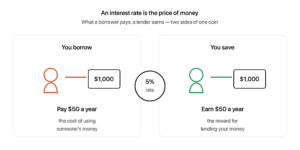
If you borrow $1,000 at a 5% annual interest rate, you pay $50 a year for the privilege of using that money. If you deposit $1,000 in a savings account paying 5%, you earn $50 a year. Same rate, two sides of the same coin: what a borrower pays, a lender receives.
This is why economists call interest “the price of money.” Just as the price of coffee tells you what a cup costs, the interest rate tells you what borrowing costs. And like any price, it is shaped by supply and demand — the supply of savings available to lend, and the demand from people and businesses who want to borrow.
Why interest exists at all
Why should borrowing money cost anything? Three reasons explain it, and together they justify why lenders expect a return.
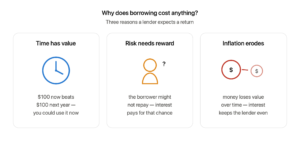
Time has value. Money today is worth more than the same money next year, because you could use it now — to invest, to spend, to earn. A lender giving up that opportunity expects compensation.
Risk needs rewarding. Any loan carries the chance the borrower will not repay. Interest compensates the lender for taking that risk. Riskier borrowers pay higher rates, which is why a government usually borrows more cheaply than a struggling company.
Inflation erodes value. As we saw in Inflation Explained, money loses purchasing power over time. A lender needs interest just to break even against inflation, and more than that to actually profit.
How interest rates ripple through your life
A change in interest rates touches almost every part of the economy. Here is how the same shift reaches different corners of your life.

Borrowing. When rates rise, mortgages, car loans, credit cards, and business loans all become more expensive. A higher mortgage rate can add hundreds of dollars to a monthly payment. When rates fall, borrowing becomes cheaper and loans more affordable.
Saving. Higher rates reward savers with more interest on deposits. Lower rates mean savings earn less, which pushes some people to seek returns elsewhere, such as in stocks.
Spending and investment. When borrowing is cheap, people and businesses borrow and spend more — buying homes, expanding factories, hiring staff. When borrowing is expensive, they pull back. This is the lever central banks pull to speed up or slow down the whole economy.
The value of the currency. Higher rates tend to attract foreign investment seeking better returns, which increases demand for the currency and strengthens it. This is why interest rate decisions move exchange rates worldwide.
Who sets interest rates?
This is where a common confusion needs clearing up, because two different things are at work.
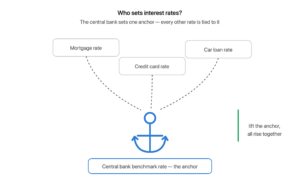
The central bank — in the US, the Federal Reserve — sets a key benchmark rate. This is the rate at which banks lend to each other overnight, and it acts as an anchor for the whole system. When people say “the Fed raised rates,” this benchmark is what they mean.
Everything else builds on top of that anchor. Commercial banks add a margin when they lend to you, based on your risk and their costs. So while the Fed does not directly set your mortgage rate, its benchmark rate strongly influences it. Move the anchor, and nearly every other rate in the economy moves with it.
As of 2026, the Federal Reserve’s benchmark rate sits in a range of roughly 3.5% to 3.75%, held steady after a series of moves in previous years as the Fed balanced the competing risks of inflation and a slowing job market.
The central bank’s balancing act
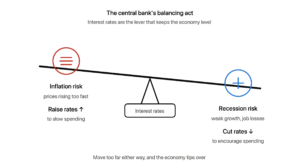
Central banks raise and lower rates as their main tool for steering the economy, and the logic runs in two directions.
To cool an overheating economy or fight inflation, they raise rates. Higher borrowing costs reduce spending and investment, which slows demand and eases upward pressure on prices. This is exactly what the Fed did aggressively to combat the inflation spike of 2022.
To revive a weak economy or fight the threat of recession, they cut rates. Cheaper borrowing encourages spending and investment, stimulating growth. This is what central banks do at the first sign of a serious downturn.
The difficulty is that these effects are powerful but slow and imprecise. Raise rates too much and you can trigger the recession you were trying to avoid. Cut too much and you can reignite inflation. This constant balancing act is the central challenge of monetary policy — and why every central bank decision is watched so closely.
Real vs nominal interest rates
One more distinction sharpens your understanding, and it connects directly to inflation.
The nominal interest rate is the headline number you see advertised. The real interest rate is that number minus inflation — what you actually earn or pay in terms of purchasing power.
If your savings account pays 4% but inflation is 3%, your real return is only about 1%. If it pays 2% while inflation runs at 3%, you are actually losing purchasing power despite earning interest. This is why, during periods of high inflation, savers can quietly go backwards even as their account balance grows. Always look at interest rates through the lens of inflation to see what is really happening.
Difficult words, made simple
| Term | Plain-English meaning |
|---|---|
| Interest rate | The cost of borrowing money, or the reward for lending it |
| Benchmark rate | The key rate set by a central bank that anchors all others |
| Nominal rate | The headline interest rate, before adjusting for inflation |
| Real rate | The interest rate after subtracting inflation |
| Central bank | The institution that sets a country’s benchmark rate |
| Monetary policy | A central bank’s use of rates to steer the economy |
| Default | When a borrower fails to repay a loan |
The big takeaway
An interest rate is simply the price of money — what borrowers pay and lenders earn. That single idea sits behind an enormous share of what happens in an economy. When rates rise, borrowing slows, saving is rewarded, spending cools, and the currency tends to strengthen. When rates fall, the reverse unfolds.
Because this one lever touches borrowing, saving, spending, investment, and currency values all at once, it is the central bank’s most powerful tool. Every time you hear that rates have moved, you now know it is not abstract financial noise — it is a decision that will reach your mortgage, your savings, and the prices you pay. Learning to read interest rates is learning to read the pulse of the entire economy.
Sources
Federal Reserve benchmark rate figures are drawn from Federal Reserve releases as of 2026. This article is general educational information, not financial advice.
Related reading: Inflation Explained.
Growmmunity publishes explanations, not financial advice.