
Unemployment Explained: What the Jobs Numbers Really Tell You
Unemployment is one of the most closely watched numbers in the entire economy, appearing in the news every single month and shaping decisions made everywhere from the Federal Reserve to your own kitchen table. It measures how many people want to work but cannot find a job — and behind that simple idea lies a powerful signal about the health of the whole economy. When you understand unemployment, you understand one of the clearest windows into whether the economy is thriving or struggling.
Today we will explain what unemployment actually measures, how it is counted, why it matters so much, why a low number is not always the unmixed good it seems, and how it connects to nearly everything else we have explored. As always, we build everything from clear, everyday examples.
What unemployment actually measures
The unemployment rate measures the share of people who want a job and are actively looking for one, but do not have one. It is expressed as a percentage of the workforce.
The key detail, often misunderstood, is who counts as “unemployed.” You are counted as unemployed only if you do not have a job and are actively looking for one. People who are not looking for work — retirees, students, or those who have given up searching — are not counted as unemployed at all. They are considered outside the workforce.
This means the unemployment rate is a ratio: the number of jobless people actively seeking work, divided by everyone in the workforce (those working plus those looking). If 100 people are in the workforce and 5 are jobless but searching, the unemployment rate is 5%.

How it is counted, and why that matters
Because of how unemployment is defined, the headline number does not always capture the full picture. Understanding this makes you a far sharper reader of economic news.
Consider what happens when people give up looking for work entirely. Because only active job-seekers are counted, someone who becomes so discouraged that they stop searching actually disappears from the unemployment rate. Strangely, this can make the unemployment rate fall even when the job market is weak, simply because discouraged people are no longer counted. This is why economists look beyond the headline rate.

One important companion figure is the participation rate — the share of working-age people who are actually in the workforce at all. If unemployment is low but the participation rate is also falling, it may mean people are leaving the workforce rather than finding jobs, a less healthy sign. Reading both numbers together tells a truer story than either alone.
Why a low unemployment rate isn’t always pure good news
Instinctively, low unemployment sounds entirely good — and mostly it is, since it means most people who want work can find it. But as we learned when exploring interest rates and the Federal Reserve, there is a surprising twist.
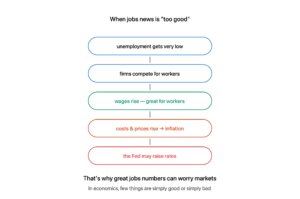
When unemployment gets very low, employers must compete harder to hire and keep workers, often by raising wages. Rising wages are wonderful for workers, but they can also push up the cost of doing business, and companies may raise their prices to cover those costs. This can feed inflation — the very thing the Fed works to control.
This is why, paradoxically, very good news about jobs can sometimes worry markets and the Fed. A red-hot jobs market can signal rising inflation ahead, making interest rate hikes more likely. It is a perfect example of a theme running through this whole series: in economics, few things are simply good or simply bad, and everything connects to everything else.
The link to recessions
Unemployment is tightly bound to the economic cycle we explored in Recessions and Depressions. In fact, it is one of the defining features of a downturn.
When the economy weakens, businesses sell less, so they cut costs — and cutting jobs is one of the most common ways they do it. Rising unemployment is therefore both a symptom of recession and a cause of it deepening, since people who lose jobs spend less, which weakens the economy further. This is the downward spiral we described earlier, with unemployment at its heart.
Because of this, unemployment is one of the most important signals of where the economy stands. A sharply rising unemployment rate is one of the clearest warning signs that the economy is heading into, or already in, a recession. Watching it is like taking the economy’s pulse.

Different kinds of unemployment
Not all unemployment is the same, and understanding the different types helps you see why some unemployment is normal and even healthy.

Frictional unemployment is the temporary joblessness that happens as people move between jobs — someone who quit one job and is spending a few weeks finding a better one. This is natural and even healthy, a sign of a dynamic economy where people can change jobs.
Structural unemployment happens when the skills people have no longer match the jobs available, often because of changing technology or industries. This is more painful and longer-lasting, requiring workers to retrain or relocate.
Cyclical unemployment is the joblessness caused by economic downturns, rising in recessions and falling in booms. This is the kind that most concerns policymakers, because it reflects a struggling economy rather than natural movement.
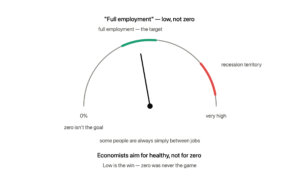
Because some unemployment is always normal, economists do not aim for zero. Instead they speak of “full employment” as the healthy level where only natural, frictional, and structural unemployment remain — not a literal zero.
Why this matters to you
The unemployment rate affects you whether or not you are looking for work. It shapes the Federal Reserve’s decisions on interest rates, which ripple into your borrowing costs, your savings, and the wider economy. A jobs report can move markets, currencies, and rates, so understanding it helps you anticipate those shifts.
It also tells you something vital about the security of your own situation. A strong jobs market means more opportunities, more bargaining power for higher wages, and greater job security. A weakening one signals caution — a time to be more careful with money and more aware of risk. Reading the unemployment trend helps you gauge the economic weather around your own life.
Most of all, understanding unemployment lets you decode one of the most important recurring stories in economic news. Every month, when the jobs numbers arrive and markets react, you will now understand what is really being measured, why it matters, and why the reaction is sometimes the opposite of what you would expect. You can see past the headline to the deeper truth: that behind every jobs number lies the health of the whole economy, and the lives of millions of people within it.
Difficult words, made simple
| Term | Plain-English meaning |
|---|---|
| Unemployment rate | The share of job-seekers who want work but can’t find it |
| Workforce | Everyone working or actively looking for work |
| Participation rate | The share of working-age people who are in the workforce |
| Discouraged worker | Someone who stopped looking, so isn’t counted as unemployed |
| Frictional unemployment | Brief joblessness while moving between jobs |
| Structural unemployment | When skills don’t match available jobs |
| Full employment | The healthy level where only natural unemployment remains |
The big takeaway
Unemployment measures the share of people who want work and are actively looking but cannot find it — a simple idea that offers one of the clearest windows into the economy’s health. How it is counted matters: because only active job-seekers count, the headline number can mislead, which is why economists also watch the participation rate and the different types of unemployment.
Low unemployment is mostly good but can signal rising wages and inflation, which is why strong jobs news sometimes worries the Fed and markets. Rising unemployment is one of the clearest signs of recession, sitting at the heart of the downward spiral. Understanding unemployment lets you take the economy’s pulse, decode a major monthly news story, and gauge the economic weather around your own life.
Sources
This article explains standard principles of how unemployment is measured and understood, drawing on widely accepted economic definitions. It is general educational information, not financial advice.
Related reading: Recessions and Depressions and Inflation Explained.
Growmmunity publishes explanations, not financial advice.