
What Is Money? Why a Piece of Paper Has Value
What is money, really? Take a dollar bill out of your wallet and look at it. It is a rectangle of cotton and linen with ink on it. Objectively, it is nearly worthless as an object. You cannot eat it, wear it, or build with it. And yet you can exchange it for food, clothing, or shelter — and the person accepting it will do so without hesitation.
Why? That question sits at the heart of how modern economies work, and the answer is stranger than most people realise. The problem money was invented to solve
To understand what money is, it helps to look at what the world was like without it.
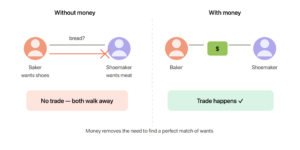
Imagine you are a baker in a village with no money. You have bread. You need shoes. So you find the shoemaker and offer to trade.
But there is a problem. The shoemaker does not want bread today — she already has plenty. What she actually wants is meat. So now you have to find a butcher who wants bread, trade your bread for meat, then bring that meat to the shoemaker and hope she still wants it. And if the butcher does not want bread either, you are stuck entirely.
Economists call this the “double coincidence of wants” problem. For any trade to happen under barter, two people must want exactly what the other has, at exactly the same moment. Most of the time, that does not happen — so most trades simply never occur.
Money solves this elegantly. The baker sells bread to anyone who wants bread and receives money. She then uses that money to buy shoes from the shoemaker, who can spend it on meat. Nobody had to match wants. Money became the universal bridge.
The three jobs money must do
Anything can serve as money, as long as it performs three functions well. Economists have used this framework for centuries, and it is the clearest way to understand what money actually is.
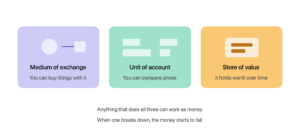
1. Medium of exchange. You can use it to buy things. People accept it in trade without needing to want the item itself.
2. Unit of account. It gives you a common measuring stick. Without money, comparing a bicycle to a laptop to a month’s rent is nearly impossible. With money, all three have a price and can be compared instantly.
3. Store of value. It holds worth over time. You can earn money today and spend it next year. This is why fresh fish never worked well as money — it rots. Gold worked brilliantly because it does not.
Keep these three jobs in mind, because when a currency collapses, it is always because one or more of these functions has broken down.
How money evolved
Money did not appear all at once. It evolved through recognisable stages, each solving a problem the previous stage could not.
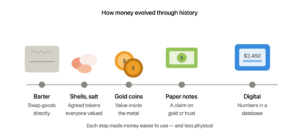
Barter came first — direct swaps of goods. It works in small communities but fails as soon as trade grows complex.
Commodity money came next. Communities settled on items everyone valued and would accept: shells, salt, cattle, beads. Roman soldiers were sometimes paid partly in salt, which is where the word “salary” comes from. These items were not useful because of what they did, but because everyone agreed to accept them.
Metal coins followed. Gold and silver were durable, portable, divisible, and naturally scarce — nearly ideal properties for money. A gold coin had value because the metal itself was valuable. This is called intrinsic value.
Paper money was the next leap, and a genuinely clever one. Carrying gold was heavy and dangerous, so people deposited gold with trusted institutions and received paper receipts. Those receipts could be exchanged back for gold at any time. Eventually people realised the receipts themselves could be traded directly — and paper money was born. Crucially, the paper had no value on its own. It was a claim on something valuable.
Digital money is where we are now. Most money today exists only as numbers in computer systems. When your salary arrives, no physical cash moves anywhere. A database at your employer’s bank decreases, and a database at your bank increases. That is the entire transaction.
The moment money changed forever: 1971
Here is the part that surprises most people when they first learn it.
For most of modern history, paper currencies were backed by gold. A US dollar was a promise: bring this to the government and you could exchange it for a fixed quantity of gold. The paper was a claim on real metal sitting in a vault.
In 1971, President Richard Nixon ended that arrangement. The United States stopped allowing dollars to be converted into gold. Overnight, the dollar became backed by nothing physical at all.
So what backs the dollar today? Three things, none of them tangible:
Government declaration. The US government declares the dollar to be legal tender, meaning it must be accepted for debts and taxes within the country.
Collective trust. You accept dollars because you are confident others will accept them from you. That belief, held by hundreds of millions of people simultaneously, is what gives the currency its power.
The economy behind it. A dollar represents a claim on the goods and services the American economy produces. A currency is ultimately only as strong as the economy standing behind it.
Money that works this way is called fiat money — from the Latin word meaning “let it be done.” It has value because a government declares it does and people believe it. Today, every major currency in the world is fiat money.
Why the dollar is not just another currency
All currencies are fiat, but they are not equal. The US dollar occupies a position no other currency comes close to.
Oil is priced in dollars globally. A large share of international trade is settled in dollars, even between two countries that are not American. Central banks around the world hold dollars as their primary reserve asset — a financial safety net.
This gives the United States what one French finance minister famously called an “exorbitant privilege.” America can borrow more cheaply than other countries, and decisions made by the US Federal Reserve ripple through every economy on Earth.
It also means that if you live outside the US and have never held a dollar, dollar movements still affect the price of your fuel, your imported goods, and your holidays abroad.
Where money actually comes from
Most people assume money is created when a government prints it. That is only a small part of the story — and the smaller part.
The vast majority of money in a modern economy is created by commercial banks making loans.
First, what is a commercial bank?

A commercial bank is simply the ordinary kind of bank you already use — the one where you keep your salary, use a debit card, or apply for a car loan. Names like JPMorgan Chase, Bank of America, HSBC, or your local high-street bank all describe commercial banks.
They are different from a central bank (such as the US Federal Reserve), which does not serve ordinary customers at all. A central bank manages the whole monetary system and sets interest rates. A commercial bank serves you.
The core job of a commercial bank is to act as a bridge between two groups of people: savers who have spare money sitting idle, and borrowers who need money now. The bank pays savers a small amount of interest to attract deposits, then lends that money to borrowers at a higher interest rate. The difference between those two rates is how the bank makes its living.
How lending creates new money
Here is where it gets interesting. Follow the numbers carefully, because this is one of the most surprising facts in economics.
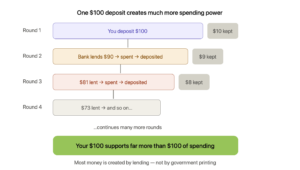
Round 1. You deposit $100 at your bank. The bank is required to keep only a fraction on hand as reserves — let us say 10%, so $10 stays put. The other $90 can be lent out.
Round 2. The bank lends $90 to someone buying a used bicycle. That person pays the bicycle seller, who deposits the $90 at their own bank. That bank keeps $9 and can lend out $81.
Round 3. The $81 is lent to someone else, spent, and deposited again. That bank keeps roughly $8 and lends about $73.
And the cycle continues, each round slightly smaller than the last.
Now notice something remarkable. Your original $100 deposit is still entirely yours — you can walk in and withdraw it. But at the same time, the bicycle seller has $90, the next borrower spent $81, and so on. All of that new spending power exists in the economy alongside your untouched $100.
No printing press was involved. Money was created by the simple act of lending.
This is why banks sit at the centre of every modern economy, and why banking crises are so devastating. When banks stop lending, the money supply contracts, and the circular flow slows sharply.
What happens when trust breaks
Since fiat money is built on belief, what happens when that belief evaporates?
The historical answer is hyperinflation — inflation so extreme and so fast that money effectively stops working.
What hyperinflation actually looks like
The clearest way to understand it is through the price of a single ordinary item. In Germany during the early 1920s, one loaf of bread cost roughly this much:
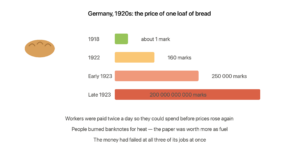
Read that last figure again. Two hundred billion marks for a loaf of bread. Within five years, the same item went from costing about one unit of currency to costing two hundred billion.
Daily life became surreal. Workers demanded to be paid twice a day, so they could rush out and spend their wages during lunch before prices rose again by evening. People carried cash in wheelbarrows and suitcases. And most famously, some people burned banknotes in their stoves for heat — because the paper had become worth more as fuel than as money.
Why it happens: too much money, too few goods
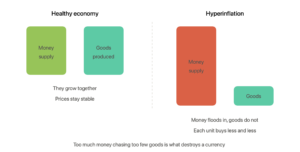
The mechanism is simpler than it sounds. Imagine an economy that produces 100 loaves of bread and has $100 in circulation. Each loaf costs roughly $1.
Now suppose the government prints an additional $900, so there is $1,000 in circulation — but the bakeries still only produce 100 loaves. There is now ten times as much money chasing exactly the same amount of bread. The price rises to about $10 per loaf. Nothing about the bread changed. Only the amount of money did.
Hyperinflation is this process running out of control. Governments in crisis — often after a war, a collapse in production, or a debt spiral — print money to pay their bills. But printing money does not create more bread, more fuel, or more housing. It just adds more claims on the same limited pile of goods.
It is not only history
Zimbabwe experienced this in 2008, eventually issuing a 100 trillion dollar banknote that could barely buy groceries. Venezuela went through its own collapse more recently, with many citizens abandoning the local currency in favour of US dollars for daily transactions.
In every case, the pattern is identical. The government prints money far faster than the economy produces goods. Prices climb. People notice and start spending money as fast as they receive it, which pushes prices up even faster. Eventually, people stop believing the currency holds value at all — and once that belief goes, the money fails at all three of its jobs simultaneously. It is no longer a store of value, no longer a reliable unit of account, and finally no longer accepted as a medium of exchange.
This is the deep reason central banks are so obsessive about controlling inflation. They are not just managing prices — they are protecting the collective belief that makes money function at all.
Difficult words, made simple
| Term | Plain-English meaning |
|---|---|
| Barter | Trading goods directly without using money |
| Double coincidence of wants | Both traders must want exactly what the other has |
| Medium of exchange | Something widely accepted in payment for goods |
| Store of value | Something that keeps its worth over time |
| Fiat money | Money backed by government declaration and trust, not metal |
| Legal tender | Money that must legally be accepted to settle debts |
| Reserve currency | A currency held by central banks worldwide as a safe asset |
| Hyperinflation | Extremely rapid price rises that destroy a currency’s value |
The big takeaway
Money is not valuable because of what it is made of. It is valuable because of what everyone agrees it can do.
A dollar bill is a shared social agreement, printed on paper. It works because you believe others will accept it, and they believe the same about you. Strip away that mutual belief and the paper becomes exactly what it physically is — a rectangle of cotton with ink on it.
Understanding this changes how you read economic news. When you hear that a central bank is “printing money,” or that a currency is “losing confidence,” or that inflation is “eroding purchasing power,” you now know these are all statements about the same underlying thing: the strength of a collective belief.
Sources
Historical details on the gold standard, the 1971 Nixon shock, and hyperinflation episodes are drawn from standard economic history references. This article is general educational information, not financial advice. For decisions about your own money, consult a qualified professional.
Growmmunity publishes explanations, not financial advice.