
Why Is the Penny Going Away? The Coin That Cost 3.7 Cents to Make 1 Cent
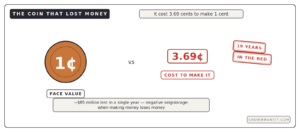
Why is the penny going away? Because of the single funniest number in American economics: last fiscal year, it cost the US Mint 3.69 cents to manufacture one penny. The government lost money on every single coin — and had for 19 consecutive years, to the tune of roughly $85 million in a single year.
So after 233 years, it’s over. The Treasury minted its final penny in late 2025 and has stopped putting new ones into circulation; the last blanks have been stamped, shortages arrived even sooner than expected, and stores nationwide are scrambling to figure out what happens when the smallest unit of American cash simply… runs out.
This is a genuinely delightful economics lesson disguised as small change: it teaches why money costs money to make, what happens to your $19.82 purchase in a penny-less world, who wins and loses from rounding, and why a coin can be simultaneously worthless and beloved. In plain English, as always. (New to economics? Start with What Is an Economy? — and for the deeper question of why coins have value at all, What Is Money?)
First: how does a country lose money by making money?
Normally, making money is literally profitable. A $100 bill costs cents to print; the government pockets the difference. Economists call that profit seigniorage — one of the oldest perks of running a currency.
The penny ran seigniorage in reverse. A modern penny is mostly zinc with a copper coating, and as metal, labour, and shipping costs rose over decades, the manufacturing bill crossed the coin’s face value back in the mid-2000s — and never came back. By last year: 3.69 cents of cost for 1 cent of money. (For comparison, a dime costs under 6 cents and a quarter under 15 — both still profitable.) Every penny minted subtracted from the public purse.
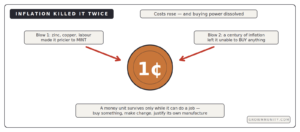
Here’s the beginner’s twist worth savouring: inflation killed the penny twice. It raised the cost of making the coin — and it eroded what the coin could buy, until a penny couldn’t purchase anything at all. The forces from our inflation explainer spent a century grinding the penny’s purpose away; the Mint just made it official.
What actually changes at the cash register
The practical question everyone asks: what happens to prices like $19.82?
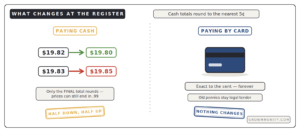
If you pay by card or phone: nothing. Digital payments stay exact to the cent, forever. The penny’s death only touches physical cash.
If you pay cash: rounding. The emerging standard — borrowed from Canada, Australia, and New Zealand, which retired their smallest coins decades ago — is to round the final total (not individual prices) to the nearest 5 cents. So a $19.82 cash total becomes $19.80; a $19.83 total becomes $19.85. Roughly half of totals round down in your favour, half round up.
Your existing pennies still work. Every penny ever minted remains legal tender — spend them, deposit them at the bank, or keep a few as souvenirs of a 233-year run. They just won’t be replaced as they vanish into couch cushions and jars.
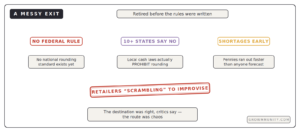
And the transition is genuinely messy. Here’s the wrinkle the headlines miss: America retired the coin before writing the rounding rules. There’s no federal rounding law yet, and in at least ten states and localities, existing cash laws actually prohibit businesses from rounding transactions — leaving retailers, in the words of one National Retail Federation official, “scrambling” to improvise policies as penny supplies dry up faster than anyone forecast.
The big fear: will rounding secretly raise prices?
This deserves an honest answer, because it’s the one thing people genuinely worry about.
The fear: stores set prices ending in .99 for a reason. Won’t they engineer totals that always round up, skimming a couple of cents from every cash customer — a tiny, invisible tax multiplied by billions of transactions?
The evidence: reassuring, mostly. Rounding applies to the total after tax, which is nearly random in its final digit — a basket of items plus sales tax doesn’t land on .99 the way a single price does. Studies of Canada’s 2012 transition and analyses cited by US banks suggest round-ups and round-downs largely offset, leaving the average consumer’s cost essentially unchanged. The caveat: any burden that does exist falls on cash-reliant households — disproportionately lower-income and unbanked Americans — while card users are untouched. A small effect, but not an evenly shared one; only about 14% of US payments are made in cash now, which is both why the penny became expendable and why most people won’t notice it’s gone.

Why keep a money-losing coin for 19 years? (The honest debate)
The “should’ve died decades ago” view: the penny failed every test of money — it couldn’t buy anything, vending machines and parking meters rejected it, most minted pennies made exactly one trip from bank to pocket to jar, and each one was manufactured at a 269% loss. Canada, Australia, and New Zealand proved retirement is painless. Keeping it was pure nostalgia, subsidised by taxpayers; the US even ran this exact play before, retiring the half-cent in 1857 — when the half-cent, adjusted for inflation, was worth more than today’s dime.
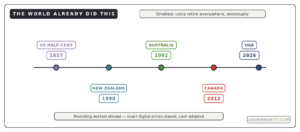
The “not so fast” view: the rushed exit shows why the penny’s defenders wanted a plan first: no federal rounding standard, conflicting state laws, and shortages hitting before policies exist. Sceptics also note the awkward economics next door — the nickel costs even more to make relative to face value, and if pennyless registers demand more nickels, the Mint could lose money faster than before. And charities that lived on penny drives, plus cash-dependent households, absorb real if small costs. The destination was right, this camp argues; the route was chaos.
What both sides agree on: this was ultimately inflation’s verdict, not a politician’s. When a unit of money becomes too small to matter, every country eventually retires it — the only choice is whether to do it tidily.
Difficult words, made simple
| Term | Plain-English meaning |
|---|---|
| Seigniorage | The profit from making money — face value minus production cost. The penny’s was negative |
| Face value | What a coin is worth as money (1¢) — versus the 3.69¢ it cost to make |
| Legal tender | Money that must be accepted for debts — your old pennies keep this status forever |
| Cash rounding | Adjusting cash totals to the nearest 5¢ — $19.82→$19.80, $19.83→$19.85 |
| Rounding the total | Only the final after-tax sum rounds — individual prices can still end in .99 |
| The Mint | The government’s coin factory — which lost ~$85M a year on pennies alone |
| Unbanked | Households without bank accounts — the most cash-reliant, most affected by rounding |
| The half-cent | America’s precedent: retired in 1857, when it bought more than today’s dime |
| The nickel problem | The 5¢ coin also costs more than face value — the sequel nobody’s solved |
| Coin drive | Charity collections built on pennies — a small casualty of the transition |
The big takeaway
The penny’s death is a one-cent masterclass in how money really works. A currency unit survives only while it can do a job — buy something, make change, justify its own manufacture — and inflation slowly stripped the penny of all three, until the government was paying nearly 4 cents to produce 1 cent of money, 19 years running. The 1857 half-cent, Canada’s 2012 penny, and now America’s: same story, same verdict, different centuries.
Three things worth keeping. First, money costs money to make, and when the cost exceeds the face value, the coin’s days are numbered — that’s negative seigniorage, and now you know the word. Second, rounding hits totals, not prices, and only in cash — your card payments never change. Third, watch the nickel: it inherits both the penny’s job and the penny’s disease, which means this story has a sequel.

New to economics? Start with What Is Money? and Inflation Explained — the two ideas that, together, wrote the penny’s obituary.
Sources
This article synthesizes reporting from The Hill (Nexstar), the Washington Examiner, and Fremont Bank’s consumer explainer:
• The Hill: Death of the penny: Why the US is minting its last, and what happens now
• Washington Examiner: The penny is going away in early 2026: What it means for you
• Fremont Bank: What the end of the penny means for you and your wallet
All figures are drawn from those reports and the US Mint data cited within them. Background: Penny (United States coin) and Seigniorage. This article presents both sides of the retirement debate without endorsing either. This is general information, not financial advice.
Growmmunity publishes explanations, not financial advice.