
Risk and Return: The Fundamental Trade-Off Behind Every Investment
Risk and return is the single most important relationship in all of investing, and understanding it is what separates thoughtful investors from gamblers and worriers alike. Every financial decision you will ever make — where to keep your savings, whether to invest, what to invest in — comes down to a trade-off between these two forces. Grasp how they relate, and the entire landscape of investing suddenly becomes navigable.
Today we will explain what risk and return really mean, why they are inseparably linked, and how understanding their relationship helps you make sensible decisions without either reckless greed or paralyzing fear. As always, we will keep everything clear and grounded in everyday examples.
What “return” means
Return is simply the reward you get for investing your money — how much it grows. If you invest $100 and it becomes $110, you earned a 10% return. Return is the gain that makes investing worthwhile in the first place; it is the reason people put money to work rather than leaving it under a mattress.

Returns can come in different forms. A stock might grow in price, as we saw in Why Stock Prices Move. A bond pays regular interest, as we covered in Bonds Explained. A savings account pays a small amount of interest. In every case, the return is the reward for putting your money somewhere in the hope it will grow.
What “risk” means
Risk is the possibility that things do not go as hoped — that you lose some or all of your money, or that returns fall short of expectations. It is the uncertainty attached to any investment.
Some investments carry very little risk. Money in an insured savings account is extremely safe; you are almost certain to get it back. Other investments carry much more risk. A single company’s stock might soar, or it might collapse and leave you with nothing. Risk measures how much the outcome can vary, and how bad the worst case might be.
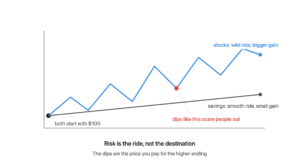
Importantly, risk is not simply “bad.” It is uncertainty in both directions. A riskier investment has a wider range of possible outcomes — both better and worse. Understanding risk means understanding that range, not just fearing it.
The unbreakable link: no reward without risk
Here is the heart of the matter, the principle that governs all investing: higher potential returns almost always come with higher risk. You cannot generally get large rewards without accepting greater uncertainty. The two are bound together.
Why must this be true? Think about it from the other side. If some investment offered high returns with no risk, everyone on earth would rush to put all their money into it. That flood of demand would quickly drive up its price and push its returns back down, until the easy reward disappeared. In a world full of people seeking profit, guaranteed high returns simply cannot survive. Reward has to be paid for with risk.

This is why any offer promising high returns with little or no risk should set off alarm bells. It contradicts the most basic law of investing, and such promises are very often signs of a scam. The link between risk and return is not just a tendency — it is close to an iron rule.
The risk-return spectrum
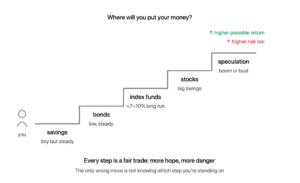
Different investments sit at different points along a spectrum from low-risk, low-return to high-risk, high-return. Seeing them laid out makes the trade-off concrete.
| Type | Typical risk | Typical return |
|---|---|---|
| Insured savings account | Very low | Very low |
| Government bonds | Low | Low |
| Company bonds | Moderate | Moderate |
| Broad stock index funds | Higher | Higher (over time) |
| A single company’s stock | High | Potentially high or negative |
Notice the pattern: as you move down toward higher potential returns, the risk rises with it, step by step. There is no row offering high returns at low risk, because in the real world, that row does not exist.
How investors manage risk
If risk is unavoidable when seeking returns, the goal is not to eliminate it — that would mean giving up all reward — but to manage it wisely. Investors use several time-tested tools.
Diversification is the most powerful, and we met it in Index Funds Explained. By spreading money across many investments, you ensure no single failure can ruin you. If you own hundreds of companies and one collapses, the damage is small. Diversification is the closest thing investing has to a free gift: it reduces risk without necessarily reducing your expected return.

Time is another great ally. Risky investments like stocks swing wildly in the short term, but historically their ups and downs have smoothed into growth over long periods. The longer your time horizon, the more short-term risk you can afford to ride out, as we saw with compounding.

Matching risk to your situation is essential. Money you will need next month should be kept very safe, because you cannot afford for it to fall right before you need it. Money you will not touch for decades can afford to take on more risk in exchange for higher potential growth. Wise investing means aligning the risk you take with your own goals and timeline.

Risk tolerance: knowing yourself
Beyond the math, there is a human side to risk. Different people can handle different amounts of it — not just financially, but emotionally. This is called risk tolerance.
Some people can watch an investment drop 20% and stay perfectly calm, confident it will recover. Others lose sleep and panic-sell at the worst possible moment. Neither is wrong, but knowing which kind of person you are matters enormously. An investment that is mathematically sensible but keeps you awake at night may not be right for you, because the greatest danger is often not the market itself but being frightened into a bad decision at the bottom.
Honest self-knowledge — understanding how much uncertainty you can genuinely live with — is as important as understanding the investments themselves. The best strategy is one you can actually stick with through the inevitable ups and downs.
Why this matters to you
The risk-return trade-off is the foundation beneath every financial decision, whether or not you ever call yourself an investor. It explains why your savings account pays so little (it is nearly risk-free), why stocks can be rewarding but nerve-wracking (higher risk, higher potential return), and why anything promising big, safe, guaranteed returns is almost certainly too good to be true.
Understanding it protects you in both directions. It guards you against reckless greed, by reminding you that chasing high returns always means accepting real risk. And it guards you against paralyzing fear, by showing that sensible risk, managed through diversification and time, is not gambling but the reasonable price of growth. You learn to neither hide all your money in fear nor throw it away in hope.
Above all, it gives you a calm, clear framework for thinking about money. Every choice becomes a thoughtful question: what return am I seeking, what risk does it require, and does that trade-off fit my goals and my temperament? Answer that honestly, and you are already investing more wisely than most — simply by understanding the fundamental bargain at the heart of it all.
Difficult words, made simple
| Term | Plain-English meaning |
|---|---|
| Return | The reward or gain you get from an investment |
| Risk | The chance that an investment loses money or disappoints |
| Risk-return trade-off | The rule that higher returns require accepting higher risk |
| Diversification | Spreading money across many investments to reduce risk |
| Time horizon | How long before you will need the money |
| Risk tolerance | How much uncertainty you can handle, financially and emotionally |
| Volatility | How much an investment’s value swings up and down |
The big takeaway
Risk and return are two sides of the same coin. Return is the reward for investing; risk is the uncertainty you accept to earn it. The fundamental law is that they are bound together — higher potential returns almost always demand higher risk, and any promise of high, safe, guaranteed returns defies this law and should be deeply distrusted.
The goal is not to avoid risk entirely, which would mean giving up all growth, but to manage it wisely through diversification, through time, and by matching the risk you take to your own goals and temperament. Understand this single trade-off, and every financial decision becomes clearer and calmer. You stop chasing impossible free rewards and stop fearing all uncertainty, and instead start asking the one question that matters: is this the right balance of risk and return for me? That question, asked honestly, is the beginning of wise investing.
Sources
This article explains standard principles of the risk-return relationship in investing. It is general educational information, not financial advice. Always consider your own circumstances and, where appropriate, consult a qualified professional before investing.
Related reading: Index Funds Explained and Bonds Explained.
Growmmunity publishes explanations, not financial advice.