
Great Profits, But the Market Still Fell
On Friday, August 14, 2026, something slightly confusing happened in Europe’s stock market. Companies were reporting excellent profits — some of the best in years — and yet the overall market went down, ending a four-week winning streak.
How can good news and a falling market happen at the same time? The best way to picture it is a scale — the kind with two trays that weighs one side against the other. On one tray sits the good news, on the other the bad news. Whichever side is heavier decides which way the market moves that day.
First, What Is the “STOXX 600”?
When you hear “European shares fell,” what actually fell? The main number people watch is the STOXX 600.
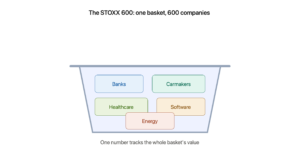
Think of it as a giant shopping basket holding 600 of Europe’s biggest companies — banks, carmakers, drug companies, software firms, and more. Instead of tracking each company one by one, we track the whole basket’s value with a single number. When the STOXX 600 goes up, European companies on average are worth more. When it goes down, they’re worth less.
On Friday, the STOXX 600 ended 0.2% lower at 657.86, and it fell 0.3% over the week. Small numbers — but notable, because it broke a four-week streak of gains.
On the Good-News Tray
One side of the scale held strong, positive weight.
Excellent company earnings. “Earnings” simply means how much profit companies made. This quarter, European companies did remarkably well — aggregate earnings are forecast to grow 23.4%, the biggest increase in nearly four years. Profits in energy and materials companies soared in particular.
A steady economy. Europe’s economy grew 0.4% in the second quarter — not spectacular, but solid and exactly what economists expected. A calm, predictable economy makes investors comfortable.
A place to hide from AI worries. Here’s an interesting one. Many global investors have poured money into AI-related tech stocks, and some are now nervous those stocks have climbed too high. Europe has relatively fewer big tech companies, so investors have been moving some money there to spread out their risk — like not putting all your eggs in one basket.
On the Bad-News Tray
The other side held weight heavy enough to win, just barely.
Rising oil prices. Crude oil rose 1.39%. When oil gets more expensive, it costs more for companies to make and ship almost everything. That squeezes profits and worries investors.
Geopolitical tension. Iran and the US remain in a standoff over the Strait of Hormuz — a narrow stretch of sea that a huge share of the world’s oil passes through. When that route is threatened, oil prices tend to stay high and uncertain, which unsettles markets.
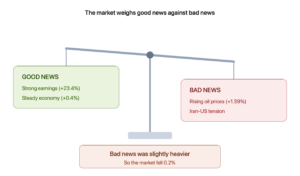
On Friday, this tray tipped the scale. The bad news was slightly heavier than the good, the market dipped, and the four-week rally ended.
Why the Oil Connection Reaches Everyone
The Strait of Hormuz might sound distant and irrelevant if you’re just filling up your car — but it’s deeply connected to your daily life. A large portion of the world’s oil travels through that narrow waterway. When tension rises there, traders worry supply could be disrupted, so oil prices climb.
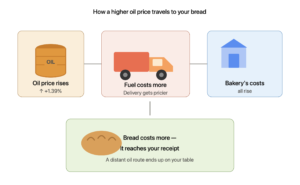
Consider a simple example. Imagine a small bakery that pays for delivery vans, ovens, and imported ingredients. When oil prices rise, the bakery’s delivery costs, heating bills, and shipping fees all creep up. To protect its profit, it may raise the price of bread. Multiply that across millions of businesses, and you can see how a diplomatic standoff on the other side of the world eventually reaches your grocery receipt.
That’s why this “stock market story” is really an everyone story — the same oil-price pressure that nudged European stocks down also quietly shapes the cost of everyday things.
The Investing Lesson Hidden Here
There’s a useful takeaway for anyone curious about investing.
A strong earnings season doesn’t automatically mean stocks go up on any given day. Markets weigh many things at once — profits, oil, politics, and mood. A single day’s dip after weeks of gains is normal and doesn’t erase the bigger picture: the STOXX 600 is still within 1% of a record high.
One professional investor quoted in the report described broadening their European investments across all sectors, rather than betting on just one. That echoes the “don’t put all your eggs in one basket” idea — a principle that applies no matter where someone invests.
The Winners and Losers of the Day
Even on a down day, some parts of the market rise while others fall. Here’s a quick snapshot:
| Went Up That Day | Went Down That Day |
|---|---|
| Defence stocks (+1.2%) | Healthcare stocks (−1.5%) |
| Maersk, a shipping giant (+8.7%, a 4-year high) | Zealand Pharma (−5.8%) |
| Software firms like SAP (+2.7%) and Nemetschek (+8.4%) |
This is a good reminder: “the market went down” is an average. Underneath that average, individual companies can move in completely opposite directions depending on their own news.
Difficult Words, Made Simple
| Term | Plain-English Meaning |
|---|---|
| STOXX 600 | A basket tracking 600 of Europe’s biggest companies |
| Earnings | How much profit a company made |
| Rally | A stretch of time when prices keep rising |
| Crude oil | Unrefined oil — the raw material behind fuel and much more |
| Strait of Hormuz | A narrow sea route that much of the world’s oil passes through |
| Diversifying | Spreading money across many investments to reduce risk |
The Big Takeaway
A market’s daily move is rarely about one thing. It’s a scale weighing forces that lift it (good earnings, a steady economy) against forces that drag it down (expensive oil, political tension). On Friday, the down side was heavier by a hair.
And notice how connected it all is. A standoff over a distant waterway raises oil prices, which pressures company profits, which nudges a stock index lower — and also quietly affects the price of everyday things. At Growmmunity, that’s what we love to trace: not just what happened, but how it reaches all the way to your everyday life.
Source
This article is based on reporting by Ragini Mathur, Tharuniyaa Lakshmi, and Johann M Cherian for Reuters, published on Yahoo Finance. Read the original report here: European shares snap 4-week rally as higher oil prices temper strong earnings.
All figures come from that report. The scale and bakery are simplified illustrations created to explain the concepts. Market data changes constantly — always check current information before making financial decisions.
Growmmunity publishes explanations, not financial advice. For decisions that affect your money, consult a qualified professional.
2 thoughts on “Great Profits, But the Market Still Fell: Why European Stocks Dropped”