
Is AGI Already Here? What Nvidia’s $96 Billion Quarter Really Tells Us
In the last week of August 2026, two stories about the same company landed at the same time — and together they say more about where AI is heading than either does alone.
Story one: Nvidia, the company that makes the chips powering almost all modern AI, reported $96.22 billion in revenue for a single quarter — more than double a year earlier, and far beyond what Wall Street expected.
Story two: on the very same earnings call, Nvidia CEO Jensen Huang was asked about AGI — artificial general intelligence, the milestone the entire industry claims to be racing toward. His answer was startling. In many respects, he said, AGI is already here. And more than that: the milestone itself is “kind of senseless at this point.”
The most powerful chipmaker in the world just made record money selling the machinery of AI — and dismissed the industry’s favourite finish line in the same breath. This guide unpacks what happened, what AGI actually means, why Huang said what he said, and how a beginner should read all of it. (New to how AI costs and revenues work? Our explainer on AI Tokenomics is the perfect companion to this story.)
First: what is Nvidia, and why does one chipmaker matter this much?
If AI is a gold rush, Nvidia is not a gold miner. Nvidia sells the shovels.
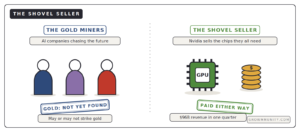
Every major AI system — chatbots, image generators, coding assistants — runs on specialised chips called GPUs (graphics processing units). Nvidia designs the most powerful ones, and nearly every big AI company on earth buys them: Amazon, Meta, Google, OpenAI, and thousands more.
That position explains the astonishing numbers:
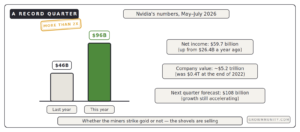
• Revenue: $96.22 billion in one quarter — more than double last year
• Net income: $59.69 billion — up from $26.42 billion a year earlier
• Data centre revenue alone: $89 billion, also more than doubled
• Company value: roughly $5.2 trillion, up from $400 billion at the end of 2022
To put that last number in perspective: in about three and a half years, Nvidia’s value grew thirteen-fold. During a gold rush, the miners may or may not strike gold — but the shovel seller gets paid either way. That is exactly what these results show: whether or not any particular AI company succeeds, they all buy chips first.
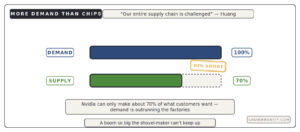
And demand still exceeds what Nvidia can make. Huang told analysts that the entire supply chain is strained and the company can currently supply only about 70% of what customers want. The five biggest cloud companies alone are expected to spend nearly $800 billion on infrastructure this year, rising to $1.3 trillion in 2027.
Now the other story: what is AGI, and what did Huang actually say?
AGI — artificial general intelligence — is the idea of an AI that can match or surpass human thinking across a wide range of tasks, not just one specialty. Today’s AI is brilliant at specific things but still fails at tasks an ordinary person finds easy. AGI would close that gap.
Here is the problem, and it matters for everything that follows: nobody agrees on what AGI actually means. There is no official definition, no agreed test, no referee. Which means anyone can claim it, and no one can prove them wrong.
Watch how the industry’s biggest names use the same word to mean completely different things:
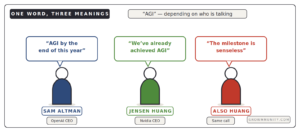
Sam Altman (OpenAI): said in a recent interview that OpenAI believes it will achieve AGI by the end of this year. For him, AGI is an imminent milestone — a finish line about to be crossed.
Jensen Huang (Nvidia): asked about Altman’s claim on the earnings call, he replied: “For many tasks, we could say that we’ve already achieved AGI.” Then he went further: “I think of all of those milestones… they’re kind of senseless at this point.”
Already here, arriving in December, or a meaningless question — depending on who is talking. Same word, three different meanings.
The contradiction hiding in Huang’s own words
Here is the detail that makes this story genuinely interesting, and it comes from Huang himself.
Back in March 2026, podcaster Lex Fridman asked Huang whether an AI could start, build, and run a billion-dollar company within 20 years. Huang’s answer: “I think it’s now. I think we’ve achieved AGI.”
But in the very same conversation, he added a qualifier. An AI might create a billion-dollar viral app, he said — but it could not build a company like Nvidia. His exact words: “The odds of 100,000 of those agents building Nvidia is zero percent.”
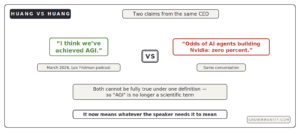
Read those two statements together. AGI is here — but AI cannot do the thing Huang himself did. Both claims cannot be fully true under one definition of AGI. What the contradiction reveals is that “AGI” has stopped being a scientific term and become a rhetorical one. It now means whatever the speaker needs it to mean in that moment.
An analogy: imagine restaurant owners arguing about whether anyone has achieved “perfect cooking.” One says perfection arrives next year. Another says his kitchen achieved it long ago — then admits his dishes still can’t match a home-cooked meal. At some point you realise the argument isn’t really about cooking. It’s about whose restaurant gets the customers.
Why would Huang dismiss the industry’s favourite milestone?
This is the question worth sitting with, because the answer connects the two stories.
Listen to what Huang said he cares about instead. The focus, he argued, should be on whether AI is “doing productive and useful work.” And from a company perspective: “generating profitable tokens.” In his earnings statement he put it even more directly: “AI has reached its inflection point. It’s doing useful work. Its tokens are productive and profitable. Now, compute is revenue.”
A quick translation for beginners. When AI processes your question and writes an answer, it works in small units of text called tokens. Every token costs computing power — and computing power means Nvidia chips. So “profitable tokens” means: every piece of work AI does now generates real money. And “compute is revenue” means: buying computing power is no longer an experiment or a bet — it directly produces income. (We explained this whole token economy in AI Tokenomics: Why Companies Keep Getting Surprised by Their AI Bills.)
Now the two stories click together. Think about what each man’s company needs:
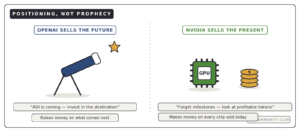
OpenAI needs the future to sound extraordinary. It burns enormous amounts of money and raises funding based on what is coming next. “AGI by the end of the year” is a reason to invest in the destination.
Nvidia needs the present to be profitable. It makes money on every chip sold today, whether or not AGI ever arrives. “The milestone is senseless — look at the useful work being done now” is a reason to keep buying shovels regardless of when, or whether, anyone strikes gold.
Neither man is necessarily lying. But neither is offering a neutral scientific judgement, either. Each definition of AGI happens to be the one that suits the business of the person defining it. That is not a scandal — it is simply how you should read CEO statements about the future: as positioning, not as prophecy. We saw the same pattern when tech leaders published their AI manifestos, and when CEOs made sweeping claims about AI and the future of jobs.
The nervousness underneath the record numbers
Here is the part of the earnings story that headlines tend to bury. Even with results this spectacular, investors are uneasy — and the article spells out why.
The scale of the bet keeps growing. Trillions of dollars are being poured into AI infrastructure. The unresolved question is whether AI will generate enough real economic value to justify it. Nvidia’s revenue proves that companies are spending heavily on AI. It does not yet prove that those companies are earning heavily from AI. The shovel seller’s profits tell you the miners are digging — not that they’ve found gold.

Markets can fall even when profits are great. If spending ever slows, the companies that sold the infrastructure feel it first. We covered exactly this dynamic — strong earnings, falling stocks — in Great Profits, But the Market Still Fell.
Public pushback is growing. The AP article notes rising objections to data centre expansion and fears that rapid AI adoption could cost many people their jobs. Notice the tension: the same “productive tokens” that delight shareholders are what worry workers.
None of this means a crash is coming. It means the record numbers and the anxiety are not contradictory — they are two views of the same enormous bet, seen from different seats.
So how should a beginner actually read these two stories?
Four takeaways, stated as neutrally as we can manage:
1. When someone says “AGI,” always ask: as defined by whom? The word currently has no fixed meaning. A claim that AGI is here, near, or meaningless tells you as much about the speaker’s incentives as about the technology.
2. Follow the revenue, not the vocabulary. Huang’s most honest sentence may be the least quotable one: compute is revenue. Whatever you call the technology, real money is changing hands at historic scale. That is measurable; “AGI” is not.
3. The shovel seller’s success is real — and it is a different fact from the miners’ success. Nvidia’s numbers prove massive investment in AI. Whether that investment pays off for the companies making it is a separate question that remains genuinely open.
4. Both optimists and sceptics have a real case. The optimist points to doubled revenues, accelerating growth, and demand outrunning supply. The sceptic points to trillions spent against unproven returns, and a market priced for perfection. Serious people hold each view. A beginner does not need to pick a side — only to understand what each side is looking at.
Difficult words, made simple
| Term | Plain-English meaning |
|---|---|
| AGI | AI that matches or beats human thinking across many tasks — with no agreed definition or test |
| GPU | The specialised chip that powers AI — Nvidia’s core product |
| Token | The small unit of text AI works in; every token consumed costs computing power |
| “Compute is revenue” | Huang’s claim that buying computing power now directly produces income, not just experiments |
| Earnings call | A quarterly call where a company reports results and answers analysts’ questions |
| Hyperscalers | Giant cloud-computing companies (Amazon, Meta, Google) that buy chips in enormous volume |
| Net income | Profit left after all costs — Nvidia’s was $59.69 billion in one quarter |
| Market value | What all of a company’s shares are worth together — Nvidia’s is about $5.2 trillion |
| AI agent | AI that carries out multi-step tasks on its own, beyond answering single prompts |
| Supply chain | Everything needed to manufacture and deliver a product — currently Nvidia’s biggest constraint |
The big takeaway
Two stories, one lesson. Nvidia’s record quarter shows that the AI boom is, right now, very real — measured in dollars, the realest thing there is. And Jensen Huang’s dismissal of AGI shows that the industry’s favourite word for the future has become so stretched that even the man selling the machinery no longer finds it useful.
Put differently: the money is concrete, and the milestone is fog. A beginner reading AI news in 2026 is better served by watching the first and staying politely sceptical of the second.
Three things worth watching from here: whether Nvidia hits its $108 billion forecast next quarter, whether OpenAI actually declares AGI by year’s end — and if so, by whose definition — and whether the trillion-dollar infrastructure bet starts showing returns in the earnings of the companies buying the chips, not just the one selling them.
New to economics? Start with our foundational guide, What Is an Economy? — and see AI Tokenomics for how the token economy in this story actually works.
Source
This article is based on reporting by the Associated Press: Strong AI chip demand fuels Nvidia’s Q2 results well beyond Wall Street’s expectations (by Alex Veiga), and by Mashable: Nvidia CEO Jensen Huang says AGI is already here — and the milestone is ‘senseless’ (by Matt Binder).
All figures and quotes are drawn from those reports and the sources cited within them. This article aims to present both optimistic and sceptical views of the AI boom fairly and does not endorse either. This is general information, not financial advice. For investment decisions, consult a qualified professional.
Growmmunity publishes explanations, not financial advice.