
Oil and Economy: Why the Price of Crude Moves the Whole World
Oil is the single most important commodity on earth, and its price ripples through almost every part of the economy and your daily life. It fuels the cars, trucks, ships, and planes that move people and goods. It heats homes and powers factories. It is a raw material in plastics, fertilizers, medicines, and countless everyday products. When the price of oil moves sharply, the effects reach the price of your groceries, your flights, your fuel, and much more — which is why the world watches crude oil prices so closely.
Today we will explain why oil matters so much, what makes its price rise and fall, why a conflict in one region can send prices soaring worldwide, and how all of this reaches your wallet. We will use the current global situation as our anchor, and build everything from clear examples.
Why oil matters so much
Oil’s importance comes from how deeply it is woven into modern life. It is not just fuel — it is the lifeblood of the entire physical economy.
Almost everything you buy has to be moved, and moving things runs largely on oil. The food in your supermarket traveled there on trucks and ships burning fuel refined from crude. Your online orders arrive the same way. Think of it this way: hidden inside every price tag is a small delivery fee, and that delivery fee follows the price of oil. When crude rises, the cost of moving every physical good rises with it, which is why an oil price spike tends to push up the price of almost everything, feeding directly into the inflation we explored in Inflation Explained.

Beyond transport, oil is a hidden ingredient in a staggering range of products — plastics, synthetic fabrics, fertilizers that grow our food, and many medicines. This is why oil is often called the commodity that touches everything, and why its price is one of the most watched numbers in the global economy.
What moves the price of oil
Like any price, oil is set by supply and demand, as we saw in Supply and Demand. But several specific forces make oil especially prone to sharp swings.
Supply decisions. A large share of the world’s oil is produced by a group of major oil-exporting nations — known as OPEC+ — who sometimes coordinate how much they pump. Imagine several families sharing one big water tap: when the group turns the tap down, supply falls and prices rise; when they open it up, prices tend to fall. A relatively small turn of that tap can move global prices significantly.
Geopolitics and conflict. Because much of the world’s oil comes from a few regions, conflict or instability in those areas can threaten supply and send prices soaring. Wars, sanctions, and tensions in major oil-producing regions are among the most powerful drivers of sudden price spikes.
Global demand. When the world economy is growing strongly, factories hum, people travel more, and demand for oil rises, pushing prices up. When the economy slows or enters recession, demand falls and prices drop. Oil prices are, in this sense, a barometer of global economic health.
The US dollar. Because oil is priced in dollars worldwide, the strength of the dollar — shaped by the Fed — affects how expensive oil feels to the rest of the world, tying crude prices to the currency dynamics we have explored throughout this series.

The current picture: conflict and rising prices
The situation in 2026 is a vivid, real-time example of these forces at work. Since the spring, conflict in the Middle East has severely disrupted the flow of oil, and prices have risen sharply as a result.
The flashpoint has been the Strait of Hormuz, a narrow stretch of water through which about one-fifth of the world’s oil is shipped. Think of the world’s oil system as a garden hose: the Strait is the spot where someone’s hand can pinch it, and when that grip tightens, the flow everywhere drops.

In 2026, with tanker traffic through the strait restricted for months, the price of Brent crude — the main global benchmark — spiked above $110 per barrel at the height of the crisis, and has swung roughly between $85 and $95 in recent months, up sharply from before the conflict. The US Energy Information Administration expects Brent to average around $87 for the year, well above normal times.
This illustrates the core lesson perfectly: a conflict concentrated in one part of the world, affecting one crucial waterway, can raise energy costs for people on every continent. Because oil is global and essential, a threat to its supply anywhere becomes a price problem everywhere.
How oil prices reach your wallet
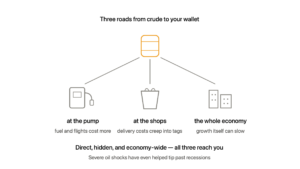
An oil price spike does not stay in the oil market. It spreads outward into the wider economy through several channels, eventually reaching you.
Directly, through fuel. The most immediate effect is at the pump. When crude prices rise, the cost of petrol and diesel rises, so filling your car or paying for a bus or flight costs more.
Indirectly, through everything else. Because moving goods runs on fuel, higher oil prices raise the cost of transporting nearly every product. Shops face higher delivery costs and pass them on, so the price of groceries, clothing, and countless other items creeps up. This is how an oil spike quietly raises the cost of living across the board.
Through the broader economy. Sustained high oil prices can slow economic growth, because consumers and businesses spend more on energy and less on everything else. Severe oil price shocks have contributed to recessions in the past, making oil a force that can shape the entire economic cycle.
Winners and losers
A change in oil prices does not affect everyone the same way. It creates clear winners and losers, which helps explain the global politics around it.
Oil-exporting countries — those that sell large amounts of crude — benefit from high prices, which pour money into their economies. When prices fall, their fortunes can suffer badly, since so much of their income depends on oil.
Oil-importing countries — those that must buy most of their oil from abroad — are hurt by high prices, which drain money out of their economies and raise their cost of living. They benefit when oil is cheap.

This tug-of-war between exporters and importers shapes much of global economics and politics. It is why oil is not just an economic matter but a deeply geopolitical one, tied to the fortunes and rivalries of nations.
Why this matters to you
Oil prices reach into your life whether or not you ever think about crude. They shape what you pay for fuel, for flights, for heating, and — through the cost of transporting everything — for a huge range of everyday goods. When oil spikes, your cost of living tends to rise; when it falls, you feel some relief. Few single prices affect your daily expenses as broadly as this one.
Understanding oil also helps you read the news with real insight. When you hear of conflict in a major oil region, a threatened shipping route, or a decision by big producers to cut output, you now understand these will ripple outward into fuel prices, grocery bills, and inflation. You can trace the line from a distant event to the cost of your next tank of fuel or weekly shop.
Most of all, oil reveals, perhaps more clearly than anything else, how connected and interdependent the world economy is. A single commodity, drawn from a few regions, priced in dollars, and shipped through narrow waterways, quietly powers the entire physical world — and when its price moves, everyone, everywhere, eventually feels it. Grasping the role of oil is grasping one of the most powerful and far-reaching forces in the whole of economics.
Difficult words, made simple
| Term | Plain-English meaning |
|---|---|
| Crude oil | Raw, unrefined oil pumped from the ground |
| Barrel | The standard unit oil is measured and priced in |
| Brent crude | The main global benchmark price for oil |
| Benchmark | A reference price others are compared to |
| OPEC+ | A group of major oil-exporting nations that coordinates production |
| Chokepoint | A narrow route that much of the world’s supply must pass through |
| Oil-exporting country | A nation that sells large amounts of oil abroad |
| Oil-importing country | A nation that must buy most of its oil from others |
| Supply shock | A sudden disruption that sharply changes available supply |
The big takeaway
Oil is the commodity that touches everything — fueling transport, powering industry, and hiding inside countless products, so its price ripples through the entire economy and into your daily life. Set by supply and demand, oil is especially prone to sharp swings driven by the decisions of major producers, by conflict in key regions, by global demand, and by the strength of the dollar.
The current situation, with conflict restricting a critical shipping route and pushing prices far above where the year began, shows perfectly how a problem in one region raises energy costs worldwide. From the pump to the supermarket to the health of the whole economy, oil reaches your wallet through many channels. Understanding it reveals one of the most powerful, far-reaching, and deeply interconnected forces in all of economics — a single price that, when it moves, is felt by everyone, everywhere.
Sources
Oil price figures and the 2026 situation, including Brent crude levels and the disruption of the Strait of Hormuz, are drawn from public reporting and energy market sources such as the US Energy Information Administration as of August 2026. This article presents general educational information and remains politically neutral. It is not financial advice.
Related reading: Supply and Demand and Inflation Explained.
Growmmunity publishes explanations, not financial advice.