
Loans and Mortgages Explained: How Borrowing for Big Purchases Really Works
Loans and mortgages are how most people afford the biggest purchases of their lives — a car, an education, and above all a home. Very few people can pay cash for a house, so borrowing bridges the gap between what you have now and what you need to buy something large. Used well, a loan is a powerful tool that makes major life goals possible. Used poorly, it can become a heavy burden. Understanding how loans and mortgages actually work is essential to using them to your advantage.
Today we continue our personal finance journey by exploring the world of borrowing for big purchases. Building on the interest rates and credit scores we have already covered, we will explain what loans and mortgages are, how they are structured, what determines their cost, and how to think about them wisely. As always, we keep everything clear and practical.
What a loan actually is
A loan is a sum of money you borrow and agree to pay back over time, usually with interest. It lets you access a large amount now in exchange for repaying it gradually in the future.
The basic structure of most loans is straightforward. You borrow an amount — called the principal — and repay it over a set period through regular payments. Each payment covers a portion of the principal plus the interest, which is the cost of borrowing we explored earlier in the series. By the end of the term, you have repaid the full principal plus all the interest.
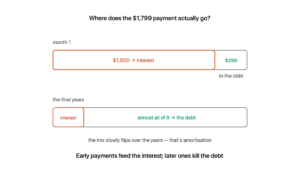
Here is a detail that surprises almost everyone the first time they see it.Early in a loan, most of each payment goes to interest, not to the debt itself. Take a $300,000 home loan at 6% over 30 years, where the monthly payment is about $1,799. In the very first month, roughly $1,500 of that goes to interest and only about $299 actually reduces what you owe. As the balance slowly shrinks, that mix shifts, and later payments go mostly to the principal. This gradual shift is called amortisation, and knowing about it explains why a loan balance seems to barely move in the early years.
Loans come in many forms for different purposes — car loans, student loans, personal loans, and home loans, among others. While the details vary, they share this same core structure: borrow now, repay over time with interest. Understanding this shared skeleton lets you understand any loan you encounter.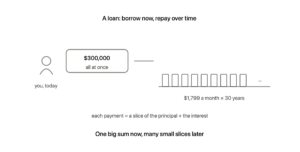
What a mortgage is
A mortgage is a specific kind of loan used to buy property, especially a home. Because homes are so expensive, mortgages are usually the largest loan a person ever takes, and they are repaid over very long periods — often decades.
A defining feature of a mortgage is that the property itself serves as security for the loan, a concept called collateral. This means if the borrower cannot repay, the lender can ultimately take the property. Think of it as a safety net attached to the loan: the lender knows that even in the worst case, something of value stands behind the money. Because that safety net exists, mortgages tend to have far lower interest rates than unsecured borrowing like credit cards, where the lender has nothing to fall back on. A mortgage might charge around 6% while a credit card charges 20% or more — and the reason is exactly the risk and return logic we met earlier: lower risk, lower interest.
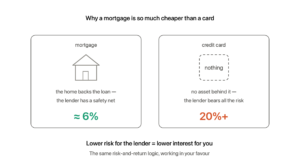
Mortgages are typically repaid over long terms, which spreads the large cost into manageable monthly payments. But the long term also means that, over the life of the loan, the total interest paid can be very substantial. Understanding this trade-off — smaller monthly payments but more total interest over time — is key to thinking clearly about home borrowing.
What determines the cost of a loan
The true cost of a loan depends on several factors working together. Understanding them helps you see why the same purchase can cost very different amounts for different people or under different terms.
The interest rate. This is the biggest factor. As we saw with credit scores, your creditworthiness helps determine the rate you are offered, and even a small difference in rate can mean a large difference in total cost over a long loan. The broader level of interest rates, set by central banks, also shapes what rates are available to everyone.
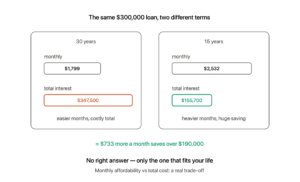
The loan term. How long you take to repay matters enormously — and the numbers are striking. On that same $300,000 loan at 6%, a 30-year term means paying about $1,799 a month and roughly $347,500 in total interest. A 15-year term means paying about $2,532 a month, but only around $155,700 in total interest. Paying about $733 more each month saves more than $190,000 over the life of the loan. This is a genuine trade-off between monthly affordability and total cost, and there is no universally right answer — only the one that fits your situation.
The amount borrowed. Naturally, the more you borrow, the more interest you pay in total. Borrowing only what you need, and putting down a larger initial payment where possible, reduces the cost — every dollar you do not borrow is a dollar you never pay interest on.
Fixed versus variable rates
One important choice with many loans, especially mortgages, is between a fixed and a variable interest rate. Understanding the difference connects directly to everything we learned about interest rates moving.
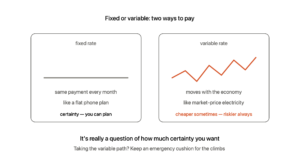
A fixed rate stays the same for the life of the loan (or a set period), so your payments are predictable and unchanging. This offers certainty and protection: even if interest rates rise across the economy, your rate stays put. The trade-off is that you may pay a bit more for that certainty, and you will not benefit if rates fall.
A variable rate moves up and down with broader interest rates. If rates fall, your payments may drop; but if rates rise — as we saw central banks can make them do — your payments increase, sometimes significantly. This offers potential savings but also uncertainty and risk.
A simple way to picture it: a fixed rate is like a phone plan with the same bill every month, while a variable rate is like paying the market price for electricity — sometimes cheaper, sometimes painfully higher. Choosing between them is really a choice about how much certainty you want versus how much risk you can bear. And this is where an emergency fund matters: if you take a variable rate, you need a cushion that can absorb a rise in payments without derailing your life.
Borrowing wisely
Because loans are powerful but carry real cost and risk, borrowing wisely is essential. A few principles help you use these tools to your benefit rather than your harm.
Borrow only what you genuinely need and can comfortably afford to repay, considering not just today but how your payments would feel if your circumstances changed — this is exactly what the budgeting habit prepares you for, because you already know what your monthly picture can absorb. Understand the full cost, not just the monthly payment: as the numbers above showed, a low monthly payment over a very long term can hide an enormous total interest cost. Shop around, since different lenders offer different rates, and even a small improvement in rate can save a great deal over a long loan.
Work to build a strong credit score before borrowing for something major, since it directly lowers your interest rate and therefore your total cost. And remember the earlier lesson: because high-interest debt like credit cards is so costly, it usually makes sense to prioritize clearing that before taking on new borrowing. Thoughtful borrowing turns loans into tools that build your life rather than burdens that weigh it down.
Why this matters to you
Loans and mortgages will very likely play a major role in your financial life, since they are how most people afford homes, cars, and education. Understanding them helps you make these enormous decisions wisely, potentially saving you a great deal of money and stress over the years. A home loan alone is often the largest financial commitment a person ever makes, so understanding it truly matters.
This knowledge also protects you from borrowing more than you can handle, or taking loans whose true cost you did not grasp. By understanding interest rates, terms, and the trade-offs involved, you can borrow with clear eyes, choosing terms that fit your life and avoiding painful mistakes. You can also recognize a good loan offer from a poor one.
Most of all, understanding loans and mortgages lets you use one of finance’s most powerful tools to your advantage. Borrowing is not inherently good or bad — it is a tool, and its value depends on how wisely it is used. With understanding, you can harness loans to achieve major life goals like home ownership, while managing their cost and risk sensibly. That understanding turns borrowing from something intimidating into something you can navigate with confidence, helping you build the life you want on a sound financial foundation.
Difficult words, made simple
| Term | Plain-English meaning |
|---|---|
| Loan | Money borrowed and repaid over time with interest |
| Principal | The original amount borrowed, before interest |
| Mortgage | A loan used to buy property, backed by the property |
| Collateral | An asset the lender can take if you don’t repay |
| Amortisation | How each payment shifts from mostly interest to mostly principal |
| Loan term | How long you have to repay the loan |
| Fixed rate | An interest rate that stays the same |
| Variable rate | An interest rate that moves up and down over time |
The big takeaway
A loan is money you borrow and repay over time with interest, letting you afford big purchases now and pay gradually. Early payments go mostly to interest — on a $300,000 loan at 6%, the first month sends about $1,500 to interest and only $299 to the debt. A mortgage is a large, long-term loan for property, backed by the home itself as collateral, which is why its rate is far lower than a credit card’s.
The cost of any loan depends mainly on its interest rate, its term, and the amount borrowed. Term matters enormously: 30 years means about $1,799 a month and $347,500 in interest, while 15 years means about $2,532 a month but only $155,700 — smaller payments, or a far smaller total. A key choice is between fixed rates, which offer certainty, and variable rates, which move with the economy. Borrow only what you need and can afford, understand the full cost, shop around, and build a strong credit score first. Used thoughtfully, loans make major life goals possible on a sound footing.
Sources
This article explains widely taught principles of how loans and mortgages work. Specific products, rates, and terms vary by country and lender, and all figures used are illustrative examples. It is general educational information, not financial advice.
Related reading: Interest Rates Explained and Credit Scores Explained.
Growmmunity publishes explanations, not financial advice.