
Retirement Savings Explained: Why Starting Early Is the Most Powerful Money Move You Can Make
Retirement savings is the money you set aside during your working years to support yourself when you eventually stop working — and thanks to the power of compound interest, when you start saving matters even more than how much you save. This is one of the most important and least appreciated truths in all of personal finance. A person who starts saving modestly in their twenties can end up with more than someone who saves far more but starts decades later. Understanding why, and how retirement saving works, is one of the most valuable pieces of financial knowledge you can ever gain.
Today we continue our personal finance journey by exploring retirement savings. Building on the compound interest we explored earlier, we will explain what retirement saving is, why starting early is so extraordinarily powerful, how retirement accounts generally work, and how to think about this distant but crucial goal. As always, we keep everything clear and practical.
What retirement saving actually is
Retirement saving means setting aside money during the years you work, so that you have enough to live on when you stop working in later life. It is, in essence, transferring some of today’s income into your future, building a store of money to support you when you no longer earn a regular wage.
The need for this is simple but profound. At some point, most people stop working — by choice or necessity — yet still need money to live. Without savings built up during working years, this later stage of life can be financially difficult. Retirement saving solves this by steadily accumulating money over decades, so your older self is provided for. Many countries also have state pension systems, but these vary enormously and are often designed as a floor rather than a full income — which is why personal saving matters almost everywhere.

What makes retirement saving unique among financial goals is its extraordinarily long time horizon. You might be saving for a future that is thirty, forty, or more years away. This long horizon, as we will see, is not a burden but a gift — because it unlocks the single most powerful force in personal finance.
Why starting early is so powerful
Here is the most important lesson about retirement saving, and it flows directly from compound interest. Because compounding grows money exponentially over time, the length of time your money grows matters enormously — often more than the amount you save.
Recall how compound interest works: your money earns returns, and then those returns earn returns of their own, snowballing ever faster over time. The longer this process runs, the more dramatic it becomes. Money invested in your twenties has decades to compound, growing many times over. The same amount invested in your forties has far less time, and grows far less.
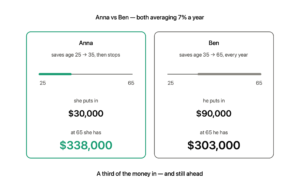
This sounds like a nice idea until you see it in numbers — and then it becomes almost startling. Picture two savers, both earning an average 7% a year.
Anna starts at 25. She puts away $3,000 a year for just ten years, then stops completely at 35 and never adds another dollar. She has contributed $30,000 in total.
Ben starts at 35 — exactly when Anna stops. He puts away the same $3,000 a year, but keeps going for thirty straight years until he is 65. He has contributed $90,000 in total, three times what Anna did.
At 65, Anna has roughly $338,000. Ben has roughly $303,000. Anna contributed a third as much, stopped three decades earlier, and still finished ahead. Nothing separates them except that Anna’s money started compounding ten years sooner. (These are illustrative figures using a steady 7% return; real returns vary year to year.)
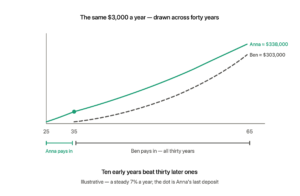
This is why the most powerful retirement move available to almost anyone is simply to begin as early as possible, letting time do the heavy lifting.
The cost of waiting
The flip side of this truth is sobering: delaying retirement saving is surprisingly costly, because each year of delay is a year of compounding lost — and the earliest years are the most valuable of all.
Think of a snowball rolling downhill. A snowball released at the very top gathers snow the whole way down and arrives enormous. One released halfway down rolls just as fast, but simply has less hill left, so it arrives much smaller. The early years of saving are the top of that hill — and once they pass, they cannot be re-run. This is why losing those early years cannot easily be made up later, even by saving much more: the later contributions simply have less hill to roll down.
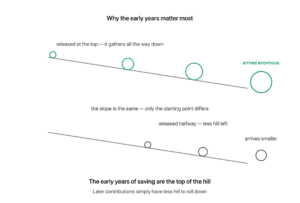
This is not meant to discourage anyone who starts later — starting at any age is far better than not starting, and it is never too late to benefit. Ben, after all, still built a substantial sum. But it powerfully underscores why, if you possibly can, beginning early is one of the wisest financial decisions available. The best time to start was years ago; the second best time is now.
How retirement accounts generally work
Most places offer special accounts designed specifically to encourage retirement saving, and while the details vary greatly, some general principles are widely shared. Understanding them helps you make use of these valuable tools.
Retirement accounts are typically designed for long-term saving and investing, often holding investments like the index funds we explored earlier, so your money can grow over decades. This is a key difference from your emergency fund, which stays in cash precisely because you might need it tomorrow. Retirement money has decades to recover from any dip, so it is usually invested rather than left as cash — and there is a second reason for that: over thirty or forty years, inflation quietly erodes the purchasing power of cash sitting still, while invested money has a chance to outpace it. That longer horizon is also why the ups and downs of markets matter far less here than they would over a single year, though the risk and return trade-off never disappears entirely.
A common and important feature is some form of tax advantage, designed to reward saving for retirement. As we saw when discussing taxes, governments often use the tax system to encourage retirement saving, which can meaningfully boost how much your money grows.

Sometimes, employers also contribute to retirement savings alongside what you set aside, effectively adding free money to your retirement pool. If an employer adds 50 cents for every dollar you contribute, that is an immediate 50% return before any investment growth at all — which is why, where such arrangements exist, taking full advantage of them is usually very worthwhile. Because the specific accounts, rules, and benefits vary so much by place, it is worth learning what is available where you live — but the general principle is that these dedicated, often tax-advantaged accounts are powerful tools for building your future.
How to think about retirement saving
Retirement can feel impossibly distant, especially when you are young, which is exactly why it is so often neglected. A few guiding principles help you approach it wisely despite its distance.
The most important principle is simply to start, as early as you can, even with small amounts, letting compounding work its magic over the long horizon. Making contributions automatic, as we discussed with saving generally, helps ensure consistency over the many years involved — and over a forty-year horizon, consistency is worth far more than any clever timing. Where employer contributions or tax advantages are available, using them fully amplifies your efforts.
It also helps to view retirement saving as a normal, ongoing part of your financial life rather than a distant problem for later. By treating it as a regular habit, built into your budget from early on, you make steady progress toward a secure future without dramatic sacrifice. The combination of starting early, staying consistent, and letting compounding work is what turns modest, regular saving into genuine security decades later.
Why this matters to you
Retirement saving matters enormously because it shapes the financial security of a large and important part of your life — the years when you may no longer earn a regular income. Building savings during your working years is what makes a comfortable, secure later life possible, rather than one of financial difficulty. This is among the most consequential financial goals anyone has.
The knowledge that starting early is so powerful is especially valuable when you are young, precisely when retirement feels least urgent. Understanding this can motivate you to begin sooner, potentially transforming your financial future through the simple act of starting early and letting time and compounding work for decades. Few insights in personal finance are as genuinely powerful as this one.
Most of all, understanding retirement saving empowers you to take control of your long-term future rather than leaving it to chance. By grasping how compounding rewards early, consistent saving, and how dedicated retirement accounts can help, you can make choices today that profoundly benefit your future self. Whatever your age, understanding these principles lets you act wisely — and the earlier you begin, the more powerfully time works in your favor. This is one of the greatest gifts your present self can give your future self: the security and freedom that come from having started early and saved steadily.
Difficult words, made simple
| Term | Plain-English meaning |
|---|---|
| Retirement saving | Money set aside now to live on after you stop working |
| Time horizon | How far in the future your financial goal is |
| Compounding | Growth building on earlier growth, snowballing over time |
| Retirement account | A special account designed for long-term retirement saving |
| Pension | A regular income in later life, often from a state or employer scheme |
| Tax advantage | A benefit that reduces tax to encourage certain saving |
| Employer contribution | Money an employer adds to your retirement savings |
| Nest egg | The pool of savings built up for retirement |
The big takeaway
Retirement saving means setting money aside during your working years to support yourself when you stop working. Its defining feature is a very long time horizon — and thanks to compound interest, that length of time is a gift. Because compounding accelerates over decades, when you start matters even more than how much you save: Anna, saving $3,000 a year from 25 to 35 and then stopping, ends up with more than Ben, who saved the same amount every year from 35 to 65 and contributed three times as much.
This makes starting early one of the most powerful financial moves available to anyone, while delay is costly because the earliest years of compounding are the most valuable — the top of the hill the snowball rolls down. Dedicated retirement accounts, often with tax advantages or employer contributions, are powerful tools for this long-term growth. The wisest approach is simple: start as early as you can, stay consistent, use the tools available, and let time and compounding build your security. It is one of the greatest gifts you can give your future self.
Sources
This article explains general principles of retirement saving. The Anna and Ben figures are illustrative calculations assuming a steady 7% annual return, which no real investment guarantees. Specific accounts, rules, pension systems, and tax treatments vary greatly by country and change over time; consult official sources or a qualified professional for your situation. It is general educational information, not financial advice.
Related reading: Compound Interest Explained and Index Funds Explained.
Growmmunity publishes explanations, not financial advice.