
Cryptocurrency Explained: A Beginner’s Neutral Guide to Digital Money
Cryptocurrency is one of the most talked-about and least understood topics in modern finance, generating enormous excitement, fierce debate, and no small amount of confusion. You have almost certainly heard of it — the headlines about dramatic price swings, the passionate believers, the equally passionate skeptics. Yet for most people, what cryptocurrency actually is remains genuinely murky. Today we will explain it clearly and neutrally, so you can understand this phenomenon and form your own view, whatever that may be.
Our goal here is understanding, not advocacy. Cryptocurrency is a subject on which reasonable, intelligent people strongly disagree, and we will not tell you what to think of it. Instead we will explain what it is, how it works in simple terms, why people are drawn to it, and what risks and criticisms it faces — leaving you equipped to reach your own informed conclusions. As always, we keep everything clear and practical.
What cryptocurrency actually is
Cryptocurrency is a form of digital money that exists only electronically and operates without a central authority like a government or bank controlling it. Unlike traditional money, which is issued and managed by central banks as we explored earlier in this series, cryptocurrencies are designed to work through a decentralized network of computers.
Think of the contrast with regular money. When you hold traditional currency, its value and supply are managed by a central bank, and your bank keeps the record of what you own. If you want to know your balance, you ask your bank — and whatever the bank’s record says, that is your answer. Cryptocurrency was designed to work differently: no central bank, no single company, and no single record-keeper to ask. Instead, records are maintained collectively across a vast network, with no single point of control.
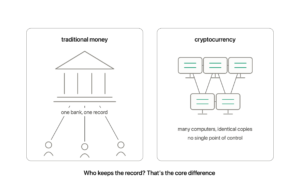
This idea of money without a central authority is the core innovation, and the source of much of both the excitement and the controversy. To understand why, we need to look, simply, at the technology that makes it possible.
How it works, in simple terms
The technology underlying most cryptocurrencies is called the blockchain, and while its details are complex, the basic idea can be understood simply. It is essentially a shared, public record book.
Picture a village where every payment is written in a ledger. In the ordinary version, one ledger sits in the bank’s safe, and the bank alone writes in it. In the blockchain version, a thousand villagers each hold an identical copy, and whenever someone pays someone else, every copy is updated at the same time. Now imagine trying to cheat by editing your own copy to say you have more money. Your book would instantly disagree with the other 999, and the network would simply reject it. That is what people mean when they call the blockchain tamper-resistant: not that it is guarded, but that there is nothing single to attack.

New units of many cryptocurrencies are created through a process, often called mining, in which powerful computers do complex work to help maintain and secure this shared record, and are rewarded with new coins. Many cryptocurrencies are also designed to have a limited supply, meaning only a fixed number will ever exist. Bitcoin, the first and best-known example, is capped at 21 million coins — a limit written into its code rather than decided by any authority. This is a deliberate contrast with traditional money, which central banks can create more of. These design choices are central to how believers think about cryptocurrency’s value.

Why people are drawn to it
Cryptocurrency has attracted passionate interest for several reasons, and understanding them helps explain the phenomenon, whatever one ultimately concludes about it.
Decentralization. Some are drawn to the idea of money not controlled by any government or bank, seeing it as offering independence from central authorities and traditional financial systems.
Limited supply. Because many cryptocurrencies are designed so that only a fixed amount can ever exist, some supporters see them as protected from the inflation that can erode traditional money when more of it is created, viewing them as a potential store of value.
Potential for gains. Cryptocurrencies have experienced dramatic price rises at times, attracting people hoping to profit. This potential for large gains has been a major driver of interest, though as we will see, it comes with equally dramatic risks.
Technology and innovation. Others are drawn to the underlying technology itself, believing the blockchain concept may have valuable uses beyond currency — record-keeping, contracts, and supply tracking among them. For them, the interest is as much about the innovation as the money.
The risks and criticisms
Cryptocurrency also faces serious risks and criticisms, which are just as important to understand as its appeal. A balanced view requires taking these seriously.

Extreme volatility. Cryptocurrency prices can swing wildly, rising or falling dramatically in short periods. To put that in perspective: when the stock market moves 3% in a day, it makes the news. Moves of 10% or 20% in a day are not unusual in crypto. In practical terms, that means $1,000 put in today could be worth $800 tomorrow — or $1,200. Recall our lesson on risk and return: the potential for high returns comes with high risk, and cryptocurrency exemplifies this in the extreme.

Uncertain value. Critics argue that many cryptocurrencies are not backed by anything tangible and that their value rests largely on what others are willing to pay, making them prone to the bubbles we studied earlier. Skeptics question whether much of the value is speculative. Supporters counter that traditional money is also a matter of shared belief — this disagreement is genuine and unresolved.
Practical and security concerns. Cryptocurrencies can be complex to use safely, and there have been cases of theft, fraud, scams, and lost access. The lack of a central authority, appealing to some, also means fewer protections if something goes wrong: there is generally no bank to call, no transaction to reverse, and no one to restore a lost password.
Regulatory uncertainty. How governments will treat cryptocurrency is still evolving, and changes in rules can significantly affect it. Rules differ sharply from country to country, and what is permitted where you live may not be permitted elsewhere. This uncertainty adds another layer of risk.
Forming your own view
Given the passionate arguments on both sides, how should a thoughtful beginner approach cryptocurrency? The answer is with the same balanced, informed thinking we have applied throughout this series.
Cryptocurrency is neither the certain future of money that its most enthusiastic supporters claim, nor necessarily the worthless bubble its harshest critics allege. It is a genuinely new and evolving phenomenon whose ultimate significance remains unknown, on which honest, informed people disagree. Recognizing this uncertainty is itself a mark of clear thinking.
What matters most is applying the principles you have already learned. Understand that extreme potential returns come with extreme risk. Be deeply wary of hype, fear of missing out, and anything that sounds too good to be true — a promise of guaranteed returns is, as we saw with reading financial news, one of the clearest warning signs there is. Never risk money you cannot afford to lose on something so volatile.

There is also a sensible order to these things. Before considering anything this volatile, the foundations come first: an emergency fund in place, and high-interest debt cleared — because clearing a 20% debt is a certain gain, while crypto offers no certainty of any kind. Approach the topic with curiosity but caution, seeking to understand rather than being swept up in either euphoria or panic. These principles, drawn from everything we have covered, serve you well here as everywhere.
Why this matters to you
Understanding cryptocurrency matters simply because it has become such a prominent part of the modern financial conversation. Whether or not you ever engage with it, you will encounter it constantly — in the news, in conversation, in the wider culture. Understanding what it actually is lets you follow these discussions with genuine comprehension rather than confusion.
This understanding also protects you. Because cryptocurrency involves such high risk and has attracted scams and hype, knowing the basics — especially the risks — helps you avoid costly mistakes and see through exaggerated claims in either direction. In a field full of strong opinions and strong emotions, calm understanding is a valuable defense.
Most of all, understanding cryptocurrency lets you form your own view on one of the most debated topics in modern finance. Rather than being told what to think, you can weigh the appeal and the risks yourself, applying the balanced, informed thinking this series has cultivated. Whatever you conclude — and thoughtful people conclude very different things — you will do so from a place of understanding rather than confusion. That ability to engage with a complex, contested topic thoughtfully and independently is exactly the kind of economic literacy that empowers you throughout your financial life.
Difficult words, made simple
| Term | Plain-English meaning |
|---|---|
| Cryptocurrency | Digital money that works without a central authority |
| Decentralized | Not controlled by any single government, bank, or company |
| Blockchain | A shared, tamper-resistant record copied across many computers |
| Ledger | A record book of transactions |
| Mining | Using computers to secure the network and create new coins |
| Supply cap | A fixed maximum number of coins that can ever exist |
| Volatility | How sharply and quickly a price swings up and down |
| Store of value | Something meant to hold its worth over time |
The big takeaway
Cryptocurrency is digital money designed to work without a central authority like a government or bank, using a technology called the blockchain — imagine a village ledger held not in one bank safe but as a thousand identical copies, so no single one can be quietly rewritten. People are drawn to it for its decentralization, its often-limited supply (Bitcoin is capped at 21 million coins), its potential for gains, and its underlying innovation. But it faces serious risks: extreme volatility, uncertain value, security concerns, and regulatory uncertainty.
Cryptocurrency is neither the certain future its supporters claim nor necessarily the worthless bubble its critics allege — it is a new, evolving phenomenon whose significance remains genuinely uncertain, and on which thoughtful people disagree. The wise approach is to apply the principles you have learned: high potential returns mean high risk, beware hype, put the foundations in place first, never risk what you cannot afford to lose, and seek understanding over emotion. Understanding cryptocurrency lets you follow an important debate and form your own informed view.
Sources
This article provides a neutral, general explanation of cryptocurrency for educational purposes. It does not endorse or discourage any cryptocurrency or investment, and takes no position on their value. Cryptocurrency is highly risky, and its legal treatment and rules vary significantly by country and continue to change. It is general educational information, not financial advice.
Related reading: Risk and Return and Bubbles and Crashes.
Growmmunity publishes explanations, not financial advice.