
Is a Fed Rate Hike Coming? What the Jackson Hole Speech Means for Your Wallet
On Friday, one man gave a 30-minute speech in a mountain resort in Wyoming — and within minutes, the odds of your borrowing costs going up jumped from roughly one-in-three to better than a coin flip.
The man was Kevin Warsh, the new chairman of the US Federal Reserve, giving his first big address at the Fed’s annual Jackson Hole symposium. He never actually said “we will raise interest rates.” He didn’t have to. He said inflation is still too high, that the Fed’s focus “should be on prices,” and — in the line markets seized on — “otherwise, we have work to do.”
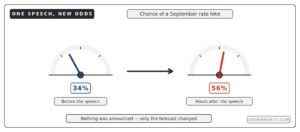
That was enough. Bond yields jumped, and traders raised the probability of a September rate hike to about 56%, up roughly 20 percentage points in a single day.
If you’re new to this world, that sequence probably sounds bizarre: a speech with no announcement in it moved trillions of dollars. This guide explains who the Fed is, what Jackson Hole is, what a rate hike actually does to your life, and why a few careful sentences can move markets — in plain English. (New to economics? Start with What Is an Economy?)
First: what is the Fed, and why does one speech matter this much?
The Federal Reserve — “the Fed” — is America’s central bank. Its job, simplified, is to keep the economy from running too hot or too cold, and its main tool is the interest rate: the price of borrowing money itself.
Think of the Fed as the driver of a car with one pedal setup:
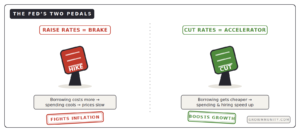
Cutting rates = pressing the accelerator. Borrowing gets cheaper, so people and businesses spend and invest more. The economy speeds up — but push too hard and prices start rising too fast. That’s inflation.
Raising rates = pressing the brake. Borrowing gets more expensive, spending cools, and price rises slow down — but brake too hard and you can stall the economy into a recession.
Every mortgage, credit card, car loan, and business loan in America is priced, directly or indirectly, off the rate this one institution sets. That is why a single speech by its chairman can move markets: he is the person whose foot is on the pedals.
And Jackson Hole? It is the Fed’s annual late-August gathering of central bankers and economists in Wyoming — think of it as the world’s most consequential summer retreat. By tradition, the Fed chair’s speech there is the year’s biggest signal of where policy is heading. Markets around the world stop and listen.
The background: why this particular speech was so tense
Three things made Friday’s speech unusually high-stakes — and knowing them makes everything Warsh said make sense.
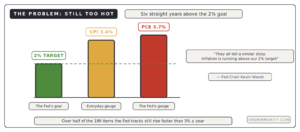
1. Inflation has now been above target for six straight years. The Fed’s formal goal is 2% inflation, measured by an index called the PCE. The latest reading, released just days before the speech: 3.7%. The more familiar consumer price index says 3.4%. As Warsh put it: none of these measures are perfect, “but they all tell a similar story: inflation is running above our 2% target.” If rising prices are new territory for you, our explainer Inflation: Why Your Money Buys Less Than It Used To covers the basics.
2. The economy is sending mixed signals. Warsh said the economy “appears to have strengthened” — investment is strong, consumer spending is resilient. But the US also lost 23,000 jobs in July, and the bond market has been jittery, with the 30-year Treasury yield recently touching a 19-year high. (That bond-market anxiety connects directly to the story we covered in America’s $40 Trillion National Debt.)
3. The Fed itself is divided — and under pressure. At July’s meeting, three officials formally dissented, voting to raise rates immediately rather than wait. Meanwhile, President Trump has continued to publicly push for rate cuts. Friday’s speech put Warsh more clearly at odds with that demand — a reminder that the Fed is designed to make these calls independently of politics, even when that creates friction.
So Warsh walked on stage facing hawks inside his own building who want hikes now, a White House that wants cuts, markets confused by his earlier vague press conferences, and inflation that will not come down. No pressure.
What Warsh actually said (translated into plain English)
Here are the key lines from the speech, with a beginner’s translation of each.
He said: “Inflation is running above our 2% target. So the Fed’s predominant focus right now should be on prices.”
Translation: Jobs, growth, AI — all secondary. Job number one is getting prices under control.
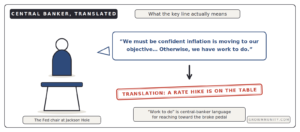
He said: “We must be confident that underlying inflation is moving to our objective, clearly and at sufficient speed. Otherwise, we have work to do.”
Translation: If inflation doesn’t fall convincingly, we will raise rates. “Work to do” is central-banker language for the brake pedal.
He said: The recent summer’s encouraging inflation readings don’t yet show “meaningful” improvement.
Translation: Don’t celebrate two good months. He digs into all 199 components of the PCE index, and over half of them are still rising faster than 3% a year — far above the roughly one-third that was normal before the pandemic.
He said: “I stand here today committed to a discipline, not to a decision.”
Translation: I will not tell you what we’ll do in September. I’ll tell you how we think, and you can work out the rest.
That last line is a philosophy with a name — and it explains the strangest part of this story.
Why won’t he just say what the Fed will do?
For years, the Fed practised something called forward guidance: openly hinting at its next moves so markets wouldn’t be surprised. Like a GPS announcing “in 400 metres, turn left.”
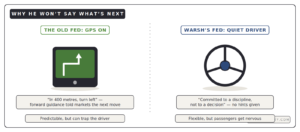
Warsh has deliberately abandoned this, and Friday he explained why. Pre-announcing moves, he argued, creates a “hall of mirrors”: markets react to the Fed’s hints, the Fed reads those market reactions as information, and everyone ends up staring at reflections of their own expectations instead of the actual economy. His alternative: “A quieter Fed, more purposeful in its communications, is better able to meet its objectives.”
The trade-off is real, and you watched it play out this month. A quiet driver keeps options open — but passengers get nervous when they can’t tell if the next move is the brake or the accelerator. Warsh’s vagueness at earlier press conferences actually rattled bond markets; Friday’s speech was, in part, his answer to those critics: still no roadmap, but a much clearer statement of what he’s watching.
So why did markets move if nothing was announced?
This is the genuinely fascinating part for a beginner, because it shows how financial markets actually work: they trade on probabilities, not announcements.
Markets constantly price in the odds of future events, like a weather forecast for money. Before the speech, futures traders put the chance of a September rate hike at roughly 34%. Warsh’s tough words on inflation shifted that forecast to about 56% within hours, according to CME Group’s FedWatch tool. The two-year Treasury yield — the bond most sensitive to Fed policy — jumped to its highest level since late July.
Nothing happened. Only the likelihood of something happening changed. But when trillions of dollars are positioned around those likelihoods, a forecast change is the event.
Worth noting: not every expert reads September as a done deal. Heather Long, chief economist at Navy Federal Credit Union, said Warsh “opened the door to a Fed rate hike” but expects it more likely by October or December than September. The honest summary: a hike moved from “unlikely” to “more likely than not, timing uncertain.”
What a rate hike would mean for you
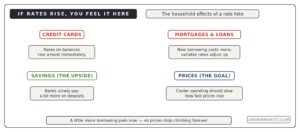
If the Fed does raise rates, here is the practical chain for an ordinary household — no jargon.
| Where you’d feel it | What happens |
|---|---|
| Credit cards | Rates on card balances typically rise almost immediately after a hike |
| Mortgages & car loans | New loans get more expensive; variable-rate loans adjust upward |
| Savings accounts | The one upside — banks slowly pay a bit more on your deposits |
| Businesses & jobs | Costlier borrowing can slow expansion and hiring over time |
| Prices (the goal) | Cooler spending should, eventually, slow how fast prices rise |
That last row is the whole point. A hike deliberately makes borrowing hurt a little more now so that everything doesn’t keep costing more forever. Whether that trade-off is being timed correctly is exactly what the Fed’s own officials are arguing about — remember those three dissents.
Difficult words, made simple
| Term | Plain-English meaning |
|---|---|
| The Fed | America’s central bank — sets the base price of borrowing money |
| Rate hike / cut | Raising or lowering that base price — the economy’s brake and accelerator |
| Jackson Hole | The Fed’s annual Wyoming symposium where the chair’s speech signals the year’s direction |
| Inflation target | The Fed’s goal of 2% annual price rises — currently overshot at 3.7% |
| PCE / CPI | Two gauges of inflation; PCE is the Fed’s preferred one |
| Forward guidance | The old practice of hinting at future rate moves — which Warsh has abandoned |
| Hawk / dove | A hawk wants higher rates to fight inflation; a dove prefers lower rates to support jobs |
| Dissent | A Fed official formally voting against the majority — three did in July |
| Treasury yield | The interest rate on US government bonds; the 2-year moves most on Fed expectations |
| FedWatch odds | Market-implied probabilities of the Fed’s next move, read from futures prices |
The big takeaway
Strip away the mountain scenery and the careful phrasing, and Friday’s message was simple: inflation is still the problem, and the Fed’s new chairman is willing to raise rates to fix it — he just won’t tell you when.
For a beginner, this story is a perfect miniature of how modern economics works. No policy changed on Friday. But because markets trade on probabilities, a shift in expectations — from a one-in-three chance of a hike to better than even — instantly repriced bonds, and with them the future cost of every loan in the economy. Words from the right mouth are events.
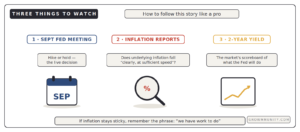
Three things worth watching from here: the mid-September Fed meeting (hike or hold — the live decision); the next inflation reports (Warsh told you exactly what he’s watching: whether underlying inflation falls “clearly and at sufficient speed”); and the 2-year Treasury yield (the market’s running scoreboard of what it thinks the Fed will do). If inflation stays sticky, remember the phrase that moved the markets — because the Fed will have work to do.
New to economics? Start with What Is an Economy? and Inflation Explained — then read America’s $40 Trillion Debt to see why bond markets were already nervous before Warsh said a word.
Sources
This article is based on reporting by CNBC, NPR, and The Hill:
• CNBC: Fed Chairman Warsh warns on inflation at Jackson Hole
• NPR: Fed’s Kevin Warsh warns inflation is too high, sparking bets rate hikes are coming
• The Hill: Investors seek clues on inflation and rates from Fed Chair Kevin Warsh at Jackson Hole
All figures and quotes are drawn from those reports and the sources cited within them, including CME Group’s FedWatch tool. This article explains the policy debate without endorsing any position — including on whether rates should rise, hold, or fall. This is general information, not financial advice. For investment decisions, consult a qualified professional.
Growmmunity publishes explanations, not financial advice.
2 thoughts on “Is a Fed Rate Hike Coming? What the Jackson Hole Speech Means for Your Wallet”