
Gold Price Record High Explained: Why the World Is Rushing Into a Metal That Pays Nothing
Here is a genuine puzzle. Gold pays no interest. It pays no dividend. It produces nothing, employs no one, and mostly sits in vaults being guarded at considerable expense. By every textbook measure, it is one of the least productive things you can own.
And yet the world cannot buy enough of it. Gold smashed through record after record over the past year — roughly one new all-time high per week through 2025, according to the World Gold Council — before peaking at $5,589 per ounce in January 2026. This month, after a spring pullback, the rally reignited: gold jumped nearly 5% in a single week in late August, with money pouring into gold funds at the fastest weekly pace in ten months.
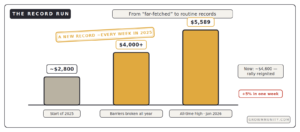
Why would rational people stampede into a shiny rock that pays nothing? The answer says less about gold and more about everything else — debt, dollars, and trust. This guide explains it all in plain English. (New to economics? Start with our foundation guide, What Is an Economy?)
First: why is gold a “safe haven” at all?
You will hear the phrase safe haven in every gold headline. Here is what it actually means.
Think of gold as the world’s oldest panic room. When investors get scared — about war, inflation, debt, or banks — they look for somewhere to park money that does not depend on anyone keeping a promise. And that is the key idea:
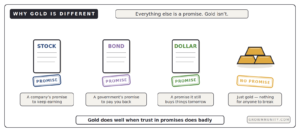
• A stock is a promise that a company will keep earning.
• A bond is a promise that a government will pay you back.
• A dollar is a promise that the money will still buy things tomorrow.
• Gold is… just gold. It promises nothing, which means no one can break the promise.
Humans have treated it as money for about 5,000 years, across every civilisation, and no government can print more of it. (For the deeper story of why anything counts as money at all, see What Is Money? Why a Piece of Paper Has Value.)
So the rule of thumb: gold does well when trust in promises does badly. Keep that sentence in mind — it explains everything that follows.
The background: three engines pushing gold to records
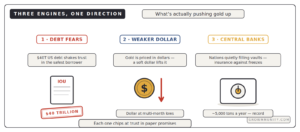
Gold’s rise was not one event. Reporting from CNBC and CBS points to three forces pushing in the same direction at once.
Engine 1: America’s debt problem
CNBC’s late-August reporting was blunt about the trigger for the latest surge: investors weighing “U.S. debt concerns, a weaker dollar and stubbornly high Treasury yields.”
We covered the full story in America’s National Debt Just Hit $40 Trillion — the debt has doubled in a decade, grows about $7 billion a day, and its interest costs are swallowing the budget. When the world’s “safest borrower” looks stretched, some investors quietly move a slice of their money into the one asset that isn’t anyone’s IOU. Gold is where doubt about government promises goes to hide.
Engine 2: the weakening dollar
Here is a mechanical relationship every beginner should know: gold and the dollar sit on a seesaw.
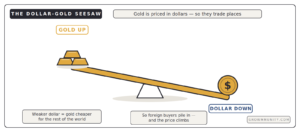
Gold is priced in dollars worldwide. So when the dollar weakens, gold instantly becomes cheaper for buyers in Europe, Asia, and everywhere else — and they buy more, pushing the price up. When the dollar strengthens, the opposite happens.
In August, the seesaw tipped hard. The US Treasury announced a plan to sharply expand its buybacks of older long-term bonds — a move meant to calm a jittery bond market, but one that pushed the dollar to multi-month lows. Gold jumped more than 5% that week. Some analysts went further, calling the rally a bet on “dollar debasement” — the worry that managing a $40 trillion debt will ultimately mean tolerating a weaker currency. Whether or not that fear proves right, enough investors believe it to move the price. (Why the dollar’s health matters to everything else on earth is the subject of our explainer Dollar Dominance: Why the World Runs on US Dollars.)
Engine 3: central banks are quietly filling their vaults
This may be the most underrated part of the story. It is not just nervous individuals buying gold — it is central banks themselves, the institutions that manage nations’ money.
CBS News reports that analysts point to strong, sustained gold demand from central banks around the world amid heightened geopolitical tensions — the wars, sanctions, and trade conflicts we have covered in US Sanctions on Iran and the US-Canada Tariff War. Total annual gold consumption is now running at record levels of nearly 5,000 metric tons a year.
Why would a central bank buy gold? Think of it as countries buying insurance. Most nations keep their savings largely in dollars. Recent years taught them two lessons: dollars can be frozen by sanctions, and the dollar’s value depends on American politics. Gold in your own vault answers to no one. So governments are diversifying — not abandoning the dollar, but no longer betting everything on it.
What just happened this month: a two-week rollercoaster
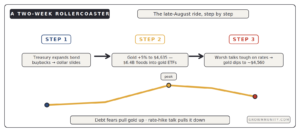
The last two weeks are a perfect miniature of how gold trades, so let’s walk the timeline.
Step 1 — The Treasury announcement. The US Treasury unveils its expanded bond-buyback plan. The dollar slides to multi-month lows.
Step 2 — The surge. Gold leaps over 5% in a week. Spot prices reach about $4,635 an ounce — the highest in more than three months — and gold ETFs (funds that let ordinary people own gold without a vault) pull in $6.4 billion in a single week, the biggest inflow in ten months.
Step 3 — The pause. Then everyone stops to listen to one man: new Fed Chair Kevin Warsh at Jackson Hole. His hawkish message — inflation is too high, a rate hike is on the table — knocked gold back toward $4,560 within days.
Wait — why would that hurt gold? Because of gold’s oldest rivalry:
Gold pays no interest. Savings do. When interest rates rise, the boring bank account and the government bond start paying you real money to hold them — and the shiny rock that pays nothing looks a little less attractive. Higher rates also tend to strengthen the dollar, tipping the seesaw the other way. That is why gold watches the Fed obsessively, and why it dipped the moment Warsh sounded tough. (We broke down that speech in Is a Fed Rate Hike Coming? Jackson Hole Explained.)
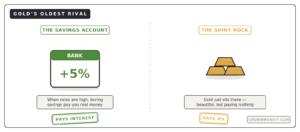
So gold is currently caught in a tug-of-war: debt and dollar fears pulling it up, rate-hike expectations pulling it down. The record books show which side has been winning.
But wait — isn’t inflation supposed to be gold’s best friend?
You may have heard that gold is an “inflation hedge” — protection against your money losing buying power. The full picture is messier, and an honest guide should say so.
The logic is sound: when each dollar buys less (see our explainer Inflation: Why Your Money Buys Less Than It Used To), a fixed, unprintable asset should hold value. Over centuries, gold has broadly done that. But over shorter periods, the record is patchy — CBS notes that critics point out gold isn’t always the reliable inflation hedge many claim. In 2022, for instance, inflation soared and gold went roughly nowhere, because the Fed’s aggressive rate hikes (the rivalry above) cancelled out the inflation effect.
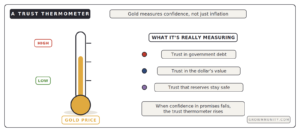
The honest summary: gold is less an inflation thermometer and more a trust thermometer. It rises most powerfully not when prices rise, but when confidence falls — in currencies, in governments’ debts, in the system keeping its promises.
Two honest views: is the gold rush wisdom or mania?
As always, both serious positions, fairly stated.
The bullish view: nothing driving this rally is temporary. The $40 trillion debt is not shrinking. Central banks’ diversification is a slow structural shift, not a mood. Annual demand is at record levels, and every wobble in the dollar or the bond market sends new buyers in. On this view, gold’s repricing reflects a genuine, lasting change in how much the world trusts paper promises.
The sceptical view: gold has run about 70-100% in barely two years — the kind of vertical move that historically invites sharp corrections. It pays nothing while you wait, costs money to store, and if the Fed keeps rates high and inflation actually falls, the rally’s fuel evaporates. Forecasters at one investment firm have even predicted a slide back toward $3,500. And the oldest advice still applies, as experts told CBS: don’t put all your eggs in one basket — even a golden one.
Both camps agree on one thing: gold’s price is now less about jewellery and more about a running global referendum on trust in the dollar system. That is what you are really watching when you watch the gold price.
Difficult words, made simple
| Term | Plain-English meaning |
|---|---|
| Safe haven | An asset people run to when they’re scared — gold is the classic one |
| Spot price | The price to buy gold right now, per troy ounce |
| Troy ounce | The traditional unit for weighing gold — about 31.1 grams |
| Gold ETF | A fund that lets you own gold through a brokerage account — no vault required |
| Inflation hedge | An asset meant to hold value when money’s buying power falls — gold’s record here is mixed |
| Dollar debasement | The fear that heavy debt leads to a deliberately or inevitably weaker currency |
| Treasury buyback | The US government repurchasing its own older bonds to calm the bond market |
| Central bank reserves | A nation’s savings — traditionally mostly dollars, now increasingly part gold |
| De-dollarization | Countries slowly reducing how much they depend on the US dollar |
| Gold standard | The old system (ended in 1971) where paper money was directly backed by gold |
The big takeaway
Gold’s record run is not really a story about gold. It is a story about the promises gold competes with. A $40 trillion national debt, a Treasury working to steady its own bond market, a dollar sliding on debasement fears, sanctions teaching countries that reserves can be frozen — each one chips at trust in paper promises, and each chip shows up as a higher gold price.
The rule of thumb from the top of this article really does carry the whole story: gold does well when trust in promises does badly. By that measure, the metal that pays nothing has become the world’s most watched opinion poll.
Three things worth watching from here: the Fed’s September decision (a rate hike is gold’s strongest headwind — the rivalry in action); the dollar’s direction (the seesaw never stops); and central bank buying figures from the World Gold Council (the slow, structural side of the story). If those vaults keep filling, the referendum on trust is still running.
New to economics? Start with What Is an Economy? and What Is Money? — then read Dollar Dominance and America’s $40 Trillion Debt to understand exactly what gold is being measured against.
Sources
This article synthesizes reporting from CNBC, CBS News, and Trading Economics:
• CNBC: Gold rebounds as bond jitters, debt fears and weaker dollar drive demand
• CNBC: Gold reaches 3-month high ahead of U.S. inflation data, Fed speech
• CBS News: What is the highest gold price in history? Here’s how it’s changed over the past year
• Trading Economics: Gold — price, chart and market commentary
All figures and quotes are drawn from those reports and the sources cited within them, including the World Gold Council. This article presents both bullish and sceptical views of gold without endorsing either. This is general information, not financial advice — gold prices are volatile, and past records are no guarantee of future performance. For investment decisions, consult a qualified professional.
Growmmunity publishes explanations, not financial advice.