
What Is Buy Now, Pay Later? Why Millions of Americans Now Split the Grocery Bill Into Four
What is buy now, pay later? It’s the little button at checkout — Klarna, Affirm, Afterpay, PayPal, even Apple — that splits your purchase into four painless-looking installments. And it has quietly become one of the most revealing indicators in the American economy, because of what people are now buying with it.
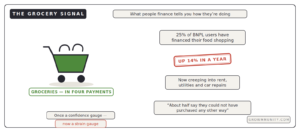
Not sneakers. Not gadgets. Groceries. A LendingTree survey found a quarter of buy now, pay later users have financed their food shopping — up 14% in a year — and reporting from The New York Times finds the loans creeping into rent, utilities, and car repairs. A Gallup poll says more than half of Americans have now used these plans, with the heaviest use among households earning under $48,000. And per one NYT reporter’s summary of the users: about half say they could not have made the purchase any other way.
This guide explains how these four-payment loans actually work, why “interest-free” doesn’t mean free, the invisible-debt problem that worries economists, and what paying for eggs in installments tells us about household finances — in plain English. (New to economics? Start with What Is an Economy?)
First: how does buy now, pay later actually work?
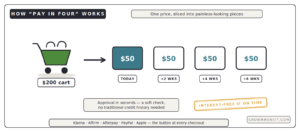
The standard product is called “pay in four,” and the mechanics are simple. Say your cart totals $200. You pay $50 today, and the app schedules three more $50 payments, typically every two weeks, over about six weeks. No interest if you pay on time. Approval takes seconds, usually with only a soft credit check — no lengthy application, often no traditional credit history needed.
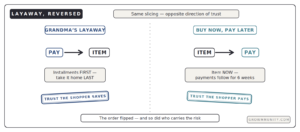
A useful way to picture it: layaway, reversed. Your grandparents’ layaway meant paying in installments first and taking the item home last. BNPL flips the order — the item now, the payments later. Same slicing of a price into pieces; opposite direction of trust.
The companies make money mostly from merchant fees — stores pay a cut because shoppers with installment buttons buy more and abandon fewer carts — plus late fees when payments slip. That business model explains the product’s superpower and its danger: it is engineered to make spending feel smaller than it is.
Why “interest-free” isn’t the same as free
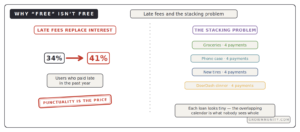
Late fees replace interest. Miss a payment and fees stack up. And missing is common: LendingTree found 41% of users made a late payment in the past year, up from 34% — a deterioration worth pausing on.
The stacking problem. Each individual loan looks tiny. But four payments for groceries, four for the phone case, four for the tires, four for DoorDash — yes, Klarna partnered with DoorDash, meaning dinner itself can now be financed — quietly assemble into a payment calendar no single app shows you. Budgeting apps see one merchant charge; you carry five overlapping loans.
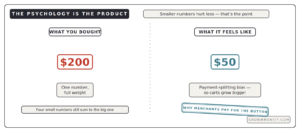
The psychology is the product. A $200 grocery run “feels like” $50. Economists call this a payment-splitting bias: smaller numbers reduce the pain of paying, so people spend more than they otherwise would. That’s precisely why merchants pay for the button.
The invisible-debt problem
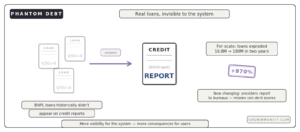
Here’s the part that worries economists more than any individual shopper’s choices: for years, most BNPL loans didn’t appear on credit reports. Traditional lenders sizing up a borrower — for a car loan, a mortgage — simply couldn’t see them. The industry nickname is “phantom debt”: real obligations, invisible to the system designed to track obligations.
That’s now changing — major providers have begun reporting to credit bureaus, meaning missed installments can increasingly dent credit scores. The transition cuts both ways: more visibility for the system, more consequences for users who treated the loans as consequence-free. For scale, consider the growth the Consumer Financial Protection Bureau documented: BNPL loan originations exploded from 16.8 million to 180 million in just two years (2019-2021) — a 970% jump — with dollar volume up over 1,000% to $24.2 billion. It has only grown since.
The signal: what groceries-in-installments tells us
Step back from the mechanics and read this as an economic indicator, because that’s what it has become.
When installment plans were for Pelotons and PlayStations, they measured consumer confidence. When a quarter of users finance food — and the heaviest users are lower-income households who report no other way to buy — the same product starts measuring consumer strain. It slots exactly into the pattern we’ve traced across this series: prices that outran paychecks, housing eating budgets, utility bills swelling — households aren’t spending less; they’re stretching the same spending across time, four slices at a time.
There’s a generational layer too: roughly one in five Gen Z consumers uses no credit card at all, making BNPL their first — sometimes only — borrowing tool. For the generation we met in the youth unemployment story, the entry-level credit product has changed along with the entry-level job.
Two honest views: lifeline or debt trap with better branding?
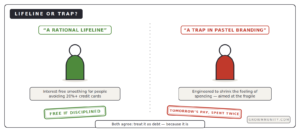
The lifeline view: for people squeezed by prices and locked out of (or rightly wary of) credit cards charging 20%+ interest, a genuinely interest-free way to smooth a lumpy week is a rational tool — arguably a better-designed one than the overdraft fees and payday loans it often replaces. Users like the teacher and mother in local reporting say it plainly: it’s how they stay within a budget when everything got expensive. Used with a calendar and discipline, it costs nothing.
The trap view: a product engineered to shrink the feeling of spending, marketed hardest to the financially fragile, with rising late-payment rates and years of invisibility to credit systems, is a debt boom wearing friendly pastel branding. Financing dinner delivery is not budgeting; it’s tomorrow’s paycheck being spent twice. And because the sector grew up outside bank regulation, nobody fully knows how much of this debt exists — an uncomfortable echo of every credit boom that ended badly.
Where both sides agree: treat it as debt, because it is. Count every open plan, never stack more than you can list from memory, and remember that four small numbers still sum to the big one.
Difficult words, made simple
| Term | Plain-English meaning |
|---|---|
| BNPL | Buy now, pay later — checkout loans from Klarna, Affirm, Afterpay, PayPal and others |
| Pay in four | The standard plan: 25% today, three more payments over ~6 weeks, interest-free on time |
| Soft credit check | A lookup that doesn’t affect your score — why approval takes seconds |
| Merchant fee | What stores pay the app — because the button makes carts bigger |
| Late fee | The real price of “interest-free” — 41% of users paid late last year |
| Loan stacking | Multiple overlapping plans across apps — the calendar nobody sees whole |
| Phantom debt | BNPL obligations historically invisible to credit bureaus — now becoming visible |
| Payment-splitting bias | Four small numbers hurt less than one big one — the psychology that sells it |
| Layaway | The old version: pay first, receive last — BNPL is layaway reversed |
| Distressed borrowing | Financing essentials like food — the signal that turned this into an economics story |
The big takeaway
Buy now, pay later is two stories wearing one button. As a product, it’s clever: instant, usually free if you’re punctual, and genuinely useful for smoothing a tight month. As a signal, it’s sobering: when over half the country has split a payment into four, late fees are climbing, and the fastest-growing category is food, the button is measuring something bigger than shopping habits.
Three things worth keeping. First, it’s a loan — the friendliest interface in finance is still debt underneath. Second, the price of “free” is punctuality — and 41% of users missed it last year. Third, watch this space as an economic indicator: what people finance tells you how they’re really doing — and right now, America is financing groceries.
New to economics? Start with What Is an Economy? — then read Inflation Explained and Why Is Housing So Expensive? for the squeeze that made the button irresistible.
Sources
This article synthesizes reporting from Fortune, CBS News, and Marketplace (with The New York Times):
• Fortune: Buy now, pay later is the new financial lifeline for lower-income Americans
• CBS News: More Americans are turning to “buy now, pay later” loans to purchase groceries
• Marketplace: “Buy now, pay later” loans creep into essentials for many consumers
All figures are drawn from those reports and the surveys cited within them, including Gallup, LendingTree, and the Consumer Financial Protection Bureau. This article explains a financial product and the debate around it without recommending its use. This is general information, not financial advice.
Growmmunity publishes explanations, not financial advice.
1 thought on “What Is Buy Now, Pay Later? Why Millions of Americans Now Split the Grocery Bill Into Four”